
Directory · #165 trending skills repo · ↗ +123 stars this week
Claude-BugHunter
elementalsouls/Claude-BugHunter
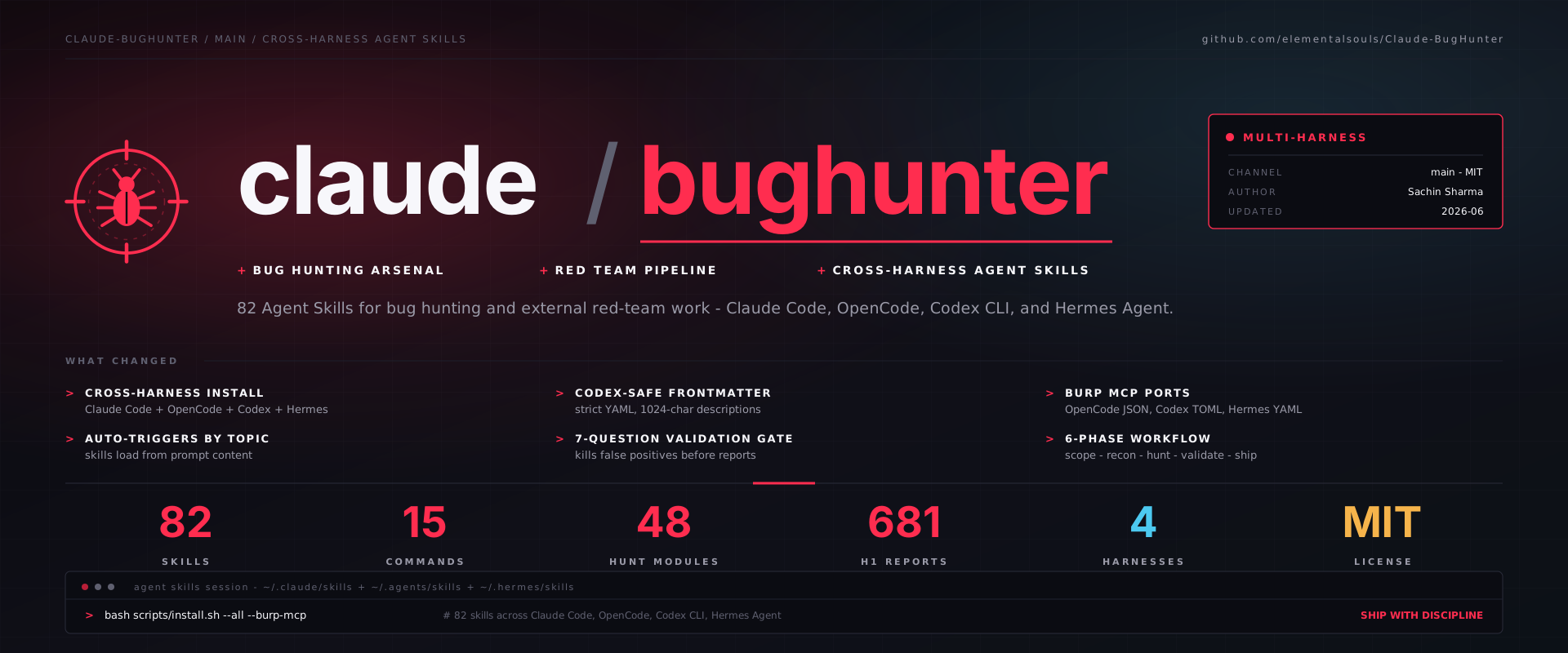
A Claude Code skill bundle for bug hunting and external red-team work - 82 skills, 15 slash commands, 681 disclosed-report patterns curated across 24 core vulnerability classes, plus enterprise identity + infrastructure attack matrices.
- Stars
- 5.5k
- This week
- +123
- Forks
- 838
- Open issues
- 3
- Skills inside
- 83
Get started
Install the skills
npx skills add elementalsouls/Claude-BugHunterInstalls into Claude Code, Codex, Cursor, OpenCode and the other agents it finds on your machine.
/plugin marketplace add elementalsouls/Claude-BugHunter
/plugin install claude-bughunter@elementalsoulsRun inside Claude Code, then pick what to install from /plugin.
git clone --depth 1 https://github.com/elementalsouls/Claude-BugHunter.git /tmp/claude-bughunter
cp -r /tmp/claude-bughunter ~/.claude/skills/claude-bughunterClaude Code reads ~/.claude/skills/ (or .claude/skills/ in a project). Other agents read the same SKILL.md format from their own skills folder.
Inside this repo
48 of 83 skills
skills/apk-redteam-pipelinebb-local-toolkitLocal-tooling companion to the bug-bounty orchestrator — carries the SAME complete bug-bounty workflow, but reach for THIS variant when you also need to resolve where tools, wordlists, and clones are installed on the local machine (jhaddix, SecLists, trufflehog, ffuf, dalfox, ghauri); for pure orcheskills/bb-local-toolkitbb-methodologyUse at the START of any bug bounty hunting session, when switching targets, or when feeling lost about what to do next. Master orchestrator that combines the 5-phase non-linear hunting workflow with the critical thinking framework (developer psychology, anomaly detection, What-If experiments). Routeskills/bb-methodologybug-bountyComplete bug bounty workflow — recon (subdomain enumeration, asset discovery, fingerprinting, HackerOne scope, source code audit), pre-hunt learning (disclosed reports, tech stack research, mind maps, threat modeling), vulnerability hunting (IDOR, SSRF, XSS, auth bypass, CSRF, race conditions, SQLi,skills/bug-bountybugcrowd-reportingBugcrowd-specific reporting tactics complementing report-writing: VRT category search-and-fallback strategy when no exact match exists, manual severity override when VRT defaults underrate impact, severity-request paragraph as first body section, OOS-clause rebuttal templates (rate limiting on auth-skills/bugcrowd-reportingcloud-iam-deepCloud IAM red-team attack chain across AWS, Azure, GCP — focused on EXTERNAL exploitation paths and post-credential-discovery privilege analysis. Covers IAM enumeration (aws iam, az role, gcloud iam), STS/AssumeRole chaining, Azure Managed Identity abuse (via SSRF/leak), GCP service account JSON abuskills/cloud-iam-deepenterprise-vpn-attackExternal SSL VPN / remote-access appliance attack matrix — Cisco ASA/AnyConnect, Fortinet FortiGate/FortiOS, Citrix NetScaler/ADC, Palo Alto GlobalProtect, Pulse Secure / Ivanti Connect Secure, SonicWall, F5 Big-IP. Covers version fingerprinting, CVE matrix (2018-2026), AAA backend identification, dskills/enterprise-vpn-attackevidence-hygieneEvidence-capture and PoC-redaction discipline for bug-bounty submissions: cookie redaction protocol (which fields to mask, Preview annotation / Burp panel hiding / DevTools workflow), PII black-bar discipline (what to mask in other-user data — names, emails, phones, faces — vs what is safe to leave skills/evidence-hygienehunt-api-misconfigHunt API security misconfiguration — mass assignment, prototype pollution, HTTP verb tampering. Mass assignment: send {is_admin:true, role:admin, verified:true} on profile/account/reset endpoints — server blindly applies. JWT signature/crypto forging (alg:none, key confusion, kid/jku) is owned by huskills/hunt-api-misconfighunt-aspnetHunt ASP.NET-specific surface — ViewState deserialization (signed-only vs encrypted), machineKey recovery, dual-parser MAC-bypass anti-pattern, request-validator bypass, trace.axd/elmah.axd disclosure, load-balanced ViewState cross-node failures, SafeControl enumeration via reflection, customErrors skills/hunt-aspnethunt-atoHunt account takeover taxonomy — 9 distinct paths to ATO, plus chains. Paths: (1) password reset flaws (host-header injection redirects token, predictable/numeric token, Referer leak, no-expiry/reuse), (2) email change without re-auth, (3) OAuth account-link CSRF, (4) MFA bypass (per hunt-mfa-bypassskills/hunt-atohunt-auth-bypassHunting skill for auth bypass vulnerabilities. Built from 12 public bug bounty reports across SAML XSW / parser-differential (GitHub Enterprise CVE-2025-25291/25292), SAML signature stripping (Uber, Rocket.Chat, samlify CVE-2025-47949), SAML domain enforcement bypass via control characters (HackerOnskills/hunt-auth-bypasshunt-brute-forceHunt Missing/Weak Rate Limiting — login brute force, OTP/2FA brute force (10^6 keyspace), password-reset-token brute, credential stuffing, username/email enumeration via error-string / status-code / timing differences, weak password policy, missing CAPTCHA (CAPTCHA token replay / single-use / concurskills/hunt-brute-forcehunt-business-logicHunting skill for business logic vulnerabilities. Built from 12 public bug bounty reports. Covers coupon-race-stacking (Instacart, Stripe, Reverb), negative-quantity-in-cart price tampering (Upserve, Eternal/Zomato), decimal/fraction price-field overflow (Shipt), client-side checkout amount trust onskills/hunt-business-logichunt-cache-poisonHunting skill for cache poison vulnerabilities. Built from 10 public bug bounty reports including X-Forwarded-Host poisoning, X-HTTP-Method-Override / GCS cache, reflected→stored XSS via cache, classic Omer-Gil Web Cache Deception, Cloudflare Cache Deception Armor bypass, session-token cache deceptiskills/hunt-cache-poisonhunt-captcha-bypassHunt CAPTCHA Bypass — 6 distinct patterns: (1) CAPTCHA field simply omitted from the request (server-side validation absent), (2) CAPTCHA token replayed from a solved challenge (no single-use enforcement), (3) CAPTCHA response accepted on a different endpoint than it was solved on (no binding to actskills/hunt-captcha-bypasshunt-cicdHunt CI/CD pipeline vulnerabilities — GitHub Actions workflow injection (pull_request_target Pwnrequest + ${{ }}-into-shell), self-hosted runner poisoning, OIDC trust-policy abuse, Jenkins script-console RCE and CVE-2024-23897 file read, GitLab CI runner-token registration, Terraform state file leakskills/hunt-cicdhunt-clickjackingHunt Clickjacking — missing X-Frame-Options / CSP frame-ancestors lets an attacker embed the target page in an invisible iframe and trick victims into clicking buttons they cannot see (UI redressing). Targets: login flows, money transfers, account settings, OAuth confirmation pages. Confirm by fetchskills/hunt-clickjackinghunt-cloud-misconfigHunt cloud / infrastructure misconfigurations. AWS: public S3 buckets (s3:GetObject anonymous), permissive bucket policies (PutObjectAcl public-write), exposed CloudFront origin, public Lambda function URL, public RDS snapshot, IAM credentials in JS bundles, AWS metadata accessible via SSRF. GCP: puskills/hunt-cloud-misconfighunt-corsHunt CORS Misconfiguration — origin-reflection with credentials, null-origin trust, subdomain-regex bypass (unanchored vs unescaped-dot vs prefix-only), pre-flight (OPTIONS) gating bypass, postMessage origin checks. High only when an attacker-controlled origin can perform a CREDENTIALED cross-originskills/hunt-corshunt-csrfHunting skill for csrf vulnerabilities. Built from 15 public bug bounty reports including modern variants — SameSite=Lax sibling-subdomain bypass (Argo CD CVE-2024-22424), GraphQL mutations-via-GET (GitLab $3,370), framework-wide CSRF middleware disabled (Stripe Dashboard $5,000), path-traversal CSRskills/hunt-csrfhunt-deserializationHunt Insecure Deserialization — Java gadget chains (ysoserial), PHP object injection (phpggc), Python pickle RCE, .NET BinaryFormatter, Ruby Marshal.load, JNDI/Log4Shell. RCE via deserialization is almost always Critical. Use when target runs Java, PHP serialization, Python pickle, .NET, or Ruby on skills/hunt-deserializationhunt-dispatchSkill-set loader for /hunt orchestrator. Fingerprints the target, picks the right platform attack skills, and loads the Red Team or WAPT skill set. Use when /hunt has just received a mode answer (redteam or wapt + blackbox|greybox) and needs to load the appropriate skills and print the taxonomy. Notskills/hunt-dispatchhunt-domHunt client-side DOM vulnerabilities — DOM Clobbering (overwrite JS globals via HTML injection), PostMessage hijacking (missing origin check), Service Worker abuse (intercept requests from same-origin script), CSS Injection/Exfiltration (attribute selectors → token char-by-char via OOB), client-sideskills/hunt-domhunt-exceptional-conditionsHunt mishandling of exceptional conditions — feed an endpoint malformed/unexpected input (wrong type, broken JSON, oversized field, null byte) and make it fail OPEN or leak internals: a verbose stack-trace / framework error page that discloses ORM internals, server file paths, library versions, or askills/hunt-exceptional-conditionshunt-file-uploadHunt file upload bugs — RCE via webshell, XSS via SVG/HTML, SSRF via XXE in DOCX, path traversal via filename. Bypass tables (10 techniques): double extension (shell.php.jpg if server checks last ext only), magic bytes spoofing (PNG header on PHP), null byte (shell.php\0.jpg), case (PHP, .Php, .pHP)skills/hunt-file-uploadhunt-fintech-graphqlHunt fintech-specific GraphQL vulnerabilities: money-movement mutations (transfers, redemptions, withdrawals, card top-ups), ledger/balance/portfolio query IDOR, decimal-precision and rounding abuse, idempotency-key bypass enabling double-spend, KYC/PII field-level authorization gaps, and admin-overskills/hunt-fintech-graphqlhunt-forgot-passwordHunt Forgot Password / Account Recovery Authentication Flaws — 5 distinct patterns: (1) username enumeration via different responses for valid vs invalid email, (2) reset token exposed directly in the API response body, (3) reset token not invalidated after use (replay), (4) password reset link workskills/hunt-forgot-passwordhunt-graphqlHunting skill for graphql vulnerabilities. Built from 12 public bug bounty reports across IDOR via node() / GID, mutation IDOR including AI/LLM features, cross-tenant IDOR, SSRF via argument, batching-DoS, query-cost-bypass, SQLi via argument, broken-object-level-authz, auth-bypass via unscoped mutaskills/hunt-graphqlhunt-grpcHunt gRPC vulnerabilities — server reflection enabled (enumerate all services/methods), missing authentication / metadata-stripping on internal endpoints, plaintext gRPC over HTTP/2, internal endpoint disclosure, proto file leakage, gRPC-Web/grpc-gateway transcoding injection, and HTTP/2 Rapid Resetskills/hunt-grpchunt-host-headerHunt Host Header Injection — password reset poisoning → ATO, web cache poisoning via unkeyed Host/X-Forwarded-Host, routing-based SSRF (Host picks upstream → cloud metadata/internal services), path-override SSRF/ACL-bypass (X-Original-URL/X-Rewrite-URL), OAuth redirect_uri/issuer poisoning, and absoskills/hunt-host-headerhunt-html-injectionHunt HTML Injection — user-supplied input is rendered as raw HTML in the response without sanitisation, allowing an attacker to inject arbitrary HTML tags (but not necessarily JavaScript). Lower severity than XSS but enables phishing, UI manipulation, and credential harvesting via injected forms. Usskills/hunt-html-injectionhunt-http-smugglingHunt HTTP request smuggling (CL.TE, TE.CL, H2.CL, H2.TE). Cause: front-end proxy and back-end server disagree on where one request ends and the next begins (Content-Length vs Transfer-Encoding header parsing inconsistency). CL.TE: front-end uses CL, back uses TE → smuggle by sending TE: chunked but skills/hunt-http-smugglinghunt-idorHunting skill for idor vulnerabilities. Built from 26 public bug bounty reports. Use when hunting idor on any target.skills/hunt-idorhunt-jwt-cryptoHunt JWT cryptographic failures — alg:none signature-stripping and RS256→HS256 key-confusion that let an attacker forge a token for any identity (e.g. an admin) without knowing a secret. Use when the app authenticates with a JSON Web Token (an `eyJ...` Bearer token in the Authorization header, a cooskills/hunt-jwt-cryptohunt-k8sHunt Kubernetes & Docker — API anonymous access, kubelet 10250 exec (SPDY/WebSocket, NOT plain POST) and the simpler /run primitive, etcd 2379 unauth, dashboard skip-login, RBAC misconfig, secret/SA-token abuse, docker.sock host escape, runc/container-escape (Leaky Vessels CVE-2024-21626), API-serveskills/hunt-k8shunt-laravelHunt Laravel specific vulnerabilities — Debug mode leakage (APP_DEBUG=true exposes full stack trace + env vars), Laravel Telescope/Horizon dashboard unauthorized access, Ignition RCE (CVE-2021-3129), Signed URL manipulation, Queue Worker abuse, mass assignment via Eloquent, deserialization via cookiskills/hunt-laravelhunt-ldapHunt LDAP Injection and XPath Injection — authentication bypass, blind char-by-char attribute exfiltration, AD user/group enumeration, XML-store XPath bypass. Covers the LDAP special-character set (* ( ) \\ NUL /), search-filter-context vs DN-injection, parenthesis-balancing, AND/OR filter logic, anskills/hunt-ldaphunt-lfiHunt Local File Inclusion (LFI), Remote File Inclusion (RFI), and Path Traversal — /etc/passwd read, log poisoning → RCE, PHP filter-chain RCE (no upload needed), php:// / data:// / zip:// / phar:// wrappers, RFI via allow_url_include, directory traversal read/write/delete. Covers OOB/blind LFI confskills/hunt-lfihunt-llm-aiHunt LLM/AI feature bugs — prompt injection, indirect injection, exfiltration via tool-use/markdown, ASCII smuggling, agentic AI security (OWASP Agentic Apps 2026, ASI01-ASI10). Patterns: direct injection ('ignore previous instructions'), indirect injection via documents/web pages/email the model reskills/hunt-llm-aihunt-mfa-bypassHunt MFA / 2FA bypass — 7 distinct patterns. (1) MFA not enforced on sensitive endpoints (password change, email change accept without MFA challenge), (2) MFA-step skip via direct navigation to post-login URL, (3) MFA-token replay (same code accepted twice), (4) brute-force the 6-digit OTP without rskills/hunt-mfa-bypasshunt-miscHunting skill for misc vulnerabilities. Built from 225 public bug bounty reports. Use when hunting misc on any target.skills/hunt-mischunt-nextjsHunt Next.js specific vulnerabilities — Server Actions arbitrary function execution, Middleware auth bypass via static asset paths, ISR cache poisoning, Image Optimization SSRF (/_next/image), RSC payload leakage, getServerSideProps injection, source map exposure, debug endpoint leakage. Use when taskills/hunt-nextjshunt-nodejsHunt Node.js specific vulnerabilities — Prototype Pollution → RCE chains (lodash/merge/assign), Express trust proxy misconfiguration, child_process/eval injection, template engine SSTI (EJS/Pug/Handlebars), path traversal in file servers, require() injection, environment variable exfil via /proc/selskills/hunt-nodejshunt-nosqliHunt NoSQL Injection — MongoDB operator injection ($where, $regex, $gt, $ne), CouchDB, Redis command injection, auth bypass via NoSQLi, data dump. Use when target uses MongoDB/Mongoose, CouchDB, Redis, or shows NoSQL error messages.skills/hunt-nosqlihunt-ntlm-infoHunt NTLM/Negotiate information disclosure on internet-reachable IIS/SharePoint/Exchange. Anonymous NTLM Type-2 challenge capture leaks NetBIOS domain, internal DNS forest, computer name, AD timestamp via AV_PAIRS structure. Default Windows-installer hostnames (WIN-XXXXXXXXXXX pattern) signal lazy pskills/hunt-ntlm-infohunt-oauthHunting skill for oauth vulnerabilities. Built from 19 public bug bounty reports. Use when hunting oauth on any target.skills/hunt-oauthhunt-open-redirectHunt Open Redirect — all types including low-impact, chained to OAuth token theft → ATO, phishing chains. URL parameter manipulation, JavaScript redirect, meta refresh, header injection. Use when hunting redirect bugs or building ATO chains.skills/hunt-open-redirectDocumentation
README
claude-bughunter
A self-contained Claude skill bundle for bug hunting and external red-team work · 83 skills · 15 slash commands · 681 disclosed-report patterns (433 now individually cited & auditable) across 24 core vulnerability classes · enterprise identity + infrastructure attack matrices · engagement-folder scaffolding · Burp MCP integration · battle-tested across authorized red-team and bug-hunting engagements, plus public training platforms (DVWA, OWASP Juice Shop, Hacker101, testphp.vulnweb.com).
Built by Sachin Sharma — Bug Hunting & GenAI Security Research.
SPONSORED BY


What is this?
claude-bughunter is a drop-in skill bundle for the Claude Code skills system. Install once and Claude Code stops being a chatbot and starts behaving like a senior bug-hunting researcher or red-team operator: it knows the techniques, the chain templates, the VRT mappings, the platform CVE chains, and the hygiene — and it stays in scope.
Four layers stack:
- Think —
bb-methodology+redteam-mindset: the 5-phase non-linear workflow, critical-thinking framework, and red-team operator discipline. - Hunt webapps — 58
hunt-*skills curated from 681 disclosed HackerOne reports: per-class detection patterns, payloads, bypass tables, and chain templates. - Hit the perimeter — enterprise platform chains (M365/Entra, Okta, vCenter, SSL-VPN appliances, SharePoint, cloud IAM): current 2024–2026 CVE chains + post-credential escalation.
- Ship it —
triage-validation+ reporting +evidence-hygiene: the 7-Question Gate, VRT-aware severity, OOS rebuttals, PII redaction, and red-team deliverables.
All triggered automatically by topic — describe what you're testing in plain English and the relevant skill loads. No invocation by name.
Quickstart
Option A — install as a Claude Code plugin (recommended). From inside Claude Code:
/plugin marketplace add elementalsouls/Claude-BugHunter
/plugin install claude-bughunter@elementalsouls
All 83 skills + 15 commands load namespaced under claude-bughunter: and update when you bump the plugin version — no files copied into ~/.claude/.
Option B — copy install (no plugin system / pin to a clone):
git clone https://github.com/elementalsouls/Claude-BugHunter.git
cd Claude-BugHunter
# macOS / Linux
bash scripts/install.sh

# Windows (PowerShell)
pwsh ./scripts/install.ps1
Both copy the skills + commands into ~/.claude/ (macOS/Linux) or %USERPROFILE%\.claude\ (Windows) and wire the hunt engagement scaffolder.
What each install path gives you:
| Path | 83 skills + 15 slash commands | cbh CLI |
hunt scaffolder |
|---|---|---|---|
| A — plugin | ✅ namespaced under claude-bughunter: |
➕ separate pipx install |
❌ clone-only |
| B — copy install | ✅ copied into ~/.claude/ |
✅ from the clone | ✅ from the clone |
The plugin is the fastest path to the skills + slash commands. The terminal-native
cbh runner installs standalone — pipx install git+https://github.com/elementalsouls/Claude-BugHunter
— so plugin users can add it without a full clone (see cbh CLI).
The hunt engagement scaffolder ships with the clone (Option B).
That's it. Open Claude Code and describe what you're testing in plain English — the right skill loads automatically, no invocation by name:
> Testing acme.com — an in-scope HackerOne target. Run recon and rank the surface.

  ⟳ loading skills: web2-recon, offensive-osint, bb-methodology …
    → subdomain enum (subfinder + crt.sh) … 47 hosts
    → live hosts (httpx) … 12 · tech fingerprint … 6 distinct stacks
    → ranked surface: api.acme.com (GraphQL, introspection ON)  ← start here
                      auth.acme.com (OAuth, SSO)               ← hunt-oauth

  Next: want me to probe the GraphQL introspection + OAuth redirect_uri?
→ Full Installation guide · Usage guide · searchable skill catalog.
The block above is an illustrative transcript. To record a real demo of your own session:
asciinema rec demo.cast→ upload to asciinema.org and drop the badge here.
Runs on multiple agent harnesses
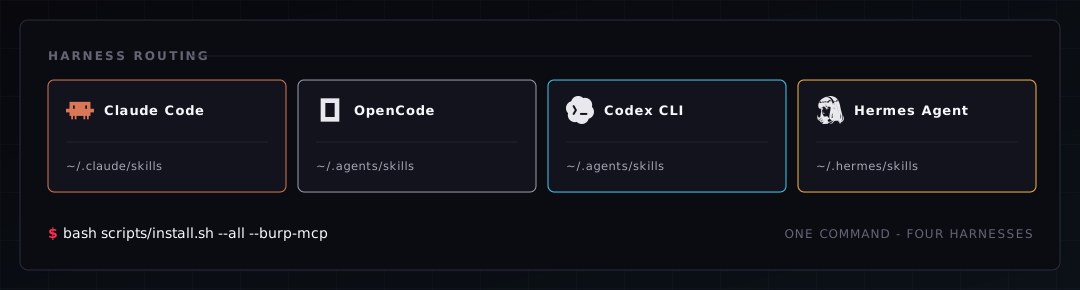
The skills are plain Agent Skills — the same SKILL.md format that Claude Code · OpenCode · OpenAI Codex CLI · Hermes Agent · Google AntiGravity all load. One command installs them everywhere:
# macOS / Linux
bash scripts/install.sh --all --burp-mcp

# Windows (PowerShell)
pwsh ./scripts/install.ps1 -All -BurpMcp
| Harness | Target Skill Directory | Flag |
|---|---|---|
| Claude Code (baseline) | ~/.claude/skills/ |
(default) |
| OpenCode | reads ~/.claude/skills/ & ~/.agents/skills/ |
(default) / --agents |
| OpenAI Codex CLI | ~/.agents/skills/ |
--agents |
| Hermes Agent | ~/.hermes/skills/ |
--hermes |
| Google AntiGravity | ~/.gemini/config/skills/ |
--antigravity |
--all (-All) detects installed harnesses and copies skills to each harness's path (~/.claude/skills, ~/.agents/skills, ~/.hermes/skills, ~/.gemini/config/skills); --burp-mcp (-BurpMcp) wires the Burp MCP server into each. The full knowledge layer ports to all five — the slash commands and /hunt engine stay Claude-Code-only by design.
Star History

Chart is self-hosted — regenerate with python3 scripts/gen_star_history.py (needs gh auth login).
Refreshes automatically each day via .github/workflows/star-history.yml.
Scope — what this bundle is for, and what it isn't
This bundle covers the external attack surface — anything reachable from the internet without first compromising an internal endpoint.
In scope
- Bug bounty hunting — web apps, APIs, SaaS, GraphQL, OAuth, JWT, file upload, IDOR, SSRF, RCE chains
- Web application pentesting — full hunt-* coverage of OWASP-mapped bug classes + discipline rules
- External red-team engagements — initial-access against internet-facing enterprise estate: M365 / Entra ID, Okta-as-IdP, SharePoint on-prem (ToolShell + legacy SOAP), VMware vCenter / Workspace ONE, SSL VPN appliances (Cisco / Fortinet / Citrix / Palo Alto / Pulse / SonicWall / F5), Android APK red-team, supply-chain recon
- Cloud misconfig + post-credential escalation — public S3, IMDS chains, STS AssumeRole, cross-account confused-deputy
- Recon + OSINT — subdomain enum, identity-fabric mapping, certificate transparency, JS analysis, secret scanning
- Reporting — H1, Bugcrowd (VRT-aware), Intigriti, Immunefi, plus client-facing red-team deliverable format
Out of scope (deliberate — not gaps, design decisions)
- Internal Active Directory attacks — BloodHound, Kerberoasting, ASREProast, DCSync, Pass-the-Hash, AD CS abuse, ntlmrelayx, Responder, PetitPotam, etc. Different operational risk profile; needs different tooling and judgment. Future bundle, not this one.
- C2 frameworks — Cobalt Strike, Sliver, Mythic, Havoc, BRC4 tradecraft. Out of scope for external-only engagement model.
- Post-exploit / persistence / lateral — Mimikatz/comsvcs LSASS dumping, golden/silver tickets, named-pipe impersonation, persistence (registry, scheduled tasks, WMI events, COM hijacking), token theft. These start after the perimeter has already broken — different bundle territory.
- Evasion — AMSI bypass, ETW patching, AV/EDR bypass. Tied to C2 tradecraft above.
- iOS pentesting / hardware / RF / ICS — out of scope by design.
- Binary exploitation / kernel pwn / browser internals — different skill universe.
If you're running an internal red team that includes domain-takeover chains via Kerberos or lateral movement, this bundle won't help you in those phases — and we'd rather say that up front than have you find out mid-engagement. The external surface handoff to internal-RT tooling (Impacket, NetExec, CrackMapExec, Rubeus, Certify, BloodHound) is intentionally outside our scope. Coverage for internal AD and post-exploit may come in a future update.
What's inside
83 skills, auto-loaded by topic — no invocation by name. Coverage across the external attack surface:
| Category | # | Examples |
|---|---|---|
| Hunt — web app vuln classes | 58 | XSS, SQLi, SSRF, IDOR, LFI, SSTI, XXE, CSRF, CORS, open-redirect, SharePoint, ASP.NET/NTLM |
| Enterprise platform attack ★ | 10 | M365/Entra, Okta, cloud-IAM-deep, vCenter, enterprise VPN, APK/iOS red-team pipelines, supply-chain recon |
| Reporting & validation | 6 | triage-validation, evidence-hygiene, report-writing, bugcrowd-reporting |
| Recon & OSINT | 5 | web2-recon, offensive-osint, osint-methodology, recon-scope-triage |
| Methodology & mindset | 4 | bb-methodology, bug-bounty, redteam-mindset, bb-local-toolkit |
Full searchable catalog → docs/skills.md. Also ships 15 slash commands (/hunt, /recon, /report, …) and a deterministic engagement engine (engine/) that maps a target's attack surface and routes each finding to the skill that handles it.
How it works
A 6-phase, non-linear workflow — recon → map & rank → hunt → validate → report — with scope enforced in code and a 7-Question Gate before anything is submitted. Two ways to drive it:
- Plain English — describe what you're testing and the relevant skill loads automatically.
/huntscaffold +cbhCLI — engagement-folder structure, state, and orchestration.
→ Usage guide & worked example · 6-phase architecture & skill-to-phase map · cbh CLI
Authorization
These skills are intended for assets you own or have written authorization to assess (bug-bounty in-scope assets, pentest engagement letters, CTF challenges, your own infrastructure).
The skills include validation gates that auto-trigger when you point Claude at unverified third-party targets — triage-validation's 7-Question Gate explicitly asks whether the asset is in scope (Q3) and on the program's accepted-impact list (Q2). The bugcrowd-reporting skill includes researcher-side hygiene (Bugcrowdninja alias, account-state restoration, friendly-tester posture) that signals legitimate authorized testing to the target's fraud team.
The bundle explicitly excludes: weaponizing 0-days against unauthorized targets, post-exploitation tooling, malware development, mass-targeting infrastructure. See SECURITY.md for the full posture.
Heads-up — Anthropic runtime cyber safeguards. Anthropic's models apply real-time safeguards that block "vulnerability exploitation or offensive security tooling development" by default — so even authorized, in-scope work can hit a refusal that isn't this bundle's doing. If you do authorized offensive security (pentest / bug bounty / red team), enroll in Anthropic's free, application-based Cyber Verification Program (CVP) to get safeguards adjusted for legitimate dual-use work. (Mass data exfiltration and ransomware development stay prohibited and are not adjustable.) Details: Anthropic — real-time cyber safeguards.
Why your model switched mid-session
Separate from refusals, and easy to miss. On Opus 5, a narrow set of higher-risk cyber requests — Anthropic names exploit generation, binary-based vulnerability scanning and penetration testing — fall back to Opus 4.8 rather than being refused. You get a notice and the response is labelled with the model that answered, but in a long agentic run that is easy to scroll past, so it can look like Opus 5 quietly got worse. See why Claude switched models.
What to do depends on what you are actually doing:
| Situation | What helps |
|---|---|
| Auditing your own code — reviewing a repo you own for defects | Say so. "Defensive review of my own repo", "check this against the OWASP Top 10", "secure refactor to remediate" describe the work accurately and read as remediation. This is not a workaround; the work genuinely is defensive. |
| Authorized offensive work — live engagement, PoC for a bounty submission | This is what the bundle is for, and the supported route is CVP. Do not reword an offensive engagement to look defensive to get past a classifier — enroll instead. |
| You just want the switching off | Settings → Capabilities disables automatic model switching. |
/hunt states the engagement frame (authorized, scope-bounded, remediable finding) on its first turn
for exactly this reason — engagement context belongs in the session explicitly, not implied.
Documentation
| Doc | Contents |
|---|---|
README.md |
This file — overview, quickstart, scope, skill summary |
INSTALL.md |
Full setup with Burp MCP integration and optional skill regenerator |
USAGE.md |
Workflow walkthrough · decision tree · worked engagement example |
docs/architecture.md |
6-phase architecture · skill-to-phase mapping · engagement composition |
docs/cbh-cli.md |
cbh CLI — native runner orchestrating recon + classify + triage + report |
docs/cve-coverage.md |
CISA KEV coverage snapshot — refreshed weekly via the workflow template at docs/automation/cve-refresh.yml.template |
docs/credits.md |
Full attribution: 43 original skills + 8 vendored from upstream |
CONTRIBUTING.md |
PR guidelines · skill quality standards · scope |
SECURITY.md |
Authorized-use posture · responsible disclosure · what's excluded |
LICENSE |
MIT |
NOTICE |
Upstream-skills attribution · no-redistribution note |
LICENSE-CONTENT |
CC BY 4.0 (skill methodology, wordlists, docs) |
Why this exists
Most bug-hunting Claude setups are either too generic (one big "security" prompt) or too fragmented (you bookmark 30 disclosed reports and re-read them every engagement). Neither scales past the second target.
This bundle was built and validated through authorized engagements that exposed different capability gaps:
Bug-bounty engagement — surfaced four gaps a starter 3-skill stack could not close:
- No hypothesis discipline — drafts written before validation → wasted hours, hurt validity ratio
- No per-program reporting tactics — VRT defaults auto-downgraded P3-worthy findings to P4
- No engagement coordination — findings, evidence, and submission IDs scattered across folders
- No evidence hygiene — screenshots leaked cookies and victim PII
External red-team engagement — exposed five additional gaps that bug-bounty defaults made worse:
- Conservative defaults retracted real findings — WAPT mindset stopped tests early on defended targets where red-team continuation would have surfaced bypass chains →
redteam-mindset - No mid-engagement situational awareness — client SOC patched confirmed SQLi within 30 min; external attacker locked 14 accounts during a live test session — both invisible without explicit detection methodology →
mid-engagement-ir-detection - No enterprise-platform attack chains — M365 + Entra ID, on-prem SharePoint, Cisco SSL VPN, vCenter, and 7 Android APKs all needed current 2024-2026 CVE knowledge and platform-specific tradecraft →
m365-entra-attack,okta-attack,hunt-sharepoint,hunt-aspnet,hunt-ntlm-info,vmware-vcenter-attack,enterprise-vpn-attack,apk-redteam-pipeline - No client-facing deliverable format — bug-bounty report templates don't fit enterprise red-team where output is a 50KB+ MD + DOCX with embedded screenshots →
redteam-report-template - No post-credential escalation model — when recon yielded credentials (AWS keys, JWTs, GCP JSON), it was unclear what they granted or how to escalate →
cloud-iam-deep
The per-class hunt-* skills address gap-zero ("what should I look for in webapps") — the original 24 codifying patterns from 681 disclosed HackerOne reports, with 20+ framework/surface skills added by the community v3 expansion — Claude knows the actual chain templates real triagers paid for, not abstract OWASP Top 10. The enterprise-platform and red-team-tradecraft layers address what bug-bounty alone cannot: external red-team engagements against monitored enterprise targets.
Roadmap
- HackerOne MCP integration (currently only Burp MCP wired in)
- Per-engagement memory layer — pattern recall across targets
- Industry-specific hunt skills —
hunt-fintech-graphqlshipped;hunt-healthcare-fhir,hunt-gov-compliancestill open - Program-rules-parser skill — auto-generate structured
scope.mdfrom program text - Refresh
hunt-*skills with newer disclosed reports (re-runpublic-skills-builder) - Additional enterprise-platform skills —
citrix-netscaler-deep,f5-bigip-attack,ad-cs-attack(AD Certificate Services) - Refresh enterprise-VPN CVE matrix quarterly to track 2026 advisories
- Update architecture SVG to include the 7-skill enterprise-platform layer
Sponsors
ApiSmart unifies leading LLM, image, and video models through one OpenAI-compatible API. Use one key to switch models, simplify billing, and improve reliability with automatic failover.
ThreatWatch360 is an AI-powered offensive-security platform: continuous Attack Surface Management, AI-assisted penetration testing, brand protection, dark-web monitoring, and Cyber Threat Intelligence in one platform. Validated findings with proof-of-concept and business-impact prioritization — signal over alert fatigue.
About
Operational tradecraft accumulated across bug-bounty engagements and authorized pentests, codified into Claude skills. Platform-agnostic — slot into any engagement workflow you already use, or none.
Author: ElementalSoul · GenAI Security Research
Sister project: Claude-OSINT — paired skills for the recon phase that this bundle picks up after. Its two recon skills (offensive-osint, osint-methodology) are canonically maintained here and re-exported there, so the two are byte-identical. Installing both is safe: each bundle's installer (install.sh on macOS/Linux, install.ps1 on Windows) records a manifest, the script skips re-copying an identical skill, and --uninstall keeps any skill the other bundle still owns — uninstalling one never breaks the other.
Vendored foundation: shuvonsec/claude-bug-bounty — methodology, validation, reporting, payload library (8 of 83 skills + 15 slash commands)
Generator tool used (not vendored): shuvonsec/public-skills-builder — used to scaffold per-class skills from H1 disclosed reports
Inspirations:
- archangel / douglasday — top-10 H1 hunter; per-class skill pattern
- Trail of Bits —
trailofbits/skills— skill-authoring discipline - SecSkills —
trilwu/secskills— subagent pattern
Tool inventory:
- PortSwigger Burp Suite + MCP Server extension
- ProjectDiscovery — subfinder · dnsx · httpx · katana · nuclei
- SecLists · Assetnote Wordlists
License
This project is dual-licensed:
- Code (Python helpers, shell scripts) — MIT.
- Content (skill methodology, wordlists, regex catalogs, severity rubrics, docs) — Creative Commons Attribution 4.0 International (CC BY 4.0).
To be precise about the boundary: *.py, *.sh, and other source files are MIT; *.md documentation, wordlists, regex catalogs, and rubrics are CC BY 4.0.
Reuse the content freely — including commercially — as long as you credit Sachin Sharma / Claude-BugHunter and link back to this repository. See NOTICE for upstream-skills attribution.
"Give Claude the right skill and it stops being a chatbot. It becomes an operator."
Releases