
Directory · #122 trending skills repo · ↗ +182 stars this week
Pm Skills
phuryn/pm-skills
PM Skills Marketplace: 100+ agentic skills, commands, and plugins — from discovery to strategy, execution, launch, and growth.
- Stars
- 28k
- This week
- +182
- Forks
- 2.9k
- Open issues
- 48
- Skills inside
- 69
Get started
Install the skills
npx skills add phuryn/pm-skillsInstalls into Claude Code, Codex, Cursor, OpenCode and the other agents it finds on your machine.
/plugin marketplace add phuryn/pm-skillsRun inside Claude Code, then pick what to install from /plugin.
git clone --depth 1 https://github.com/phuryn/pm-skills.git /tmp/pm-skills
cp -r /tmp/pm-skills ~/.claude/skills/pm-skillsClaude Code reads ~/.claude/skills/ (or .claude/skills/ in a project). Other agents read the same SKILL.md format from their own skills folder.
Inside this repo
48 of 69 skills
pm-ai-shipping/skills/code-reviewintended-vs-implementedMoved to phuryn/product-engineering, where it is maintained in the ai-shipping plugin; this copy says where it went and how to install it. Use when asked to find where the code does something other than its docs say.pm-ai-shipping/skills/intended-vs-implementedshipping-artifactsMoved to phuryn/product-engineering, where it is maintained in the ai-shipping plugin; this copy says where it went and how to install it. Use when asked to document an AI-built app so it can be reviewed before it ships.pm-ai-shipping/skills/shipping-artifactsab-test-analysisAnalyze A/B test results with statistical significance, sample size validation, confidence intervals, and ship/extend/stop recommendations. Use when evaluating experiment results, checking if a test reached significance, interpreting split test data, or deciding whether to ship a variant.pm-data-analytics/skills/ab-test-analysiscohort-analysisPerform cohort analysis on user engagement data — retention curves, feature adoption trends, and segment-level insights. Use when analyzing user retention by cohort, studying feature adoption over time, investigating churn patterns, or identifying engagement trends.pm-data-analytics/skills/cohort-analysissql-queriesGenerate SQL queries from natural language descriptions. Supports BigQuery, PostgreSQL, MySQL, and other dialects. Reads database schemas from uploaded diagrams or documentation. Use when writing SQL, building data reports, exploring databases, or translating business questions into queries.pm-data-analytics/skills/sql-queriesbrainstorm-okrsBrainstorm team-level OKRs aligned with company objectives — qualitative objectives with measurable key results. Use when setting quarterly OKRs, aligning team goals with company strategy, drafting objectives, or learning how to write effective OKRs.pm-execution/skills/brainstorm-okrscreate-prdCreate a lean, decision-ready Product Requirements Document with an 8-section template: summary, contacts, background, objective, market segments, value propositions (6-part JTBD template), solution, and release. Lean by default (about one to two pages), with a fuller spec on request. Use when writipm-execution/skills/create-prddummy-datasetGenerate realistic dummy datasets for testing with customizable columns, constraints, and output formats (CSV, JSON, SQL, Python script). Use when creating test data, building mock datasets, or generating sample data for development and demos.pm-execution/skills/dummy-datasetjob-storiesCreate job stories using the 'When [situation], I want to [motivation], so I can [outcome]' format with detailed acceptance criteria. Use when writing job stories, creating JTBD-style backlog items, or expressing user situations and motivations.pm-execution/skills/job-storiesoutcome-roadmapTransform an output-focused roadmap into an outcome-focused one that communicates strategic intent. Rewrites initiatives as outcome statements reflecting user and business impacts. Use when shifting to outcome roadmaps, making a roadmap more strategic, or rewriting feature lists as outcomes.pm-execution/skills/outcome-roadmappre-mortemRun a pre-mortem risk analysis on a PRD or launch plan. Categorizes risks as Tigers (real problems), Paper Tigers (overblown concerns), and Elephants (unspoken worries), then classifies as launch-blocking, fast-follow, or track. Use when preparing for launch, stress-testing a product plan, or identipm-execution/skills/pre-mortemprioritization-frameworksReference guide to 9 prioritization frameworks with formulas, when-to-use guidance, and templates — RICE, ICE, Kano, MoSCoW, Opportunity Score, and more. Use when selecting a prioritization method, comparing frameworks like RICE vs ICE, or learning how different prioritization approaches work.pm-execution/skills/prioritization-frameworksrelease-notesGenerate user-facing release notes from tickets, PRDs, or changelogs. Creates clear, engaging summaries organized by category (new features, improvements, fixes). Use when writing release notes, creating changelogs, announcing product updates, or summarizing what shipped.pm-execution/skills/release-notesretroFacilitate a structured sprint retrospective — what went well, what didn't, and prioritized action items with owners and deadlines. Use when running a retrospective, reflecting on a sprint, creating action items from team feedback, or learning how to run effective retros.pm-execution/skills/retrosprint-planPlan a sprint with capacity estimation, story selection, dependency mapping, and risk identification. Use when preparing for sprint planning, estimating team capacity, selecting stories, or balancing sprint scope against velocity.pm-execution/skills/sprint-planstakeholder-mapBuild a stakeholder map using a power/interest grid, identify communication strategies per quadrant, and generate a communication plan. Use when managing stakeholders, preparing for a launch, aligning cross-functional teams, or planning stakeholder engagement.pm-execution/skills/stakeholder-mapstrategy-red-teamRed-team a PRD, roadmap, or strategy by attacking its load-bearing assumptions before reality does. Steelmans then attacks each claim, ranks failure modes by impact × likelihood × cheapness-to-test, and returns the cheapest test and kill criteria for each. Use when stress-testing a plan, pressure-tepm-execution/skills/strategy-red-teamsummarize-meetingSummarize a meeting transcript into structured notes with date, participants, topic, key decisions, summary points, and action items. Use when processing meeting recordings, creating meeting notes, writing meeting minutes, or recapping discussions.pm-execution/skills/summarize-meetingtest-scenariosCreate comprehensive test scenarios from user stories with test objectives, starting conditions, user roles, step-by-step actions, and expected outcomes. Use when writing QA test cases, creating test plans, defining acceptance tests, or preparing for feature validation.pm-execution/skills/test-scenariosuser-storiesCreate user stories following the 3 C's (Card, Conversation, Confirmation) and INVEST criteria with descriptions, design links, and acceptance criteria. Use when writing user stories, breaking down features into backlog items, or defining acceptance criteria.pm-execution/skills/user-storieswwasCreate product backlog items in Why-What-Acceptance format — independent, valuable, testable items with strategic context. Use when writing structured backlog items, breaking features into work items, or using the WWA format.pm-execution/skills/wwasbeachhead-segmentIdentify the first beachhead market segment for a product launch. Evaluates segments against burning pain, willingness to pay, winnable market share, and referral potential. Use when choosing a first market, targeting an initial customer segment, or planning market entry strategy.pm-go-to-market/skills/beachhead-segmentcompetitive-battlecardCreate sales-ready competitive battlecards comparing your product against a specific competitor — positioning, feature comparison, objection handling, and win/loss patterns. Use when preparing sales teams, creating competitive materials, or responding to 'why not competitor X?'pm-go-to-market/skills/competitive-battlecardgrowth-loopsIdentify growth loops (flywheels) for sustainable traction. Evaluates 5 loop types: Viral, Usage, Collaboration, User-Generated, and Referral. Use when designing growth mechanisms, building product-led traction, or understanding how growth loops work.pm-go-to-market/skills/growth-loopsgtm-motionsIdentify the best GTM motions and tools across 7 motion types: Inbound, Outbound, Paid Digital, Community, Partners, ABM, and PLG. Use when selecting marketing channels, choosing between inbound and outbound strategy, or planning cross-channel campaigns.pm-go-to-market/skills/gtm-motionsgtm-strategyCreate a go-to-market strategy covering marketing channels, messaging, success metrics, and launch timeline. Use when planning a product launch, creating a GTM plan from scratch, or defining a launch strategy for a new market.pm-go-to-market/skills/gtm-strategyideal-customer-profileIdentify the Ideal Customer Profile (ICP) from research data with demographics, behaviors, JTBD, and needs. Use when defining your ICP, analyzing PMF survey data, or understanding who your best customers are.pm-go-to-market/skills/ideal-customer-profilecompetitor-analysisAnalyze competitors with strengths, weaknesses, and differentiation opportunities. Identifies direct competitors and maps the competitive landscape. Use when doing competitive research, preparing a competitive brief, or finding differentiation opportunities.pm-market-research/skills/competitor-analysiscustomer-journey-mapCreate an end-to-end customer journey map with stages, touchpoints, emotions, pain points, and opportunities. Use when mapping the customer experience, identifying friction points, improving onboarding, or visualizing the user journey.pm-market-research/skills/customer-journey-mapmarket-segmentsIdentify 3-5 potential customer segments with demographics, JTBD, and product fit analysis. Use when exploring market segments, identifying target audiences, evaluating new markets, or learning how to segment a market.pm-market-research/skills/market-segmentsmarket-sizingEstimate market size using TAM, SAM, and SOM with top-down and bottom-up approaches. Use when sizing a market opportunity, estimating addressable market, preparing for investor pitches, or evaluating market entry.pm-market-research/skills/market-sizingsentiment-analysisAnalyze user feedback data to identify segments with sentiment scores, JTBD, and product satisfaction insights. Use when analyzing user feedback at scale, running sentiment analysis on reviews or surveys, or identifying satisfaction patterns.pm-market-research/skills/sentiment-analysisuser-personasCreate refined user personas from research data — 3 personas with JTBD, pains, gains, and unexpected insights. Use when building personas from survey data, creating user profiles from research, or segmenting users for product decisions.pm-market-research/skills/user-personasuser-segmentationSegment users from feedback data based on behavior, JTBD, and needs. Identifies at least 3 distinct user segments. Use when segmenting a user base, analyzing diverse user feedback, or building a segmentation model.pm-market-research/skills/user-segmentationmarketing-ideasGenerate 5 creative, cost-effective marketing ideas with channels, messaging, and engagement rationale. Use when brainstorming marketing campaigns, planning product promotion, or looking for creative marketing tactics.pm-marketing-growth/skills/marketing-ideasnorth-star-metricDefine a North Star Metric and 3-5 supporting input metrics that form a metrics constellation. Classify the business game (Attention, Transaction, Productivity) and validate against 7 criteria for an effective North Star. Use when choosing a North Star Metric, setting up a metrics framework, learninpm-marketing-growth/skills/north-star-metricpositioning-ideasBrainstorm product positioning ideas differentiated from competitors. Identifies top competitors and generates positioning statements with rationale. Use when developing product positioning, differentiating from competitors, or crafting brand positioning strategy.pm-marketing-growth/skills/positioning-ideasproduct-nameBrainstorm 5 unique, memorable product names with rationale aligned to brand values and target audience. Use when naming a new product, rebranding, or exploring product name ideas.pm-marketing-growth/skills/product-namevalue-prop-statementsGenerate value proposition statements for marketing, sales, and onboarding from existing value propositions. Use when writing marketing copy, creating sales messaging, or crafting onboarding messages.pm-marketing-growth/skills/value-prop-statementsanalyze-feature-requestsAnalyze and prioritize a list of feature requests by theme, strategic alignment, impact, effort, and risk. Use when reviewing customer feature requests, triaging a backlog, or making prioritization decisions.pm-product-discovery/skills/analyze-feature-requestsbrainstorm-experiments-existingDesign experiments to test assumptions for an existing product — prototypes, A/B tests, spikes, and other low-effort validation methods. Use when validating assumptions, testing feature ideas cheaply, or planning product experiments.pm-product-discovery/skills/brainstorm-experiments-existingbrainstorm-experiments-newDesign lean startup experiments (pretotypes) for a new product. Creates XYZ hypotheses and suggests low-effort validation methods like landing pages, explainer videos, and pre-orders. Use when validating a new product idea, creating pretotypes, or testing market demand.pm-product-discovery/skills/brainstorm-experiments-newbrainstorm-ideas-existingBrainstorm product ideas for an existing product using multi-perspective ideation from PM, Designer, and Engineer viewpoints. Use when generating new feature ideas, brainstorming solutions for an identified opportunity, or ideating with a product trio.pm-product-discovery/skills/brainstorm-ideas-existingbrainstorm-ideas-newBrainstorm feature ideas for a new product in initial discovery from PM, Designer, and Engineer perspectives. Use when starting product discovery for a new product, exploring features for a startup idea, or doing initial ideation.pm-product-discovery/skills/brainstorm-ideas-newidentify-assumptions-existingIdentify risky assumptions for a feature idea in an existing product across Value, Usability, Viability, and Feasibility. Uses multi-perspective devil's advocate thinking. Use when stress-testing a feature idea, doing risk assessment, or preparing for assumption mapping.pm-product-discovery/skills/identify-assumptions-existingidentify-assumptions-newIdentify risky assumptions for a new product idea across 8 risk categories including Go-to-Market, Strategy, and Team. Use when evaluating startup risks, assessing a new product concept, or mapping assumptions for a new venture.pm-product-discovery/skills/identify-assumptions-newinterview-scriptCreate a structured customer interview script with JTBD probing questions, warm-up, core exploration, and wrap-up sections. Follows The Mom Test principles — no leading questions, no pitching, focus on past behavior. Use when preparing for user interviews, creating interview guides, or planning discpm-product-discovery/skills/interview-scriptDocumentation
README




PM Skills Marketplace: The AI Operating System for Better Product Decisions
69 PM skills and 42 chained workflows across 9 plugins. Claude Code, Cowork, and more. From discovery to strategy, execution, launch, growth, and shipping AI-built code.
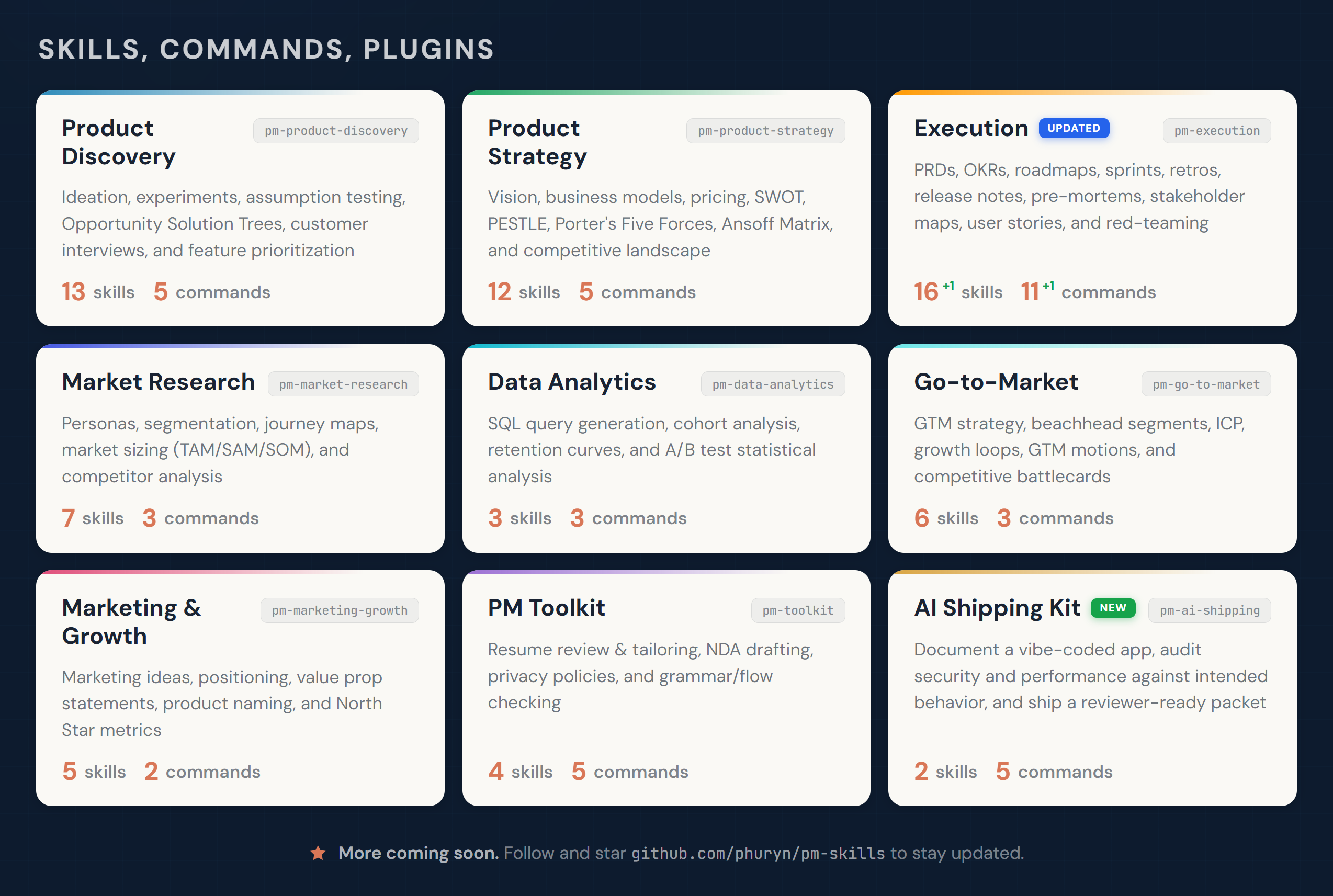
Designed for Claude Code and Cowork. Skills compatible with other AI assistants.
Start Here
New idea? → /discover
Need strategic clarity? → /strategy
Writing a PRD? → /write-prd
Planning a launch? → /plan-launch
Defining metrics? → /north-star
If this project helps you, ⭐ the repo.
Why PM Skills Marketplace?
Generic AI gives you text. PM Skills Marketplace gives you structure.
Each skill encodes a proven PM framework — discovery, assumption mapping, prioritization, strategy — and walks you through it step by step. You get the rigor of Teresa Torres, Marty Cagan, and Alberto Savoia built into your daily workflow, not sitting on a bookshelf.
The result: better product decisions, not just faster documents.
How It Works (Skills, Commands, Plugins)
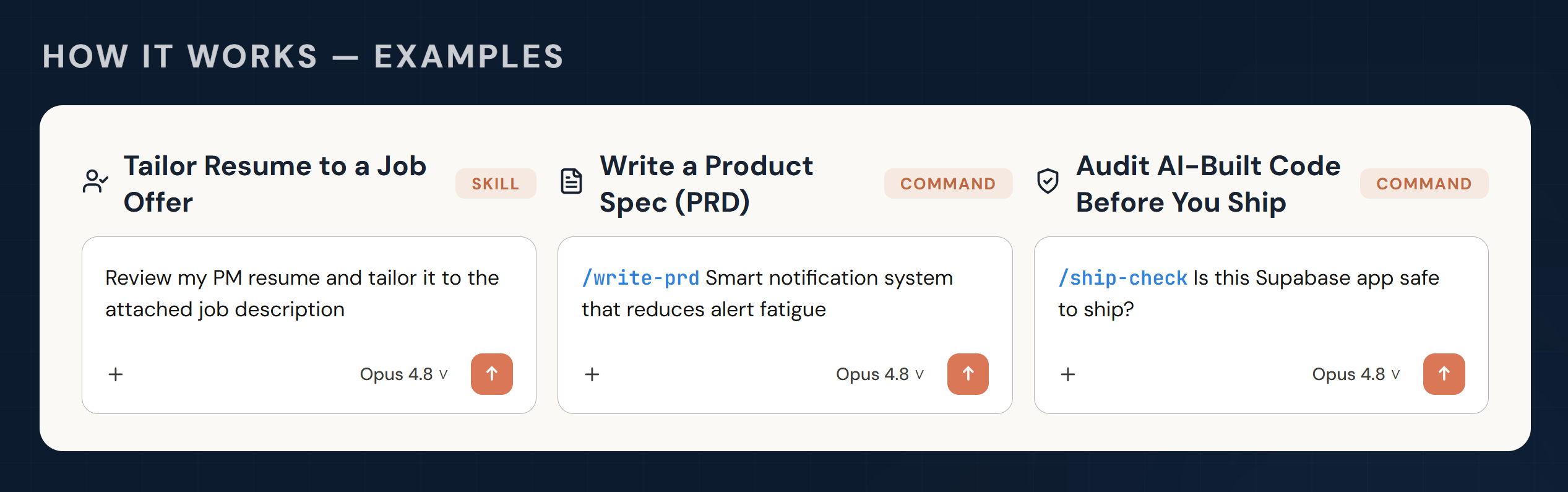
Skills are the building blocks of the marketplace. Each skill gives Claude domain knowledge, analytical frameworks, or a guided workflow for a specific PM task. Some skills also work as reusable foundations that multiple commands share.
Skills are loaded automatically when relevant to the conversation — no explicit invocation needed. If needed (e.g., prioritizing skills over general knowledge), you can force loading skills with /plugin-name:skill-name or /skill-name (Claude will add the prefix).
Commands are user-triggered workflows invoked with /command-name. They chain one or more skills into an end-to-end process. For example, /discover chains four skills together: brainstorm-ideas → identify-assumptions → prioritize-assumptions → brainstorm-experiments.
Plugins group related skills and commands into installable packages. Each plugin covers a PM domain — discovery, strategy, execution, and so on. Installing the marketplace gives you all 9 plugins at once.
Commands use skills. Some skills serve multiple commands. Some skills (like prioritization-frameworks or opportunity-solution-tree) are standalone references that Claude draws on whenever relevant — no command needed.
Commands are designed to flow into each other, matching the PM workflow. After any command completes, it suggests relevant next commands — just follow the prompts.
Installation
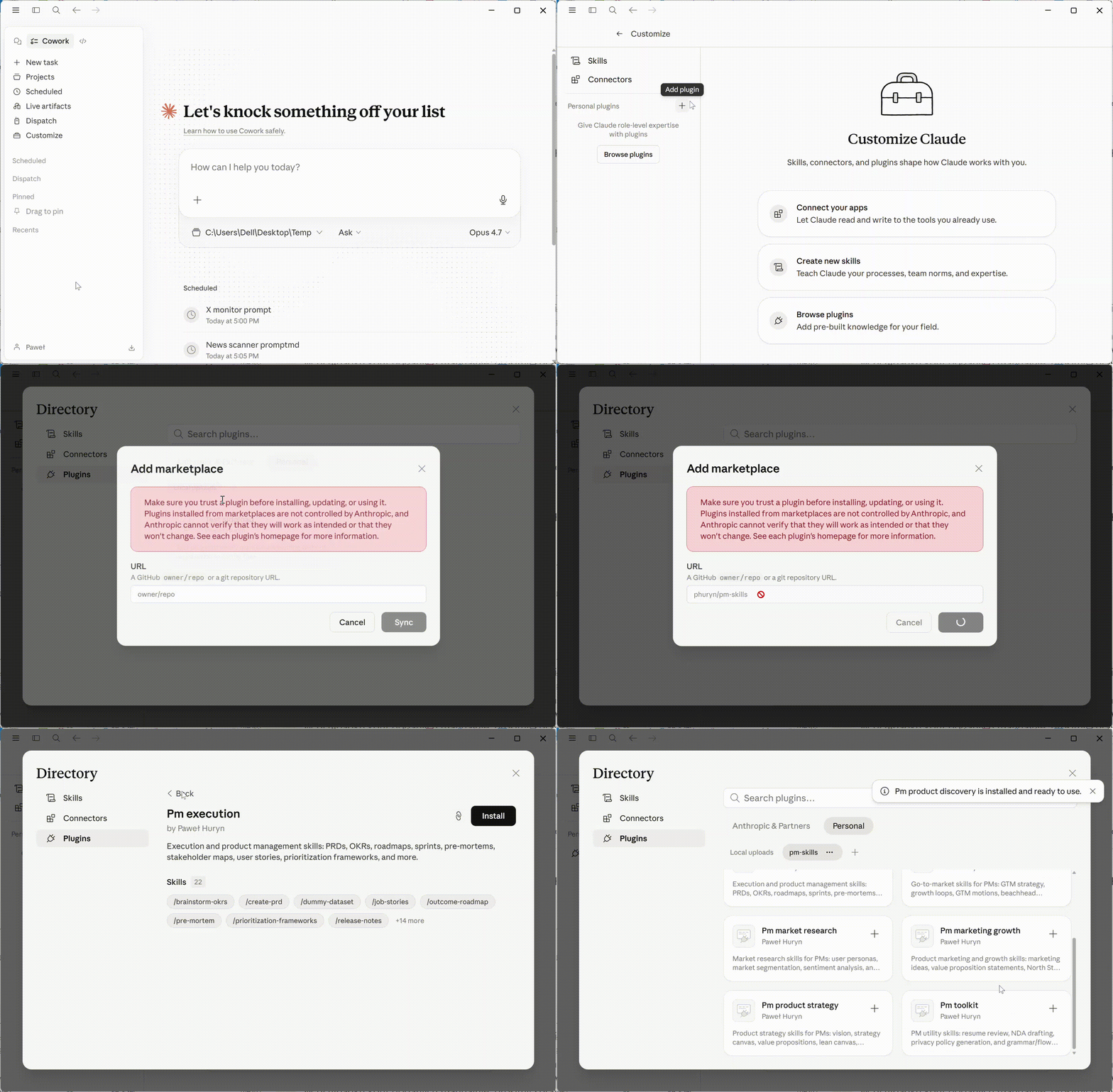
Claude Cowork (recommended for non-developers)
- Open Customize (bottom-left)
- Go to Browse plugins → Personal → +
- Select Add marketplace from GitHub
- Enter:
phuryn/pm-skills
All 9 plugins install automatically. You get both commands (/discover, /strategy, etc.) and skills.
Claude Code (CLI)
# Step 1: Add the marketplace
claude plugin marketplace add phuryn/pm-skills

# Step 2: Install individual plugins
claude plugin install pm-toolkit@pm-skills
claude plugin install pm-product-strategy@pm-skills
claude plugin install pm-product-discovery@pm-skills
claude plugin install pm-market-research@pm-skills
claude plugin install pm-data-analytics@pm-skills
claude plugin install pm-marketing-growth@pm-skills
claude plugin install pm-go-to-market@pm-skills
claude plugin install pm-execution@pm-skills

# The AI Shipping Kit moved: claude plugin install ai-shipping@product-engineering
# after: claude plugin marketplace add phuryn/product-engineering
Codex CLI (OpenAI)
Codex reads the same plugin marketplace file as Claude Code, so you can install PM Skills natively — no conversion or file-copying needed:
# Step 1: Add the marketplace
codex plugin marketplace add phuryn/pm-skills

# Step 2: Install the plugins you want
codex plugin add pm-toolkit@pm-skills
codex plugin add pm-product-strategy@pm-skills
codex plugin add pm-product-discovery@pm-skills
codex plugin add pm-market-research@pm-skills
codex plugin add pm-data-analytics@pm-skills
codex plugin add pm-marketing-growth@pm-skills
codex plugin add pm-go-to-market@pm-skills
codex plugin add pm-execution@pm-skills

# The AI Shipping Kit moved: codex plugin add ai-shipping@product-engineering
# after: codex plugin marketplace add phuryn/product-engineering
What you get: every skill (the PM frameworks), available to Codex and invocable by name. Install whole plugins rather than cherry-picking individual skills — a workflow usually relies on several skills that ship together.
What's different from Claude Code: the /slash commands (/discover, /write-prd, …) install but don't run as Codex slash commands — Codex plugins don't expose commands. To run a workflow, just describe the steps in plain language, for example:
Run product discovery on [your idea]: brainstorm options, map assumptions, prioritize the risky ones, then design experiments — pause between each step.
Optional — let Codex turn the workflows into skills. Because the command files ship inside each installed plugin, you can ask Codex to convert the ones you use most:
Read the command files in the pm-execution plugin and create equivalent Codex skills for the workflows I use most often.
This is a best-effort, model-driven conversion (some Claude-specific command syntax won't translate), but it's a quick way to get the guided workflows on Codex without leaving the CLI.
Other AI assistants (skills only)
The skills/*/SKILL.md files follow the universal skill format and work with any tool that reads it. Commands (/slash-commands) are Claude-specific.
| Tool | How to use | What works |
|---|---|---|
| Gemini CLI | Copy skill folders to .gemini/skills/ |
Skills only |
| OpenCode | Copy skill folders to .opencode/skills/ |
Skills only |
| Cursor | Copy skill folders to .cursor/skills/ |
Skills only |
| Kiro | Copy skill folders to .kiro/skills/ |
Skills only |
# Example: copy all skills for OpenCode (project-level)
for plugin in pm-*/; do
  mkdir -p .opencode/skills/
  cp -r "$plugin/skills/"* .opencode/skills/ 2>/dev/null
done

# Example: copy all skills for Gemini CLI (global)
for plugin in pm-*/; do
  cp -r "$plugin/skills/"* ~/.gemini/skills/ 2>/dev/null
done
Available Plugins
1. pm-product-discovery — Ideation, experiments, assumption testing, OSTs, interviews (13 skills, 5 commands)
Skills (13):
brainstorm-ideas-existing— Multi-perspective ideation for existing products (PM, Designer, Engineer)brainstorm-ideas-new— Ideation for new products in initial discoverybrainstorm-experiments-existing— Design experiments to test assumptions for existing productsbrainstorm-experiments-new— Design lean startup pretotypes for new products (Alberto Savoia)identify-assumptions-existing— Identify risky assumptions across Value, Usability, Viability, and Feasibilityidentify-assumptions-new— Identify risky assumptions across 8 risk categories including Go-to-Market, Strategy, and Teamprioritize-assumptions— Prioritize assumptions using an Impact × Risk matrix with experiment suggestionsprioritize-features— Prioritize a feature backlog based on impact, effort, risk, and strategic alignmentanalyze-feature-requests— Analyze and categorize customer feature requests by theme and strategic fitopportunity-solution-tree— Build an Opportunity Solution Tree (Teresa Torres) — outcome → opportunities → solutions → experimentsinterview-script— Create a structured customer interview script with JTBD probing questionssummarize-interview— Summarize an interview transcript into JTBD, satisfaction signals, and action itemsmetrics-dashboard— Design a product metrics dashboard with North Star, input metrics, and alert thresholds
Commands (5):
/discover— Full discovery cycle: ideation → assumption mapping → prioritization → experiment design/brainstorm— Multi-perspective ideation (ideas|experiments×existing|new)/triage-requests— Analyze and prioritize a batch of feature requests/interview— Prepare an interview script or summarize a transcript (prep|summarize)/setup-metrics— Design a product metrics dashboard
Examples:
Skills:
What are the riskiest assumptions for our AI writing assistant idea?Help me build an Opportunity Solution Tree for improving user activationPrioritize these 12 feature requests from our enterprise customers [attach CSV]
Commands:
/discover AI-powered meeting summarizer for remote teams/brainstorm experiments existing — We need to reduce churn in our onboarding flow/interview prep — We're interviewing enterprise buyers about their procurement workflow
2. pm-product-strategy — Vision, business models, pricing, competitive landscape (12 skills, 5 commands)
Product strategy, vision, business models, pricing, and macro environment analysis. Covers the full strategic toolkit from vision crafting through competitive landscape scanning.
Skills (12):
product-strategy— Comprehensive 9-section Product Strategy Canvas (vision → defensibility)startup-canvas— Startup Canvas combining Product Strategy (9 sections) + Business Model — an alternative to BMC and Lean Canvas for new productsproduct-vision— Craft an inspiring, achievable, and emotional product visionvalue-proposition— 6-part JTBD value proposition (Who, Why, What before, How, What after, Alternatives)lean-canvas— Lean Canvas business model for startups and new productsbusiness-model— Business Model Canvas with all 9 building blocksmonetization-strategy— Brainstorm 3–5 monetization strategies with validation experimentspricing-strategy— Pricing models, competitive analysis, willingness-to-pay, and price elasticityswot-analysis— SWOT analysis with actionable recommendationspestle-analysis— Macro environment: Political, Economic, Social, Technological, Legal, Environmentalporters-five-forces— Competitive forces analysis (rivalry, suppliers, buyers, substitutes, new entrants)ansoff-matrix— Growth strategy mapping across markets and products
Commands (5):
/strategy— Create a complete 9-section Product Strategy Canvas/business-model— Explore business models (lean|full|startup|value-prop|all)/value-proposition— Design a value proposition using the 6-part JTBD template/market-scan— Macro environment analysis combining SWOT + PESTLE + Porter's + Ansoff/pricing— Design a pricing strategy with competitive analysis and experiments
Examples:
Skills:
Compare Lean Canvas vs Business Model Canvas vs Startup Canvas for my marketplace startupDesign a value proposition for our AI writing assistant targeting non-native English speakersRun a Porter's Five Forces analysis for the project management SaaS market
Commands:
/strategy B2B project management tool for agencies/business-model startup — AI writing tool for non-native English speakers/value-proposition SaaS onboarding tool for enterprise customers
3. pm-execution — PRDs, OKRs, roadmaps, sprints, retros, release notes, stakeholder management (16 skills, 11 commands)
Day-to-day product management: PRDs, OKRs, roadmaps, sprints, retrospectives, release notes, pre-mortems, stakeholder management, user stories, and prioritization frameworks.
Skills (16):
create-prd— Lean 8-section PRD template (a fuller spec on request)brainstorm-okrs— Team-level OKRs aligned with company objectivesoutcome-roadmap— Transform a feature list into an outcome-focused roadmapsprint-plan— Sprint planning with capacity estimation, story selection, and risk identificationretro— Structured sprint retrospective facilitationrelease-notes— User-facing release notes from tickets, PRDs, or changelogspre-mortem— Risk analysis with Tigers/Paper Tigers/Elephants classificationstakeholder-map— Power × Interest grid with tailored communication plansummarize-meeting— Meeting transcript → decisions + action itemsuser-stories— User stories following the 3 C's and INVEST criteriajob-stories— Job stories: When [situation], I want to [motivation], so I can [outcome]wwas— Product backlog items in Why-What-Acceptance formattest-scenarios— Test scenarios: happy paths, edge cases, error handlingdummy-dataset— Realistic dummy datasets as CSV, JSON, SQL, or Pythonprioritization-frameworks— Reference guide to 9 prioritization frameworks (Opportunity Score, ICE, RICE, MoSCoW, Kano, etc.)strategy-red-team— Adversarial stress-test of a plan: surface load-bearing assumptions, name what would make each one fail, and rank by cheapest test
Commands (11):
/write-prd— Create a PRD from a feature idea or problem statement/plan-okrs— Brainstorm team-level OKRs/transform-roadmap— Convert a feature-based roadmap into outcome-focused/sprint— Sprint lifecycle (plan|retro|release)/pre-mortem— Pre-mortem risk analysis on a PRD or launch plan/red-team-prd— Adversarially stress-test a PRD, roadmap, or strategy and rank the riskiest assumptions by cheapest test/meeting-notes— Summarize a meeting transcript into structured notes/stakeholder-map— Map stakeholders and create a communication plan/write-stories— Break features into backlog items (user|job|wwa)/test-scenarios— Generate test scenarios from user stories/generate-data— Create realistic dummy datasets
Examples:
Skills:
Which prioritization framework should I use for a 50-item backlog?Map our stakeholders for the platform migration projectWhat's the difference between Opportunity Score, ICE, and RICE?
Commands:
/write-prd Smart notification system that reduces alert fatigue/sprint retro — Here are the notes from our last sprint/write-stories job — Break down the "team dashboard" feature into job stories
4. pm-market-research — Personas, segmentation, journey maps, market sizing, competitor analysis (7 skills, 3 commands)
User research and competitive analysis: personas, segmentation, journey maps, market sizing, competitor analysis, and feedback analysis.
Skills (7):
user-personas— Create refined user personas from research datamarket-segments— Identify 3–5 customer segments with demographics, JTBD, and product fituser-segmentation— Segment users from feedback data based on behavior, JTBD, and needscustomer-journey-map— End-to-end journey map with stages, touchpoints, emotions, and pain pointsmarket-sizing— TAM, SAM, SOM with top-down and bottom-up approachescompetitor-analysis— Competitor strengths, weaknesses, and differentiation opportunitiessentiment-analysis— Sentiment analysis and theme extraction from user feedback
Commands (3):
/research-users— Build personas, segment users, and map the customer journey/competitive-analysis— Analyze the competitive landscape/analyze-feedback— Sentiment analysis and segment insights from user feedback
Examples:
Skills:
Estimate TAM/SAM/SOM for an AI code review tool in the US marketCreate a customer journey map for our e-commerce checkout flowSegment these survey respondents by behavior and needs [attach CSV]
Commands:
/research-users We have interview data from 12 users of our fitness app/competitive-analysis Figma competitors in the design tool space/analyze-feedback Here's 200 NPS responses from Q4 [attach file]
5. pm-data-analytics — SQL generation, cohort analysis, A/B test analysis (3 skills, 3 commands)
Data analytics for PMs: SQL query generation, cohort analysis, and A/B test analysis.
Skills (3):
sql-queries— Generate SQL from natural language (BigQuery, PostgreSQL, MySQL)cohort-analysis— Retention curves, feature adoption, and engagement trends by cohortab-test-analysis— Statistical significance, sample size validation, and ship/extend/stop recommendations
Commands (3):
/write-query— Generate SQL queries from natural language/analyze-cohorts— Cohort analysis on user engagement data/analyze-test— Analyze A/B test results
Examples:
Skills:
How large a sample do I need for 95% confidence with a 2% MDE?What retention metrics should I track for a subscription app?
Commands:
/write-query Show me monthly active users by country for Q4 2025 (BigQuery)/analyze-test Here are the results from our checkout flow A/B test [attach CSV]/analyze-cohorts Weekly retention for users who signed up in January vs February
6. pm-go-to-market — Beachhead segments, ICPs, messaging, growth loops, GTM motions, battlecards (6 skills, 3 commands)
Go-to-market strategy: beachhead segments, ideal customer profiles, messaging, growth loops, GTM motions, and competitive battlecards.
Skills (6):
gtm-strategy— Full GTM strategy: channels, messaging, success metrics, and launch planbeachhead-segment— Identify the first beachhead market segmentideal-customer-profile— ICP with demographics, behaviors, JTBD, and needsgrowth-loops— Design sustainable growth loops (flywheels)gtm-motions— Evaluate GTM motions and tools (product-led, sales-led, etc.)competitive-battlecard— Sales-ready battlecard with objection handling and win strategies
Commands (3):
/plan-launch— Full GTM strategy from beachhead to launch plan/growth-strategy— Design growth loops and evaluate GTM motions/battlecard— Create a competitive battlecard
Examples:
Skills:
What's the best beachhead segment for a developer productivity tool?Design a growth loop for a B2B SaaS with a freemium tierDefine our ICP for an AI-powered HR screening platform
Commands:
/plan-launch AI code review tool targeting mid-size engineering teams/battlecard Our CRM vs Salesforce for the SMB market/growth-strategy Two-sided marketplace for connecting freelancers with startups
7. pm-marketing-growth — Marketing ideas, positioning, value props, naming, North Star metrics (5 skills, 2 commands)
Product marketing and growth: marketing ideas, positioning, value proposition statements, product naming, and North Star metrics.
Skills (5):
marketing-ideas— Creative, cost-effective marketing ideas with channels and messagingpositioning-ideas— Product positioning differentiated from competitorsvalue-prop-statements— Value proposition statements for marketing, sales, and onboardingproduct-name— Product name brainstorming aligned to brand values and audiencenorth-star-metric— North Star Metric + input metrics with business game classification
Commands (2):
/market-product— Brainstorm marketing ideas, positioning, value props, and product names/north-star— Define your North Star Metric and supporting input metrics
Examples:
Skills:
Brainstorm 5 positioning angles that differentiate us from NotionWhat's a good North Star Metric for a two-sided marketplace?Generate value prop statements for our sales team's pitch deck
Commands:
/market-product B2B analytics dashboard for e-commerce managers/north-star Two-sided marketplace connecting freelancers with clients
8. pm-toolkit — Resume review, legal documents, proofreading (4 skills, 5 commands)
PM utilities beyond core product work: resume review, legal documents, and proofreading.
Skills (4):
review-resume— PM resume review and tailoring against 10 best practices (XYZ+S formula, keywords, structure)draft-nda— Non-Disclosure Agreement with jurisdiction-appropriate clausesprivacy-policy— Privacy policy covering GDPR/CCPA compliancegrammar-check— Grammar, logic, and flow checking with targeted fixes
Commands (5):
/review-resume— Comprehensive PM resume review/tailor-resume— Tailor a resume to a specific job description/draft-nda— Draft an NDA/privacy-policy— Draft a privacy policy/proofread— Check grammar, logic, and flow
Examples:
Skills:
Review my PM resume against best practices [attach PDF]Check this product announcement for grammar and clarity
Commands:
/review-resume [attach your PM resume]/tailor-resume [attach resume + paste job description]/proofread Here's the draft of our Q1 investor update
9. pm-ai-shipping — Moved to phuryn/product-engineering, which maintains the AI Shipping Kit in its ai-shipping plugin; the skills and commands here only say where each one went. (3 skills, 5 commands)
The AI Shipping Kit is maintained in phuryn/product-engineering, in its ai-shipping plugin. The skills and commands here keep their names and only say where each one went. Install it there: product-engineering's README.
About
This marketplace evolves with product practice and AI capabilities.
Selected skills based on the work of:
- Teresa Torres — Continuous Discovery Habits
- Marty Cagan — INSPIRED and TRANSFORMED
- Alberto Savoia — The Right It
- Dan Olsen — The Lean Product Playbook
- Roger L. Martin — Playing to Win
- Ash Maurya — Running Lean
- Strategyzer — Business Model Generation and Value Proposition Design
- Christina Wodtke — Radical Focus
- Anthony W. Ulwick — Jobs to Be Done
- Alistair Croll & Benjamin Yoskovitz — Lean Analytics
- Sean Ellis — Hacking Growth
- Maja Voje — Go-To-Market Strategist
Curated by Paweł Huryn from The Product Compass Newsletter.
Compose with PM Brain

PM Brain a second brain for product managers. Plain markdown files in a folder on your laptop. Claude reads them before answering, writes to them after, sweeps them every Friday. No vector DB. No cloud. No agent memory tricks.
Contributing
See CONTRIBUTING.md.
Known Issue on Windows
If your Cowork is unstable and can't start a VM (claude-code/issues/27010), try:
$action = New-ScheduledTaskAction -Execute "powershell.exe" -Argument "-WindowStyle Hidden -Command `"if ((Get-Service CoworkVMService).Status -ne 'Running') { Start-Service CoworkVMService }`""

$trigger = New-ScheduledTaskTrigger -RepetitionInterval (New-TimeSpan -Minutes 1) -Once -At (Get-Date)

$settings = New-ScheduledTaskSettingsSet -AllowStartIfOnBatteries -DontStopIfGoingOnBatteries

Register-ScheduledTask -TaskName "CoworkVMServiceMonitor" `
  -Action $action `
  -Trigger $trigger `
  -Settings $settings `
  -RunLevel Highest `
  -User "SYSTEM"
It solves 90% of the issues on Windows. The remaining 10%: open services.msc > start "Claude" service manually
License
MIT — see LICENSE.
Releases