
Pack · #62 trending skills repo · ↗ +463 stars this week
Auto-claude-code-research-in-sleep
wanshuiyin/Auto-claude-code-research-in-sleep
ARIS ⚔️ (Auto-Research-In-Sleep) — Lightweight Markdown-only skills for autonomous ML research: cross-model review loops, idea discovery, and experiment automation. No framework, no lock-in — works with Claude Code, Codex, OpenClaw, or any LLM agent.
- Stars
- 19k
- This week
- +463
- Forks
- 1.5k
- Open issues
- 75
- Skills inside
- 197
Get started
Install the skills
npx skills add wanshuiyin/Auto-claude-code-research-in-sleepInstalls into Claude Code, Codex, Cursor, OpenCode and the other agents it finds on your machine.
/plugin marketplace add openai/codex-plugin-cc
/plugin install codex@openai-codexRun inside Claude Code, then pick what to install from /plugin.
git clone --depth 1 https://github.com/wanshuiyin/Auto-claude-code-research-in-sleep.git /tmp/auto-claude-code-research-in-sleep
cp -r /tmp/auto-claude-code-research-in-sleep ~/.claude/skills/auto-claude-code-research-in-sleepClaude Code reads ~/.claude/skills/ (or .claude/skills/ in a project). Other agents read the same SKILL.md format from their own skills folder.
Inside this repo
48 of 197 skills
skills/ablation-planneralphaxivQuick single-paper lookup via AlphaXiv LLM-optimized summaries with tiered source fallback. Use when user says "explain this paper", "summarize paper", pastes an arXiv/AlphaXiv URL, or provides a bare arXiv ID for quick understanding - not for broad literature search.skills/alphaxivanalyze-resultsAnalyze ML experiment results, compute statistics, generate comparison tables and insights. Use when user says "analyze results", "compare", or needs to interpret experimental data.skills/analyze-resultsarxivSearch, download, and summarize academic papers from arXiv. Use when user says "search arxiv", "download paper", "fetch arxiv", "arxiv search", "get paper pdf", or wants to find and save papers from arXiv to the local paper library.skills/arxivauto-paper-improvement-loopAutonomously improve a generated paper via GPT-6-Astra xhigh review → implement fixes → recompile, for 2 rounds. Use when user says \"改论文\", \"improve paper\", \"论文润色循环\", \"auto improve\", or wants to iteratively polish a generated paper.skills/auto-paper-improvement-loopauto-review-loop-llmAutonomous research review loop using any OpenAI-compatible LLM API. Configure via llm-chat MCP server or environment variables. Trigger with "auto review loop llm" or "llm review".skills/auto-review-loop-llmauto-review-loop-minimaxAutonomous multi-round research review loop using MiniMax API. Use when you want to use MiniMax instead of Codex MCP for external review. Trigger with "auto review loop minimax" or "minimax review".skills/auto-review-loop-minimaxauto-review-loopAutonomous multi-round research review loop. In Copilot CLI it defaults to the native complementary rubber-duck subagent with host-event model evidence; elsewhere it uses Codex, while explicit external reviewer overrides remain available. Implements fixes and re-reviews until a policy-approved positskills/auto-review-loopcitation-auditZero-context verification that every bibliographic entry in the paper is real, correctly attributed, and used in a context the cited paper actually supports — catching hallucinated authors, wrong years, fabricated venues, version mismatches, and wrong-context citations. Use when user says \"审查引用\", skills/citation-auditcitation-crosscheckDouble-blind bibliographic cross-check: one agent extracts each cited entry verbatim from the local .bib, a second independently re-fetches the same paper's record from the web while blind to the .bib, and a third extractor emits a mechanical field-by-field delta to catch dropped/re-ordered authors,skills/citation-crosscheckclaims-draftingDraft patent claims for an invention. Use when user says \"撰写权利要求\", \"draft claims\", \"写权利要求书\", \"claim drafting\", or wants to create patent claims. The core skill of the patent pipeline.skills/claims-draftingcomm-lit-reviewCommunications-domain literature review with Claude-style knowledge-base-first retrieval. Use when the task is about communications, wireless, networking, satellite/NTN, Wi-Fi, cellular, transport protocols, congestion control, routing, scheduling, MAC/PHY, rate adaptation, channel estimation, beamfskills/comm-lit-reviewdeepxivSearch and progressively read open-access academic papers through DeepXiv. Use when the user wants layered paper access, section-level reading, trending papers, or DeepXiv-backed literature retrieval.skills/deepxivdse-loopAutonomous design space exploration loop for computer architecture and EDA. Runs a program, analyzes results, tunes parameters, and iterates until objective is met or timeout. Use when user says \"DSE\", \"design space exploration\", \"sweep parameters\", \"optimize\", \"find best config\", or wantsskills/dse-loopembodiment-descriptionWrite detailed embodiment descriptions for patent specifications. Use when user says \"撰写实施例\", \"write embodiment\", \"实施例描述\", \"detailed description\", or wants to describe how to practice an invention.skills/embodiment-descriptionexa-searchAI-powered web search via Exa with content extraction. Use when user says "exa search", "web search with content", "find similar pages", or needs broad web results beyond academic databases (arXiv, Semantic Scholar).skills/exa-searchexperiment-auditAudit experiment integrity before claiming results. Uses cross-model review (external reviewer backend) to check for fake ground truth, score normalization fraud, phantom results, and insufficient scope. Use when user says \"审计实验\", \"check experiment integrity\", \"audit results\", \"实验诚实度\", or afskills/experiment-auditexperiment-bridgeWorkflow 1.5: Bridge between idea discovery and auto review. Reads EXPERIMENT_PLAN.md, implements experiment code, deploys to GPU, collects initial results. Use when user says \"实现实验\", \"implement experiments\", \"bridge\", \"从计划到跑实验\", \"deploy the plan\", or has an experiment plan ready to executskills/experiment-bridgeexperiment-planTurn a refined research proposal or method idea into a detailed, claim-driven experiment roadmap. Use after `research-refine`, or when the user asks for a detailed experiment plan, ablation matrix, evaluation protocol, run order, compute budget, or paper-ready validation that supports the core problskills/experiment-planexperiment-queueSSH job queue for multi-seed/multi-config ML experiments with OOM-aware retry, stale-screen cleanup, and wave-transition race prevention. Use when user says "batch experiments", "队列实验", "run grid", "multi-seed sweep", "auto-chain experiments", or when /run-experiment is insufficient for 10+ jobs thaskills/experiment-queuefeishu-notifySend notifications to Feishu/Lark. Internal utility used by other skills, or manually via /feishu-notify. Use when user says \"发飞书\", \"notify feishu\", or other skills need to send status updates.skills/feishu-notifyfigure-descriptionProcess user-provided patent figures and generate formal drawing descriptions. Use when user says \"附图处理\", \"figure description\", \"附图说明\", \"drawings description\", or wants to describe patent figures with reference numerals.skills/figure-descriptionfigure-specGenerate deterministic publication-quality architecture, workflow, and pipeline diagrams from structured JSON (FigureSpec) into editable SVG. Use when user says \"架构图\", \"workflow 图\", \"pipeline 图\", \"确定性矢量图\", \"figure spec\", \"draw architecture\", or needs precise, editable, publication-ready skills/figure-specfirecrawl-searchWeb search and page scraping via Firecrawl, returning full-page markdown. Use when user says "firecrawl search", "firecrawl scrape" or "/firecrawl-search".skills/firecrawl-searchformula-derivationStructures and derives research formulas when the user wants to 推导公式, build a theory line, organize assumptions, turn scattered equations into a coherent derivation, or rewrite theory notes into a paper-ready formula document. Use when the derivation target is not yet fully fixed, the main object stskills/formula-derivationgemini-searchSearch research papers via Gemini for broad literature discovery. Use when user says "gemini search", "gemini papers", "search with gemini", or wants AI-powered literature discovery beyond arXiv/Semantic Scholar indexes.skills/gemini-searchgrant-proposalDraft a structured grant proposal from research ideas and literature. Supports KAKENHI (Japan), NSF (US), NSFC (China, including 面上/青年/优青/杰青/海外优青/重点), ERC (EU), DFG (Germany), SNSF (Switzerland), ARC (Australia), NWO (Netherlands), and generic formats. Use when user says \"write grant\", \"grant proskills/grant-proposalidea-creatorGenerate and rank research ideas given a broad direction. Use when user says "找idea", "brainstorm ideas", "generate research ideas", "what can we work on", or wants to explore a research area for publishable directions.skills/idea-creatoridea-discovery-robotWorkflow 1 adaptation for robotics and embodied AI. Orchestrates robotics-aware literature survey, idea generation, novelty check, and critical review to go from a broad robotics direction to benchmark-grounded, simulation-first ideas. Use when user says \"robotics idea discovery\", \"机器人找idea\", \"skills/idea-discovery-robotidea-discoveryWorkflow 1: Full idea discovery pipeline to go from a broad research direction to validated, pilot-tested ideas. Use when user says \"找idea全流程\", \"idea discovery pipeline\", \"从零开始找方向\", or wants the complete idea exploration workflow.skills/idea-discoveryintegrity-forensicsRun the Anti-Autoresearch integrity-forensics sweep (span-anchored evidence ledger → GPT auditors propose findings → a rules-only reporter that lists every proposal with what the auditor said about it) against a paper via a SHA-pinned thin launcher — then convert the verdict into a typed policy gateskills/integrity-forensicsinterview-cheatsheetGenerate a long-form Chinese interview-prep cheat sheet on a specific ML/LLM topic — formulas with derivations, from-scratch PyTorch code, comparison tables, and 25 高频面试题 (L1 必会 / L2 进阶 / L3 顶级 lab). Use when the user says '写面试 cheat sheet', '写一份 X 教程', '帮我准备 Y 面试题', '出一份 X 速查', or wants a 600-1000 skills/interview-cheatsheetinvention-structuringStructure a raw invention idea into a formal invention disclosure. Use when user says \"构建发明\", \"structure invention\", \"发明构建\", \"invention disclosure\", or wants to formalize a rough idea into a patent-ready structure.skills/invention-structuringjurisdiction-formatCompile patent application into jurisdiction-specific filing format. Use when user says \"格式转换\", \"jurisdiction format\", \"国家格式\", \"compile patent\", or wants formatted patent documents for CN/US/EP filing.skills/jurisdiction-formatkeenable-searchKeyless web search and page fetch via Keenable. Use when user says "keenable search", "web search without an API key", "fetch this page as markdown", or needs broad web results beyond academic databases (arXiv, Semantic Scholar) with no search API key set up.skills/keenable-searchkill-argumentTwo-thread adversarial review: a fresh reviewer constructs the strongest 200-word rejection memo, then a second fresh reviewer defends the paper point-by-point and surfaces still-unresolved critical issues. Use when user says \"kill argument\", \"adversarial review\", \"hostile review\", \"rebuttal skills/kill-argumentlean-formalizeDevelop and verify a mathematical proof in Lean, continue an incomplete Lean project, or audit whether it proves the original statement. Connect actual inputs to intermediate lemmas, assemble the target theorem, check its transitive axioms, and provide a reproducible handoff. Use when Lean is requesskills/lean-formalizemermaid-diagramGenerate Mermaid diagrams from user requirements. Supports flowcharts, sequence diagrams, class diagrams, ER diagrams, Gantt charts, and 18 more diagram types.skills/mermaid-diagrammeta-applyPrivileged applier that LANDS meta-optimize / corpus-audit patches the user approved — the ONLY skill permitted to mutate the skill corpus from a self-modification proposal, with cross-model jury and human approval at landing. Use when the user says \"meta apply\", \"/meta-apply\", \"land the stagedskills/meta-applymeta-optimizeAnalyze ARIS usage logs and propose optimizations to SKILL.md files, reviewer prompts, and workflow defaults. Outer-loop harness optimization inspired by Meta-Harness (Lee et al., 2026). Use when user says \"优化技能\", \"meta optimize\", \"improve skills\", \"分析使用记录\", or wants to optimize ARIS's own hskills/meta-optimizemonitor-experimentMonitor running experiments, check progress, collect results. Use when user says "check results", "is it done", "monitor", or wants experiment output.skills/monitor-experimentnovelty-checkVerify research idea novelty against recent literature. Use when user says "查新", "novelty check", "有没有人做过", "check novelty", or wants to verify a research idea is novel before implementing.skills/novelty-checkopenalexSearch academic papers via OpenAlex API for open citation data, institutional affiliations, and funding information. Use when user says "openalex search", "search openalex", "open citation graph", or wants comprehensive academic metadata beyond arXiv/Semantic Scholar.skills/openalexoverleaf-syncTwo-way sync between a local paper directory and an Overleaf project, so ARIS audit/edit workflows stay on the local copy while collaborators edit in the Overleaf web UI. Use when user says \"同步 overleaf\", \"overleaf sync\", \"推送到 overleaf\", \"connect overleaf\", \"Overleaf 桥接\", \"pull overleaf\"skills/overleaf-syncpaper-claim-auditZero-context verification that every number, comparison, and scope claim in the paper matches raw result files. Uses a fresh cross-model reviewer with NO prior context to prevent confirmation bias. Use when user says \"审查论文数据\", \"check paper claims\", \"verify numbers\", \"论文数字核对\", or before submiskills/paper-claim-auditpaper-compileCompile LaTeX paper to PDF, fix errors, and verify output. Use when user says \"编译论文\", \"compile paper\", \"build PDF\", \"生成PDF\", or wants to compile LaTeX into a submission-ready PDF.skills/paper-compilepaper-figureGenerate publication-quality figures and tables from experiment results. Use when user says \"画图\", \"作图\", \"generate figures\", \"paper figures\", or needs plots for a paper.skills/paper-figurepaper-illustration-image2Generate publication-quality academic illustrations through a local Codex app-server bridge that uses Codex native image generation. This is a separate experimental alternative to `paper-illustration`, intended for Claude Code users who want a GPT-image-style renderer without modifying the original skills/paper-illustration-image2Documentation
README
Auto-claude-code-research-in-sleep (ARIS ⚔️🌙)










🌱 ARIS is a methodology, not a platform. What matters is the research workflow — take it wherever you go.
💡 Use ARIS as a skill-based workflow in Claude Code / Codex CLI / Cursor / Trae / Antigravity / GitHub Copilot CLI / OpenClaw / DeepSeek Harness — enjoy any way you like!
The executor drives, an independent model (Codex MCP by default) reviews. Alternative model combinations, including ModelScope-hosted models, need no Claude or OpenAI API.
📦 Those are the skills installed directly. Want it in one command? ARIS also ships as a standalone CLI and as plugins: 



❗ 
codex mcp-server — the entry point every ARIS reviewer call used. No impact on ARIS: the codex MCP server is now ARIS's own bridge over codex exec (mcp-servers/codex-exec/), same tools, same results, all 82 skills unchanged, ultra and per-thread resume intact. One re-registration is all it takes — already installed? → Quick Start step 2b · new install → step 2 · what changed.
🧩 The ARIS family — same method, other jobs. One line each; the details live in their own repos.



CLAUDE.md / AGENTS.md against the four shapes agents over-defend in (Hashing, Edge cases, Rubrics, Overbuild), bounding what the agent proposes, never what it looks for. Anti-Autoresearch: 61 integrity signals into a deterministic, reviewer-ready report — fabrication forensics, not an AI-text detector.

/method-figure).

cd aris-monitor && ./run.sh. Many windows? Claude Fleet by @tianyilt is the full dashboard.
🔥 ARIS-Code CLI — 独立安装版 · English | ⬇️ Download · 
ARIS_REASONING_EFFORT works on the Anthropic channel, tool calls through {}-placeholder relays fixed, OS proxy honoured. v0.4.27: launching and quitting the REPL leaves no empty session file. v0.4.26: the fable alias and /model now point at Fable 5.1 (default stays Opus 5). v0.4.25: the Codex reviewer works again on codex-cli ≥ 0.154 (built-in codex exec bridge, nothing to register), /since takes you back to your last input, /resume lists sessions by index, Windows multi-line paste fixed (pending confirmation), 83 bundled skills on GPT-6-Astra.
ARIS-Code — screenshot, what's in v0.4.28, per-release details, older versions
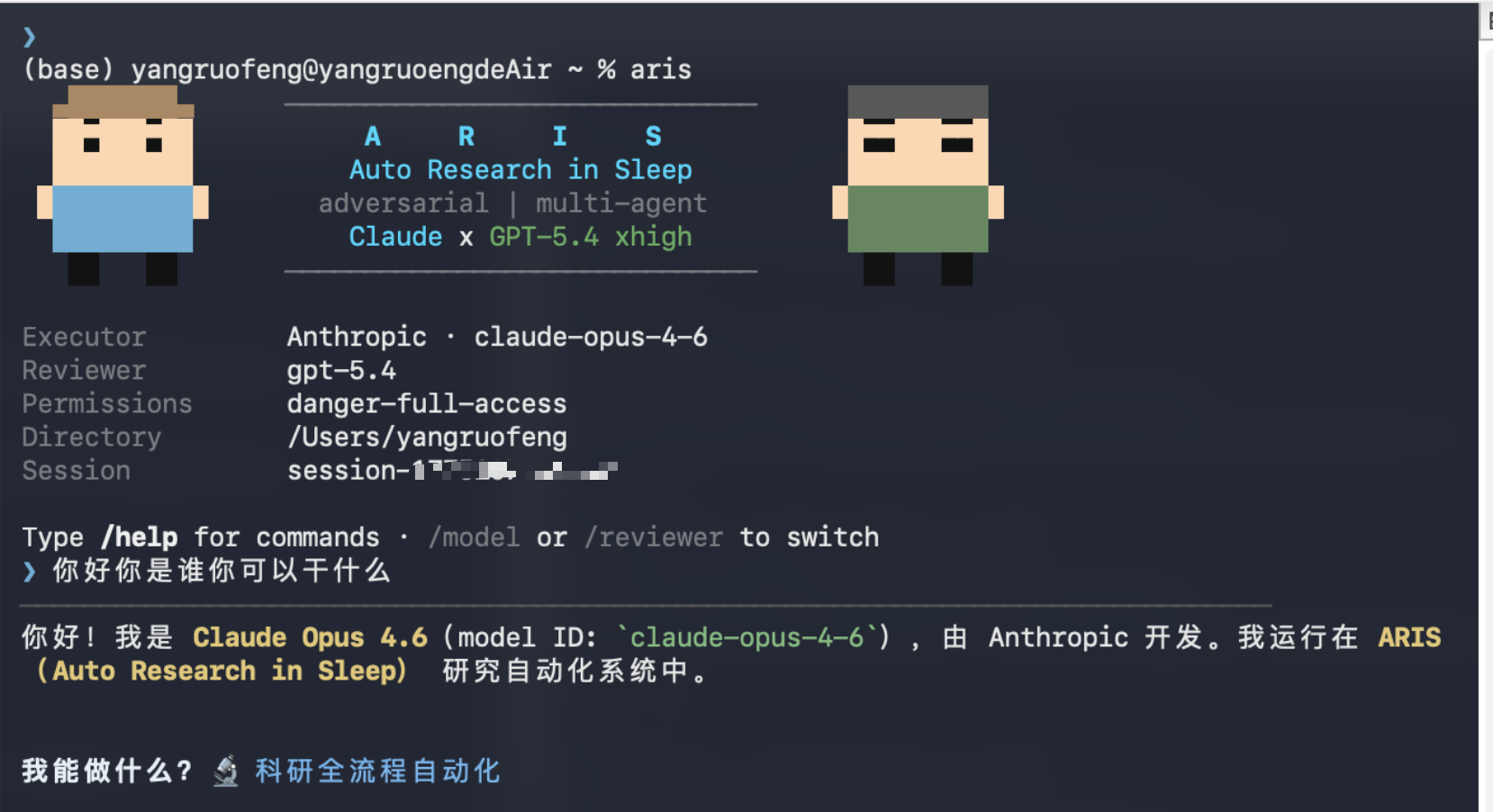
📰 ARIS-Code v0.4.28 (2026-09) — latest: ARIS_REASONING_EFFORT works on the Anthropic channel (#446), tool calls through relays that send a {} placeholder no longer fail (#444), and the OS proxy on Windows / macOS is used without exporting HTTPS_PROXY (#401). v0.4.27: launching and quitting the REPL no longer leaves an empty session file, and /resume lists only sessions with messages (#439 follow-up). v0.4.26 made Fable 5.1 the fable alias and the first /model entry (the default executor stays Opus 5). v0.4.25 is the reviewer-bridge release: codex-cli 0.154 removed codex mcp-server, so every Codex review from ARIS-Code died on an updated codex. The reviewer now runs over a built-in codex exec bridge — no mcpServers.codex entry, old entries migrate in memory, thread records interoperate with ARIS's Python bridge. Also: /since replays everything after your last input (folded like the live display, /since full for complete output), /resume lists sessions with indices and shows where you stopped (#439), Windows multi-line paste no longer submits line by line (#430, pending confirmation), the Windows shim message carries the native installer (#428), and the bundle moves to 83 skills on GPT-6-Astra. Recent headliners: v0.4.24 — Claude 5 model refresh (Opus 5 default, Fable 5 tier, availability chain) and v0.4.23 — output folding. Caps a 24-release run (v0.4.5 → v0.4.28); per-release detail below. Credits: @GetIT-Sunday, @Anduin9527, @GO-player-hhy, @Jxy-yxJ, @screw-44, @StevenUST, @opposj, @ShijunLei-cn, @algojogacor, @YukinoshitaLove, @jinliye-2026, @SajimJC, @JasmineLCY.
Per-release details (v0.4.5 → v0.4.28)
v0.4.28 (2026-09-28) —
ARIS_REASONING_EFFORTnow works on the Anthropic channel (#446):low/medium/high/xhigh/maxfor the main session and subagents; unset, requests are unchanged.ARIS_MAX_TOKENSraises the output cap when a high effort runs into it.autoCompactEnabled: falsein settings turns automatic compaction off. 🐛 #444 tool calls through relays that send a{}placeholder no longer fail withinvalid tool input JSON. 🌐 System proxy on Windows / macOS is used without exportingHTTPS_PROXY(#401, by @JasmineLCY);NO_PROXY=*connects directly as before. Upgrading: if you already exportARIS_REASONING_EFFORT, have an OS proxy, or haveautoCompactEnabled: falsein settings, read the upgrade notes.v0.4.27 (2026-09-19) — launching and quitting the REPL no longer leaves an empty session file;
/resumelists only sessions with messages (#439 follow-up).v0.4.26 (2026-09-16) — Fable 5.1: the
fablealias now resolves toclaude-fable-5-1,/modellists Fable 5.1 first (Fable 5 stays selectable) and the system-prompt identity names it; the default executor remainsclaude-opus-5(the Mythos tier is $10/$50 vs Opus 5's $5/$25, so the default does not move). Savedexecutor_modelvalues are ids, not aliases, and are untouched. Pricing already matched onfable; a test pins 5.1. Tests unchanged (aris-cli 225 + 4 e2e / runtime 252 / tools 71 / commands 6). Codex MCP (gpt-6-astra xhigh) gate: GO.v0.4.25 (2026-09-16) — the reviewer-bridge release. codex-cli 0.154 removed
codex mcp-server, the entry point ARIS-Code'saris setuphad written into settings.json for every Codex review; on an updated codex every review call died. Built-incodex execbridge:mcp__codex__codex/codex-replyrun ascodex exec --jsonwith nothing to register — no settings entry, a legacycodex mcp-serverentry is migrated in memory (env,-cdefaults,requestTimeoutSecs, trust kept), an explicit Python-bridge entry is used as configured, thread records share~/.codex/state/codex-exec/threads/with the Python bridge, 1800 s budget forultraaudits,ARIS_CODEX_BRIDGE=0restores the old path;aris doctorprints the effective backend. Found on the way: the model never received a Codex result'sthreadId(it lives only instructuredContent), socodex-replycould not continue a thread — results now start with athreadId:line./since [full]replays the user's last input and everything after it with the live formatters (display only; after/resumeand in--resumebatch mode too); a dim hint after turns with ≥ 8 tool calls (ARIS_TURN_SUMMARY=0). #430 Windows consoles deliver no paste event, so each pasted line became its own Enter — lines are now merged into the input and never auto-submitted, Ctrl+C discards the rest (ARIS_PASTE_BURST=0; inferred from crossterm's source, pending confirmation on a Windows machine). #439/resumelists sessions with[n]indices and ages and accepts an index, a unique id prefix or a path; the last turn is replayed after loading. #428 the.cmd-shim message carries the official native installer one-liner. Bundle 81→83 (pin 3e49e63 → 4734364):/proof-orchestrator,/research-implement-feature, 32 helpers (+review_gate.py,copilot_native_evidence.py,idea_discovery_gate.py), repo-roottemplates/bundled; reviewer doctrine and system prompt on gpt-6-astra (fallback gpt-5.6-sol → gpt-5.5), explicit— reviewer:directives win,LlmReviewresults carryreviewer_model:so HTTP rounds report toreview_gate.pytruthfully; gpt-6-astra pricing tier $10/$50 (cache write $12.50, read $1). Tests: api 35+6 / aris-cli 225 + 4 e2e / runtime 252 / tools 71 / commands 6, all green; livecodex execfresh + resume roundtrip on codex-cli 0.154.0. Codex MCP (gpt-6-astra): ultra design gate (2 rounds), xhigh implementation gate per step (5/2/2/2 rounds), final whole-diff gate (2 rounds) → GO.v0.4.24 (2026-08-09) — the Claude 5 model refresh (#392, requested by @YukinoshitaLove). Explicit
--model claude-opus-5/claude-fable-5already passed through on every platform — this release makes them first-class. Default →claude-opus-5(main session, subagents,aris setup; same $5/$25 tier as Opus 4.8); the v0.4.18 availability fallback becomes an ordered chain walk (Opus 5 → Opus 4.8 → Opus 4.7, one step per precise404 not_found_error, explicit choices never silently change) — the naive constant swap would have stranded 4.7-only accounts and configs saved by v0.4.23's setup, a regression the cross-model review caught and an end-to-end mock-404 chain test now locks./modelpicker adds Fable 5 / Opus 5 / Sonnet 5; newfablealias. New Mythos-class pricing tier (fable/mythos= $10/$50, cache write $12.50 / read $1, verified 2026-08 — previously fell to the conservative $15/$75 unknown-model tier, a 1.5× over-estimate); Opus 5 / Sonnet 5 pinned on their existing branches. Tests: api 41 / aris-cli 213 + 4 e2e / runtime 226 / tools 70 / commands 5, all green; live smoke on claude-opus-5, claude-fable-5 and the fable alias. Codex MCP (gpt-6-astra xhigh) implementation gate: NO-GO → NO-GO → GO.v0.4.23 (2026-08-02) — the output-folding release (top real-user complaint: "aris dumps thinking and the full content of documents it reads onto the screen"). 🧹 Tool-output folding, display layer ONLY: the disk-verified culprits were format_read_result appending the ENTIRE read payload, bash pushing full stdout/stderr, grep dumping its full content blob, and the edit preview capping line counts but not line LENGTH. Now Read/Grep show the first 6 lines, Bash shows first 4 + last 4 per stream (stderr keeps its red), each kept line capped at 240 chars (the minified-single-line case), then one dim "… (+N more lines — set ARIS_TOOL_OUTPUT_LINES=0 for full output)" hint. ONE env knob: unset = defaults, a positive integer overrides every tool, 0 = the exact old display; the session, model context,
--output-format jsonand/exportare untouched and always complete. Thinking was verified to never print (Anthropic deltas only accumulate; Kimi reasoning_content only feeds the replay cache — the "thinking dump" perception came from the document dumps); two end-to-end sentinel tests (real binary vs mock SSE server) lock that thinking/reasoning never reaches the terminal. Interactive expand/collapse was deliberately rejected as over-engineering. 🐛 Bash timeout now kills the command: a timed-out call reportedinterrupted: truewhile the dropped tokio future left the child RUNNING — side effects landed after the report; now kill_on_drop (escape hatchARIS_BASH_KILL_ON_TIMEOUT=0; background tasks untouched; locked by a real behavioral test — a timed-out "sleep 1 && touch marker" must not create the marker). 📦 Bundle 79→81 (pin 7182624 → 3e49e63):/integrity-forensics— the Anti-Autoresearch SHA-pinned thin launcher (span-anchored evidence ledger → GPT auditors propose → deterministic rules-only adjudicator decides → typed BLOCK/WARN gate + obligations ledger) — and/web-debug-search, +tools/forensics_gate.py (29 helpers, 104 embedded resources). 🎁 Also: grep's content mode no longer shows a false "0 matches" above real results (the gate caught that"numMatches": nullserializes with the key present, defeating a naive presence check); all four crates' local-mock-server tests are now proxy-immune (a shell with http(s)_proxy set used to turn 15 tests red on a released tag — 127.0.0.1 was routed through the proxy). The rest of the runtime-state package (compaction re-arm, failed-turn cleanup, /cost dollars, SSE tail) ships as v0.4.24 — the cached-token cost fix is deliberately held back because it changes what the compaction trigger measures. Tests: api 41 / aris-cli 212 + 3 e2e / runtime 225 / tools 69 / commands 5 (+13), all green under a live proxy; new-code clippy delta zero. Codex MCP (gpt-6-astra): ultra scope+design adjudication, then a 3-round implementation gate (round 1 caught the null-serialization defeat and a non-hermetic behavioral test; round 3 GO).v0.4.22 (2026-07-12) — the skills-resync + GPT-6-Astra release. 📦 Bundle resync (pin 7e3ab67 → 7182624, 93 commits): 79 bundled skills (+
meta-apply, +paper-poster-html;paper-posterretired to a redirect stub), 28 tools helpers (8 new: capture_filter, evidence_check, iteration_log, provenance, run_state, threat_scan, meta_opt/trigger_eval + sample evals), 11 new shared-references docs (fan-out-pattern, acceptance-gate, external-cadence, skill-governance, compute-env-contract, resumable-runs, evidence-precheck, injection-hygiene, capture-antipatterns, output-composition, taste-calibration); sync hardening —ARIS_SYNC_EXPECT_SHAguard (aborts before touching assets if main moved; it caught a real move on first use) + exact-inventory drift tests + the vendored posterly MIT license text now ships. 🎛 GPT-6-Astra two-tier reviewer alignment: the CLI's system-prompt nudge now passes the skills' explicitmodel: gpt-6-astra+ per-call effort pins through (the v0.4.17 blanket "never pass a model" rule would have silently stripped deep audits from ultra to xhigh), carries the canonical capability-only fallback chain (effort-unsupported → same model xhigh, deep tier only; model-unknown → explicit gpt-5.5+xhigh; never degrade on transport-class errors; an explicit call-level override disables the chain), pinsapproval-policy: "never"+ explicitsandboxon every fresh codex call, and makes the HTTP fallback pre-dispatch-only with parameter stripping; the HTTP LlmReview default deliberately stays gpt-5.5 pending a real smoke; gpt-5.6 family pricing (sol $5/$30, terra $2.50/$15, luna $1/$6) verified against the official page; banner/Reviewer display//reviewerare honest about primary-vs-fallback (pure-Codex setups get status + guidance instead of a fake picker). 🐛 8 verified fixes: explicit--modelwas silently overridden by the saved executor model (model provenance now tracked end-to-end; the 4.8→4.7 availability fallback respects explicit choices;/modeland/setupre-arm it); saved models no longer leak across provider transports (blank saved models count as absent; OpenAI transport with no model source fails fast; the first-run wizard's config now actually feeds startup model resolution);--output-format jsonnever prompts (locked by a real end-to-end binary test against a mock SSE server); Windowsaris loginfixed (PKCE randomness read /dev/urandom → getrandom); Windows command probing fixed (the PowerShell tool probed itself throughsh; now where.exe); codex.cmdshims classified honestly (three-state probe; setup requires explicit confirmation before writing a config the MCP client can't spawn); nested config.json warns instead of silently parsing to all-defaults; NotebookEdit mints collision-free cell ids. 🖥 New windows-latest CI job (workspace compile gate + three targeted test groups, each guarded against silent 0-test green). Tests: api 41 / aris-cli 204 + 1 e2e / runtime 223 / tools 69 / commands 5 (+54), all green; new-code clippy delta zero. Codex MCP (gpt-6-astra): ultra design gate — 5 rounds, NO-GO ×4 → GO — then a 3-round implementation gate whose round 2 caught a first-run config-wiring blocker before it shipped; 4 implementation subagents, every report disk-verified.v0.4.21 (2026-06-28) — bug-fix patch: 5 new user-facing bugs from a Codex adversarial hunt (all disk-verified, distinct from v0.4.20), each cross-model reviewed at a design gate and an implementation gate (gpt-5.5 xhigh; both started NO-GO — the reviewer caught an off-by-one in the grep line-mapping and a missing stream-level test before GO). 🐛 Headline: OpenAI-compatible streaming corrupted multi-byte UTF-8 (CJK / emoji) split across network chunks into
�— each HTTP body chunk wasfrom_utf8_lossy'd independently, so a 3-byte Chinese character or 4-byte emoji straddling a chunk boundary broke on both sides (a frequent hit for Chinese users on domestic OpenAI-compatible providers — Kimi/GLM/MiniMax/DeepSeek/Qwen/Doubao — streaming Chinese text); the stream buffer is now raw bytes, decoding only complete SSE lines. A saved OpenAI/custom executor config no longer overrides a shell-setEXECUTOR_PROVIDER— the startup "shell-provided vars win" path had one ungated write that re-pointedEXECUTOR_PROVIDER=anthropic … aris …to OpenAI (wrong executor / model-not-found). An Anthropic stream truncated after content but before a terminal signal now hard-errors (premature_eof) instead of saving a half-finished answer to history as a complete turn (symmetric to the OpenAI#249guard; thestop_reason-only compat path is preserved, andARIS_ALLOW_EOF_WITHOUT_STOP=1opts a terminal-signal-less proxy back into the old behavior).grep_searchwithmultiline: truenow matches across lines in content mode (was silently empty —countmode already worked). MCP tool results carried only instructuredContent(emptycontent) are no longer dropped — the model gets the JSON structured payload. Tests (CI mode): api 32→35 / runtime 205→212 / tools 67 / aris-cli 172→181 / commands 5 (+21, incl. 2 stream-level integration tests), all green. Codex MCP (gpt-5.5 xhigh): design gate (NO-GO → GO after fixing the off-by-one) → implementation gate (NO-GO → GO after adding the stream-level integration tests); the Anthropic streaming spec (every stream ends withmessage_stop) was WebFetch-verified. Two latent-only candidates (Anthropic block-indexrouting, OpenAI multi-line SSE) remain deferred.v0.4.20 (2026-06-19) — bug-fix patch: 7 user-facing bugs surfaced by a Codex adversarial hunt, each reviewed across 3 rounds (the reviewer caught a redraw gap, a trailing-blank, a spinner tail, and a blank-line edge before GO). 🐛 Headline (#299): short REPL replies showed only "✔ Done" — the spinner draws "⠋ Thinking…" with Save/RestorePosition so streamed output overwrites it on the same line, but
finishthen cleared that whole line, erasing a short single-line reply. The REPL now finishes without clearing when the turn printed visible text (Clear(UntilNewLine)wipes only the spinner tail after the reply). Streamed multi-paragraph replies rendered glued ("para1para2") — each chunk's paragraph separator was trimmed at the stream boundary; the markdown streamer now preserves separators via a held-separator so streamed output equals a single full render (no dangling blank line). Markdown tables with CJK/fullwidth content misaligned — width now counts display cells (CJK = 2), not chars.aris "prompt"/aris setup(REPL-only before) — a configured OpenAI/custom executor got the Anthropic default sent to its endpoint; the one-shot and REPL paths now share one resolver. Esc now actually closes the completion dropdown (it was recomputed right back).glob_searchreports the total matched count when truncated (not the capped 100, which made the model think a 1000-match glob had 100 files)./model's custom menu reads the effective env the executor uses, not stale on-disk config. Tests (CI mode): api 32 / runtime 205 / tools 67 / aris-cli 172 / commands 5, all green; +7 new; real-machine verified (short reply renders + "✔ Done"; paragraphs keep their blank lines). Codex MCP (gpt-5.5 xhigh): hunt → 3 review rounds (NO-GO → NO-GO → GO). Two latent-only candidates (Anthropic block-indexrouting, OpenAI multi-line SSE) deferred to a hardening pass.v0.4.19 (2026-06-14) — honesty / guardrails patch (theme from a Codex fresh-eyes audit; no behavior change for healthy setups). 🔴 MCP protocol-version negotiation guard — the stdio handshake requested
2025-03-26but never read the version the server negotiated back (a parsed-but-dead field), so a server agreeing on a version ARIS can't speak was silently accepted and latertools/list/tools/callran on an incompatible protocol with opaque failures. ARIS now validates the negotiated version against a supported set (2025-11-25/2025-06-18/2025-03-26/2024-11-05— stdio framing is identical across these) and, on an unsupported one, terminates the child + clears the slot + surfaces a clear per-server error (aris doctorshows it) — the "terminate when versions can't be agreed" behavior the MCP lifecycle spec requires. The request stays2025-03-26(proven againstcodex mcp-server), so healthy servers are unaffected — verified end-to-end: the real Codex MCP server still spawns + initializes + advertises its tools under the guard. 🧹 Papercuts: the OpenAI-family subagent fail-loud message dropped its stale "lands in v0.4.18" marker (now version-agnostic + actionable, still credential-free); OpenAI upstream error bodies are now truncated (500 chars) + credential-redacted (sk-…keys andBearer …tokens, via a substring scanner that catches the compact-JSON shape{"api_key":"sk-…"}a misconfigured proxy can reflect back) instead of splatted verbatim; the system-prompt hook-events summary now counts only the hooks the runtime actually executes (acommandhook with acommandstring), matching the parser. Tests (CI mode): api 32 / runtime 204 / tools 67 / aris-cli 167 / commands 5, all green; live smoke confirms the real Codex MCP server still initializes under the guard. Reviewed by Codex MCP (gpt-5.5 xhigh): design GO → impl NO-GO (compact-secret miss + command-string strictness) → GO after fixes.v0.4.18 (2026-06-14) — default model → Claude Opus 4.8, with corrected pricing and a safety net. The bump moves
DEFAULT_MODEL, theopusalias, the model picker,aris setup, and the subagent default toclaude-opus-4-8— with an availability fallback: if the account lacks 4.8 (the API returns404 not_found_error), ARIS auto-falls-back toclaude-opus-4-7for the session, rebuilds the system-prompt model identity so it stays coherent (the model is never told it's 4.8 while served 4.7), warns once, and retries — for the main session (text + JSON) and subagents. It fires only on that precise 404 (never 400/rate-limit/auth), latches against loops, and the text path rebuilds from a pre-turn snapshot so a retry never double-appends the user message; accounts with 4.8 are byte-identical to a plain bump. 💰 Pricing corrected (verified against Anthropic's published schedule; had been a 3–5× over-estimate): current Opus 4.5–4.8 =$5/$25(deprecated Opus 4/4.1 keep$15/$75, split by word-boundary so a futureopus-4-10isn't mis-tiered); Sonnet 4.x =$3/$15(decoupled from the generic unknown-model fallback, which stays$15/$75); Haiku was already correct. 🧹 Backlog:aris setupoption 10 pins the Codex MCP reviewer tomodel_reasoning_effort="xhigh"(deterministic for new setups, independent of~/.codex/config.toml; idempotent merge never clobbers an existing entry); a startup +aris doctormisconfig hint (#259) for a silently-ignored/misplaced config (malformed JSON, or a stray~/.aris/config.yaml— stderr-only soSessionStart/SessionEnd/… — deferred to a separate issue). Tests (CI mode): api 32 / runtime 202 / tools 67 / aris-cli 166 / commands 5, all green; a live one-shot smoke returnsmodel=claude-opus-4-8end-to-end. Reviewed by Codex MCP (gpt-5.5 xhigh) across the design + both implementation batches (design REWORK→GO, impl NO-GO→GO, batch-2 GO).v0.4.17 (2026-06-13) — the MCP release. Before v0.4.17,
mcpServersinsettings.jsonparsed, showed inaris doctor, and did nothing; now ARIS spawns each configured stdio server, runs the MCP handshake, discovers tools, and advertises them asmcp__<server>__<tool>on both provider paths (Anthropic + OpenAI-family), with end-to-end dispatch, soft per-server degradation, and an approval gate for untrusted MCP tools (external processes the sandbox can't cover;--allowedToolsnow acceptsmcp__names). 🆕 zero-API-key cross-model reviewer:aris setup→ option 10 (Codex MCP, ChatGPT subscription, no API key) writes an idempotentmcpServers.codexentry into the settings file the runtime actually reads (atomic write + backup, explicit consent beforetrust: true), with an optional API reviewer as fallback (ARIS_REVIEWER_PROVIDER=codex-mcp+ARIS_REVIEWER_FALLBACK_PROVIDER);/setupin-REPL rebuilds the system prompt + runtime so reviewer changes take effect without quitting. 🔴 Protocol fix the fakes couldn't catch: real-machine e2e againstcodex mcp-serverexposed that our stdio transport spoke LSP-styleContent-Length:framing while the MCP spec (and codex) use newline-delimited JSON-RPC — every fake-server test passed because the fakes spoke the same wrong dialect; writes are now NDJSON, reads auto-detect both, and the spec-mandatednotifications/initializedis sent afterinitialize(a select-based round-trip also closes the #286 large-request deadlock). Hooks: object-style Claude Code hooks preservematcher/timeout/async(anchored-regex matcher filtering; per-hook timeout, default 30 s kill = warning not deny). Long tail:ARIS_DISABLE_KEYCHAINgate, Anthropicstop_reasonclean-EOF symmetry (CL2), OpenAI tool-callindex-missing merge-by-id (OE6), slash commands enter history. Real-machine push-gate hardening (the zero-key reviewer's first run): codexcodex/eventnotification spam silenced by default (gated behindARIS_MCP_STDERR=inherit), the system prompt now tells the model not to pass amodelparameter to Codex (account default = gpt-5.5 + xhigh; arbitrary names are rejected by a ChatGPT account), and a Codex-MCP-primary-with-no-fallbackLlmReviewcall returns a clear "usemcp__codex__codex" message instead of a misleadingOPENAI_API_KEY/gpt-5.5error. Built with the v0.4.16 zero-regression methodology (24 new characterization tests; every deliberate flip annotated in-place). Tests (CI mode): runtime 199 / aris-cli 165 / tools 67 / api 30 / commands 5, all green. Reviewed phase-by-phase by Codex MCP (gpt-5.5 xhigh) across 17 rounds (7 NO-GOs all resolved). Subagent MCP routing (P8) + MCPprotocolVersionbump + hookasyncexecution deferred to v0.4.18.v0.4.16 (2026-05-30) — REPL UX + provider hardening, shipped under a zero-regression discipline: 64 characterization ("golden") tests locked the current
…
Releases