
Pack · #215 trending skills repo
Claude Skills
rampstackco/claude-skills
Stack-agnostic Claude Skills covering the full website lifecycle: brand, design, content, SEO, dev, ops, growth, and research. Build, ship, audit, optimize.
- Stars
- 1.0k
- This week
- —
- Forks
- 139
- Open issues
- 6
- Skills inside
- 321
Get started
Install the skills
npx skills add rampstackco/claude-skillsInstalls into Claude Code, Codex, Cursor, OpenCode and the other agents it finds on your machine.
/plugin marketplace add rampstackco/claude-skills
/plugin install rampstack-skills@rampstack
/plugin install rampstack-starter@rampstack
/plugin install rampstack-seo@rampstackRun inside Claude Code, then pick what to install from /plugin.
git clone --depth 1 https://github.com/rampstackco/claude-skills.git /tmp/claude-skills
cp -r /tmp/claude-skills ~/.claude/skills/claude-skillsClaude Code reads ~/.claude/skills/ (or .claude/skills/ in a project). Other agents read the same SKILL.md format from their own skills folder.
Inside this repo
48 of 321 skills
dist/codex/.agents/skills/accessibility-auditads-creative-developmentHow to produce ad creative that converts at performance scale. Hook patterns, format selection, video pacing, variation systems, sequential testing methodology, fatigue detection, brand-voice alignment without conversion dilution, and platform-specific creative norms. Triggers on ad creative, ad desdist/codex/.agents/skills/ads-creative-developmentads-performance-analyticsHow to read paid media dashboards without fooling yourself. Attribution models, platform reporting quirks, multi-platform reconciliation, ROAS vs LTV horizon traps, statistical noise in performance metrics, incrementality testing, and the failure modes that produce expensive lessons. Triggers on readist/codex/.agents/skills/ads-performance-analyticsafter-action-reportRun a structured after-action review (postmortem, retrospective) on a launch, incident, or completed project to capture timeline, root cause analysis, contributing factors, and actionable lessons. Use this skill whenever the user wants to run a postmortem, retrospective, AAR, or after-action review dist/codex/.agents/skills/after-action-reportai-content-collaborationHow humans and AI compose in content workflows. Where AI legitimately participates, where humans must own, hybrid workflow patterns, voice ownership preservation, the AI slop problem, disclosure and transparency, team calibration, and the ethics of intellectually honest AI-assisted content productiodist/codex/.agents/skills/ai-content-collaborationanalytics-strategyDesign measurement frameworks including event taxonomy, KPI hierarchy, dashboard architecture, attribution models, and analytics implementation strategy. Use this skill whenever the user wants to plan analytics, design dashboards, build event taxonomies, define KPIs, set up tracking, or audit existidist/codex/.agents/skills/analytics-strategyart-directionDirect visual and creative work for campaigns, photography, illustration, video, and branded experiences. Use this skill whenever the user wants to brief a photographer, direct illustrators, plan a creative campaign, develop visual concepts, or evaluate creative work for fit. Triggers on art directidist/codex/.agents/skills/art-directionbackup-and-disaster-recoveryPlan and run backups, set recovery objectives, and run disaster recovery drills. Use this skill when defining RPO/RTO targets, designing backup architecture, deciding what to back up and how often, planning for full-region or platform outages, or running a restoration drill. Triggers on backup, restdist/codex/.agents/skills/backup-and-disaster-recoverybeta-program-managementRunning closed and open betas that produce real signal. Beta participant selection, structured feedback collection, beta-to-GA decision criteria, and the difference between soft-launch (no structure, no signal), kitchen-sink (everyone in, no actionable feedback), and structured beta (calibrated cohodist/codex/.agents/skills/beta-program-managementbrand-archetype-systemApply pre-composed aesthetic archetype defaults to jumpstart brand design work covering color, typography, layout, voice, and imagery direction. Use this skill whenever the user wants a starting point for brand visual and verbal direction, references a brand they want to design near (for example 'sodist/codex/.agents/skills/brand-archetype-systembrand-discoveryRun upstream brand discovery covering audience research, competitive landscape, category dynamics, problem space, and positioning territory exploration. Use this skill at the very start of a brand or website project when the user needs to understand who they're for, who they compete with, what the adist/codex/.agents/skills/brand-discoverybrand-ideationGenerate, evaluate, and narrow brand concepts during early ideation including positioning territories, naming candidates, mood directions, and narrative angles. Use this skill whenever the user is in the early phase of brand creation, exploring brand directions, brainstorming names, building moodboadist/codex/.agents/skills/brand-ideationbrand-identityDesign or evaluate a brand visual identity system covering logo, color, typography, imagery direction, iconography, and motion principles. Use this skill whenever the user wants to design a logo, build a visual identity, define brand colors, choose brand typography, develop iconography, plan brand idist/codex/.agents/skills/brand-identitybrand-style-guideBuild or audit a comprehensive brand style guide that documents the full brand system including story, logo system, color, typography, imagery, voice, applications, and dos/don'ts. Use this skill whenever the user wants to create brand guidelines, document an existing brand, build a brand book, audidist/codex/.agents/skills/brand-style-guidebrand-voiceDevelop or document a complete brand voice and tone system covering voice attributes, tone shifts by context, vocabulary preferences, grammar rules, and copy examples. Use this skill whenever the user wants to define how a brand sounds, write a voice and tone document, audit existing copy for voice dist/codex/.agents/skills/brand-voicecalculator-designDesigning interactive calculators (ROI calculators, pricing estimators, savings projections, mortgage calculators, custom assessments) that deliver real decision-support value while serving as lead magnets and qualified-traffic generators. Honest about vanity-calculator (no real value), lead-trap (hdist/codex/.agents/skills/calculator-designchatbot-flow-designDesigning conversational flows for website chatbots and AI agents. Intent recognition architecture, branching logic, fallback handling, escalation to human, conversation analytics. Honest about scripted-bot (rigid trees, fail edge cases), hallucinating-bot (LLM without structure, makes things up), adist/codex/.agents/skills/chatbot-flow-designcode-review-webReview web application code for bugs, security issues, performance problems, and stack-specific anti-patterns. Use this skill whenever the user wants to review code, debug a production issue, investigate a build failure, audit security, or check a PR before merging. Triggers on code review, review mdist/codex/.agents/skills/code-review-webcomparison-tool-designDesigning side-by-side comparison tools (plan-compare, product-compare, alternative-compare) that help users decide rather than just listing features. Axis selection, default-comparison logic, recommendation discipline. Honest about feature-list-dump (every feature in a row, no decision support), hidist/codex/.agents/skills/comparison-tool-designcompetitor-experience-auditAudit the brand, UX, and site design of the leading sites in a vertical as a set of observable cross-site patterns, producing the experience bar a new build must meet or beat. Use this skill whenever the user wants to assess the competitive design field, capture vertical conventions, identify the dedist/codex/.agents/skills/competitor-experience-auditcontent-and-copyWrite or edit website copy, blog content, and editorial pieces with attention to voice, structure, and goal. Use this skill whenever the user wants to write an article, draft website copy, edit existing content for clarity or voice, write a blog post, or produce general editorial content. Triggers odist/codex/.agents/skills/content-and-copycontent-brief-authoringHow to author a content brief that actually guides a writer (human or AI) to produce a piece that ranks, converts, or both. Per-piece editorial brief: target keyword and cluster, search intent, audience and JTBD, heading structure, entity coverage for AEO/GEO, internal linking strategy, success critdist/codex/.agents/skills/content-brief-authoringcontent-distributionContent distribution as a discipline. Owned channels (newsletter, blog, social), earned channels (PR, syndication, mentions), paid channels (boosted posts, syndication networks), and the channel-fit decisions that distinguish strategic distribution from spam-everywhere. Audience-channel matching, codist/codex/.agents/skills/content-distributioncontent-migrationMove content between platforms, domains, or URL structures while preserving SEO equity, user bookmarks, and integrations. Use this skill when planning a CMS migration, replatforming, consolidating sites, changing URL structures, or merging content from multiple sources. Triggers on content migrationdist/codex/.agents/skills/content-migrationcontent-refresh-systemSystematic content refresh discipline. Quarterly audits, refresh prioritization (which pieces, when, how deep), refresh-vs-merge-vs-delete decisions, the lifecycle that distinguishes intentional refresh from set-and-forget decay. Builds on the refresh sections of pillar-content-architecture and editdist/codex/.agents/skills/content-refresh-systemcontent-repurposingCross-format content adaptation. Turning one substantial piece into many derivative formats (blog series, email sequences, social posts, webinars, podcasts, video shorts) without losing the original's value or producing AI-slop variants. The discipline of adaptation per medium rather than mass-blastdist/codex/.agents/skills/content-repurposingcontent-strategyDevelop a content strategy covering editorial positioning, content pillars, formats, calendar, governance, and topical authority planning. Use this skill whenever the user wants to plan a content program, define content pillars, build an editorial calendar, structure topic clusters, set up content gdist/codex/.agents/skills/content-strategycost-optimizationAudit and reduce infrastructure and tooling costs without sacrificing reliability or velocity. Use this skill when reviewing monthly cloud or SaaS spend, finding unused resources, rightsizing infrastructure, negotiating vendor contracts, deciding what to consolidate, or planning for budget cuts. Tridist/codex/.agents/skills/cost-optimizationcreative-brief-selectorProduce a creative brief grounded in live reference sites and deliberately distinct from existing demos, for any new brand build. Composes with brand-archetype-system and creative-direction. Use this skill at the start of any brand or microsite build when the result needs to land in a specific aesthdist/codex/.agents/skills/creative-brief-selectorcreative-briefCreate or refine a creative brief that bridges discovery and execution. Use this skill whenever the user is starting a new project, kicking off a website, beginning a brand build or redesign, briefing a designer or developer or AI agent, or trying to align a team before building. Triggers on creativdist/codex/.agents/skills/creative-briefcreative-directionWalk the user through four directional axes (tone register, aesthetic philosophy, audience relationship, sensory ambition) and produce a structured aesthetic brief that downstream content, copy, design, and art-direction skills consume as required input. The aesthetic depth layer, distinct from `credist/codex/.agents/skills/creative-directioncro-optimizationRun conversion rate optimization through hypothesis-driven testing including audit, hypothesis generation, test design, statistical analysis, and rollout decisions. Use this skill whenever the user wants to optimize conversion, run A/B tests, audit a funnel, generate test hypotheses, design experimedist/codex/.agents/skills/cro-optimizationdata-warehouse-experimentationRunning experiments out of the data warehouse instead of via dedicated experiment platforms. SQL-based assignment, exposure logging discipline, metric definitions in dbt models, statistical analysis in SQL or Python, variance reduction with CUPED, sequential testing, and the operational tradeoffs vsdist/codex/.agents/skills/data-warehouse-experimentationdependency-managementManage third-party libraries, runtimes, and SaaS dependencies. Use this skill when setting an update cadence, responding to security advisories, dealing with deprecated dependencies, evaluating new dependencies, auditing what's installed, or unblocking a dependency upgrade. Triggers on dependency, pdist/codex/.agents/skills/dependency-managementdesign-standardsApply production-grade design standards when building or reviewing pages, components, or UI. Use this skill whenever the user asks to build a page, design a component, lay out a section, review the UI, fix the layout, or check design quality. Triggers on build a page, create a component, design a sedist/codex/.agents/skills/design-standardsdesign-systemBuild or audit a design system including component library, design tokens, naming conventions, contribution model, and documentation. Use this skill whenever the user wants to build a design system, audit an existing system, define design tokens at the system level, structure a component library, ordist/codex/.agents/skills/design-systemdiscovery-research-synthesisTurning research artifacts into actionable PM insight. Customer interviews, user research notes, support ticket reviews, sales call transcripts, survey data, in-app feedback, all synthesized into the decisions they are meant to inform. The discipline of moving from raw discovery data to clear producdist/codex/.agents/skills/discovery-research-synthesisdispatch-authoringWrite the structured handoff from a planning session to a coding agent: a dispatch with a header, Gate 0 checks, scope, specification, verification, delivery rules, and stop conditions, so the agent can execute unattended and return a reviewable draft PR. Use this skill whenever the user wants to hadist/codex/.agents/skills/dispatch-authoringdocumentation-strategyDesign and run a documentation system for a team or product. Use this skill when planning what to document, choosing a documentation tool, organizing existing docs, fixing stale documentation, designing a maintenance cadence, or scoping technical writing work. Triggers on documentation, docs, tech wdist/codex/.agents/skills/documentation-strategydomain-strategyPlan, manage, and optimize a domain portfolio. Use this skill for DNS architecture decisions, redirect strategies, registrar choice, parking unused domains, multi-site setups, and domain consolidation or split planning. Triggers on DNS, domain, registrar, redirect, parking, subdomain, apex, www vs ndist/codex/.agents/skills/domain-strategyeditorial-qaPre-publish QA framework for content. Brief adherence, voice consistency, fact accuracy, structure and clarity, AI-content audit, SEO and AEO compliance, internal linking and schema validation, QA at scale via sampling, the QA workflow, and the discipline that distinguishes catch-problems QA from chdist/codex/.agents/skills/editorial-qaemail-deliverabilityMake sure email actually reaches inboxes. Use this skill when setting up email authentication (SPF, DKIM, DMARC), diagnosing emails landing in spam, planning a domain reputation strategy, monitoring sender reputation, or hardening against email spoofing. Triggers on email deliverability, SPF, DKIM, dist/codex/.agents/skills/email-deliverabilityemail-sequencesDesign and write email campaigns and sequences including onboarding flows, lifecycle campaigns, transactional emails, newsletters, broadcast sends, and launch and announcement emails. Use this skill whenever the user wants to write email copy, plan an email sequence, design an onboarding drip, or sedist/codex/.agents/skills/email-sequencesevidence-based-reviewsProduce honest product reviews and buying guides without fabricated first-hand experience, using disclosed evidence tiers: verified specs, owner-experience synthesis at scale, expert triangulation, and hands-on only when true. Use this skill whenever the user wants to write product reviews or buyingdist/codex/.agents/skills/evidence-based-reviewsexperiment-designA discipline for designing experiments (A/B tests, multivariate, holdouts) so the results actually answer the question you asked. Hypothesis writing, sample size, duration, segment analysis, running discipline, matching a result to a pre-committed decision rule, and the common failure modes that prodist/codex/.agents/skills/experiment-designexperimentation-analyticsHow to read experiment results without fooling yourself. Confidence intervals, p-values, multiple testing, sequential testing, CUPED, heterogeneous treatment effects, ratio metrics, network effects, dashboard reconciliation, and the interpretation failures that produce confidently wrong shipping decdist/codex/.agents/skills/experimentation-analyticsexperimentation-platform-orchestratorA platform decision framework for experimentation. When to use Statsig vs PostHog vs GrowthBook vs Optimizely vs Amplitude vs Eppo vs Kameleoon. How to migrate between them. How to coordinate when multi-platform is genuinely warranted. The decisions that compound for years and the ones you can deferdist/codex/.agents/skills/experimentation-platform-orchestratorfeature-flaggingOperational discipline for feature flags as production infrastructure. Flag types, naming, targeting rules, rollout strategy, lifecycle, governance, stale flag management, and the technical debt patterns that bite teams who weren't deliberate about it.dist/codex/.agents/skills/feature-flaggingDocumentation
README
Brand Build Skills for Claude
A complete, opinionated library of Claude Skills covering the full lifecycle of building, launching, running, and growing a brand and a website.






107 stack-agnostic skills covering brand, design, content, SEO, dev, ops, growth, and research. Includes an Ahrefs MCP-powered SEO audit suite. Use them on Next.js, WordPress, Shopify, Webflow, plain HTML, or anything else.
Featured in awesome-claude-skills under Business & Marketing.
Install in Claude Code
Add the marketplace, then install the plugin you want:
/plugin marketplace add rampstackco/claude-skills

# full catalog
/plugin install rampstack-skills@rampstack

# focused subsets
/plugin install rampstack-starter@rampstack
/plugin install rampstack-seo@rampstack
/plugin install rampstack-pm@rampstack
Prefer a lighter marketplace that lists only the curated subsets (no full catalog)? Add rampstackco/plugins instead and install the same three plugins from there:
/plugin marketplace add rampstackco/plugins
/plugin install rampstack-starter@rampstack
Skills load on demand: each contributes roughly its name and description until Claude needs it.
Table of contents
- What are Claude Skills?
- What is in this library
- Featured skills
- See it in action
- Logo design in action
- Reference build in action
- Getting started
- Quick example
- How they compose
- How the catalog connects
- Surfaces
- Recommended MCPs
- Authoring conventions
- Repository structure
- Trust and security
- Contributing
- Acknowledgments
- Resources
- License
What are Claude Skills?
Claude Skills are reusable capability packages that teach Claude how to handle a specific kind of task with a consistent framework, vocabulary, and output format. Each skill is a folder containing a SKILL.md (instructions plus YAML metadata) and optional reference files (templates, checklists, worked examples). Claude loads a skill automatically when a user request matches the skill's description.
Skills work across Claude.ai, Claude Code, and the Anthropic API. Once you write a skill, it is portable across all three.
For the official deep dive, see Anthropic's Agent Skills documentation.
What is in this library
This is not a curated list of other people's skills. It is a single, opinionated library where every skill follows the same structure and conventions, so the skills compose cleanly across a real project lifecycle.
What you get:
- 107 skills across 16 categories, every one with a complete
SKILL.mdand at least one reference file - 516 reference files (templates, checklists, decision matrices, worked examples)
- Stack-agnostic. Works on any web stack. The only named-tool exception is the SEO audit suite, which assumes the Ahrefs MCP.
- Future-proof. Principles over tools. Stable concepts over trending techniques. References to durable specs (W3C, WHATWG, Schema.org, MDN, NN/g, WCAG) over content that ages with each algorithm update.
- Uniform structure. Every skill uses the same section order, the same tone, and the same authoring conventions. Predictable in, predictable out.
- Composable. Skills reference each other.
creative-briefpoints tobrand-voice.incident-responsepoints tomonitoring-and-alerting. Each skill's "When NOT to use" tells you which sibling fits your adjacent work.
Highlight categories: brand strategy and identity, design systems, content production with full Tier 1 and Tier 2 coverage, full SEO suite (foundation plus Ahrefs MCP-powered audit suite), product management with experimentation and gap-closing tracks, growth tooling for interactive web tools, paid media discipline, frontend dev and accessibility, performance and QA, launch and incident ops, UX research, plus a meta-skill that teaches you to write your own.
Featured skills
Six entry-point skills, one per audience track. Run any of these standalone, or compose them with the rest of the catalog.
| Skill | What it does |
|---|---|
creative-direction (Brand and creative) |
Four-axis brief (tone, aesthetic, audience, sensory ambition) that gives every downstream skill a coherent direction |
experiment-design (PM, experimentation) |
From hypothesis to decision: sample size, duration, segment analysis, and the failure modes that produce wrong shipping calls |
feature-launch-playbook (PM, gap-closing) |
The discipline of launching a feature well: positioning, internal alignment, customer comms, enablement, rollout, monitoring |
pillar-content-architecture (Content) |
Hub-and-cluster topical authority: pillar selection, cluster planning, internal linking, refresh discipline |
landing-page-copy (Marketing) |
Landing pages, sales pages, hero-to-CTA flow with copy that converts |
funnel-flow-architecture (Growth tooling) |
Cross-tool conversion flows architected to match the audience and the funnel stage |
See it in action
The creative-direction skill rendered as a live showcase →
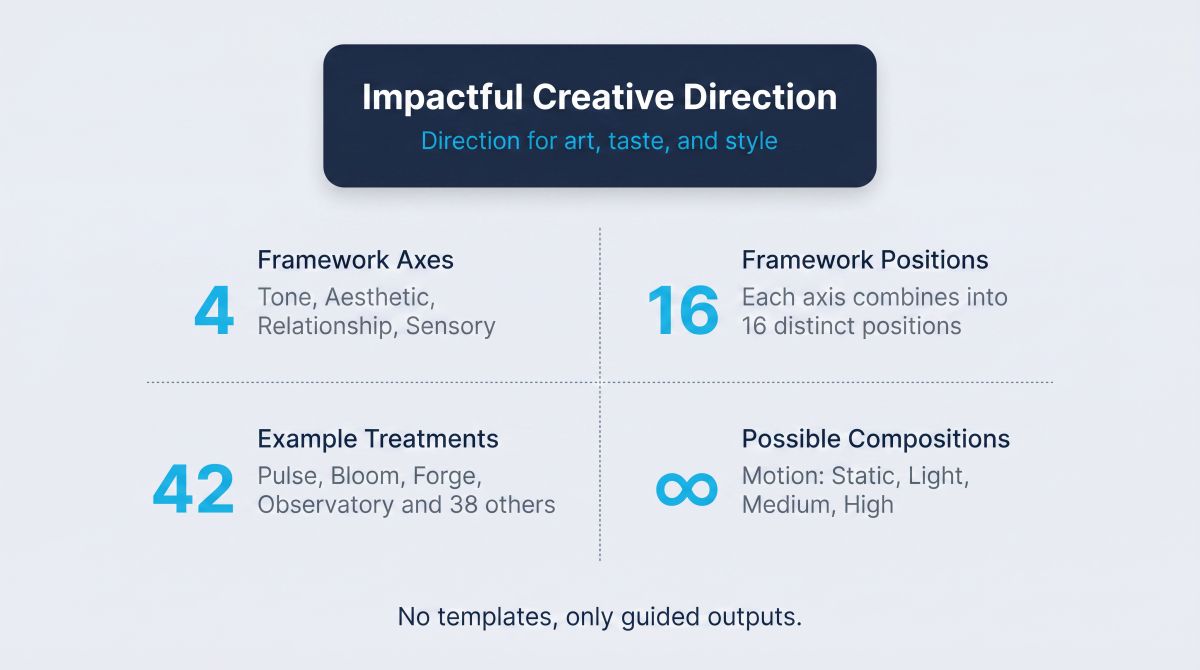
Forty-two fictional brands generated from briefs that all use the same skill. Each is a fully styled brand site, not a mockup. The showcase demonstrates what the four-axis framework produces in practice and lets you filter by axis position to see how each combination renders.
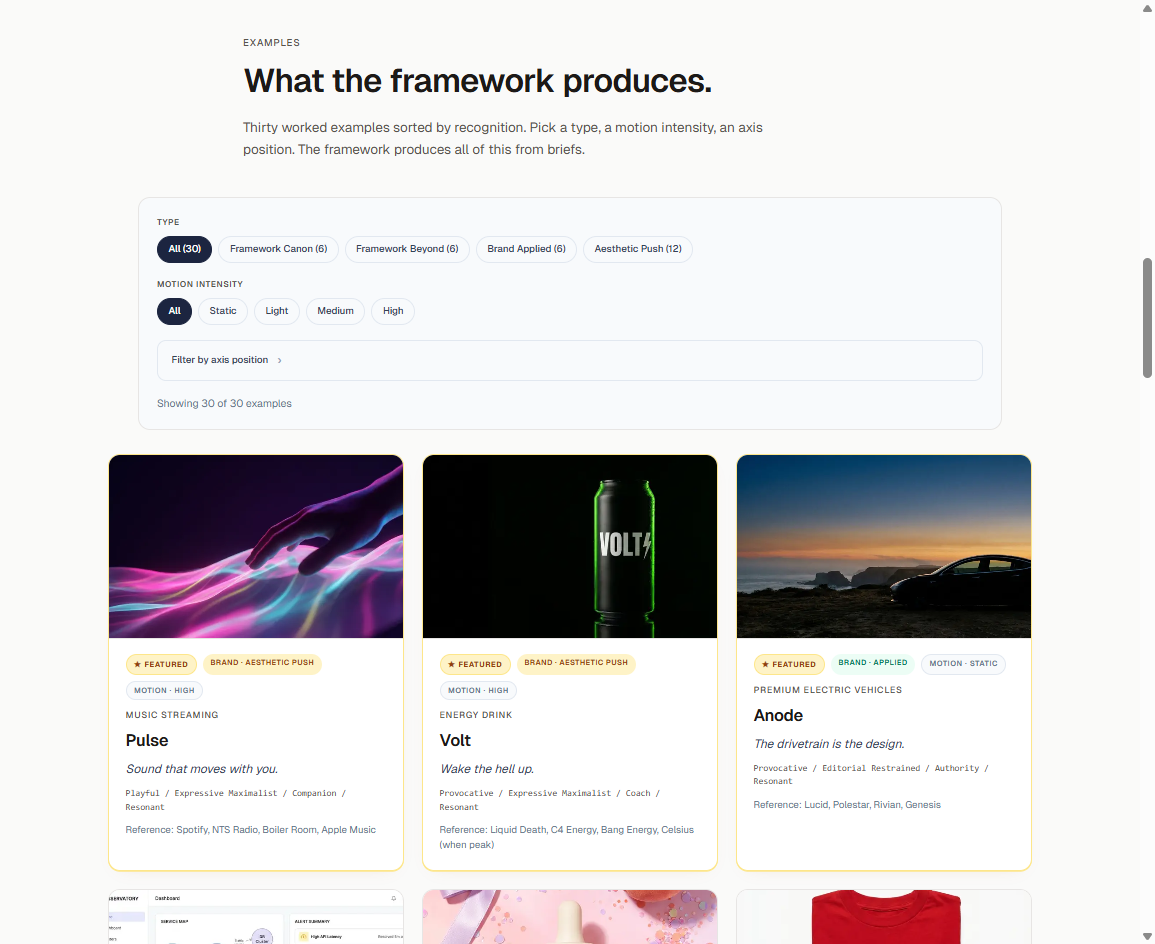
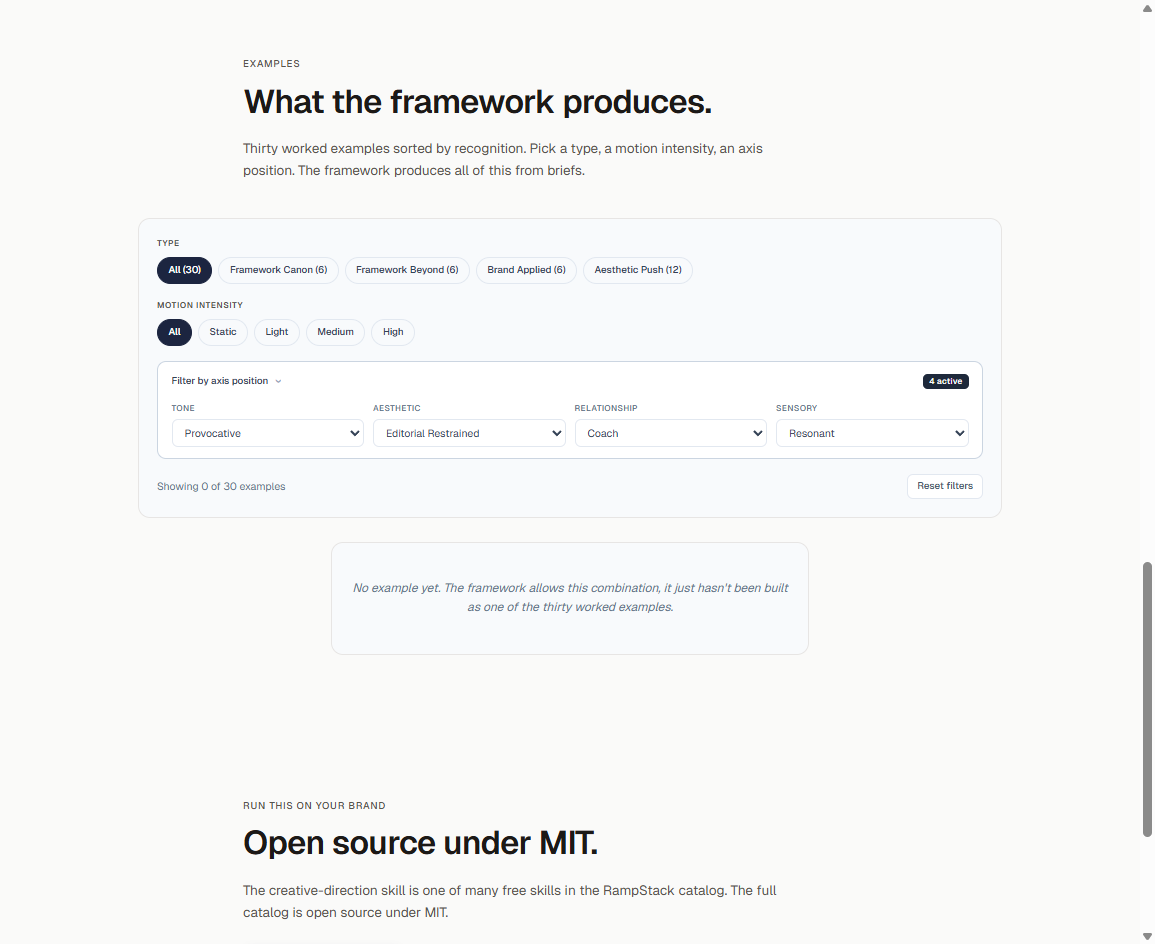
Filter by any axis position
The skill defines four axes: tone, aesthetic, relationship, sensory. The showcase lets you filter by any combination and see which examples match. Pre-filtered URLs deep-link from the SKILL.md and axes-explained reference, so you can read about a position and click straight through to the rendered examples.
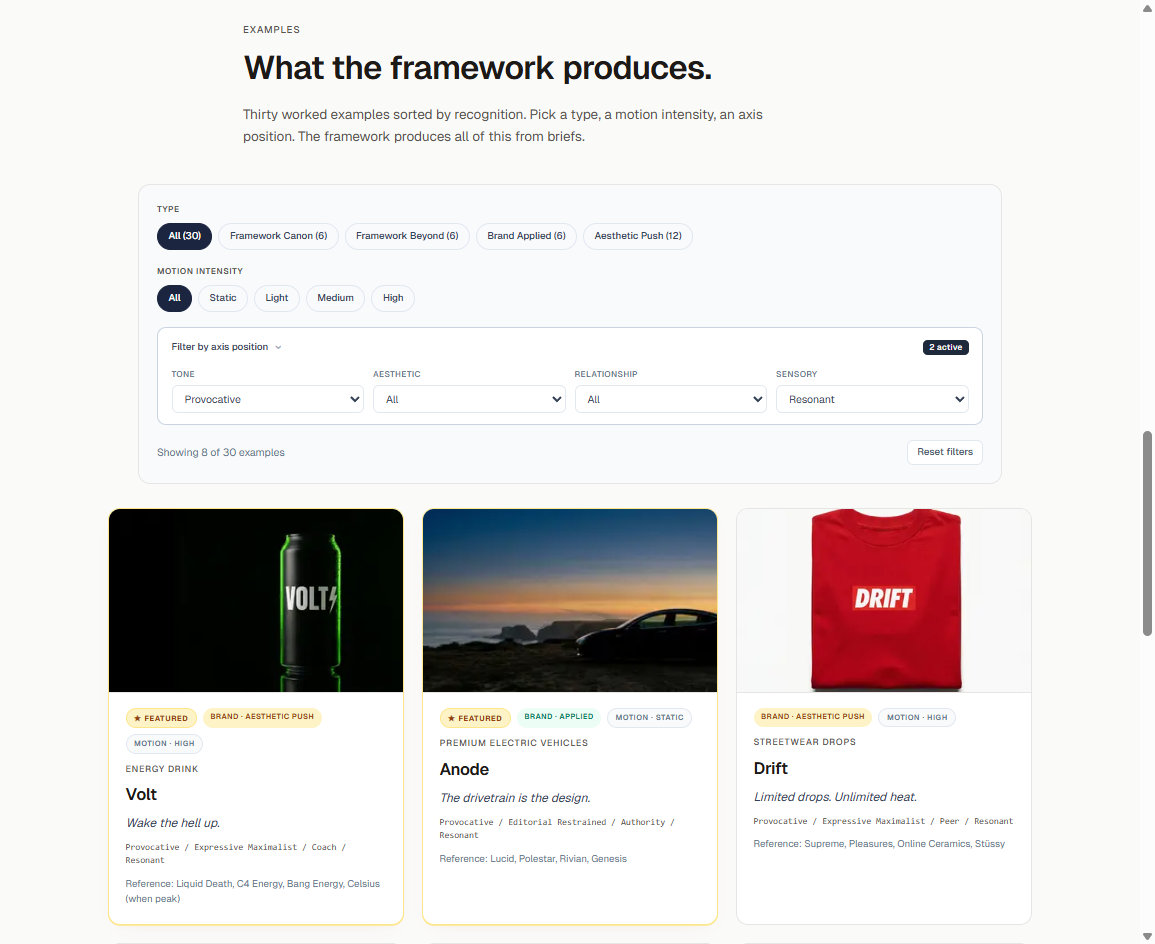
The empty state is the lesson
The framework is generative. The showcase is illustrative. Most rare-but-powerful combinations are valid creative choices that simply have not been built yet. Set Provocative + Editorial Restrained + Coach + Resonant and the grid is empty.
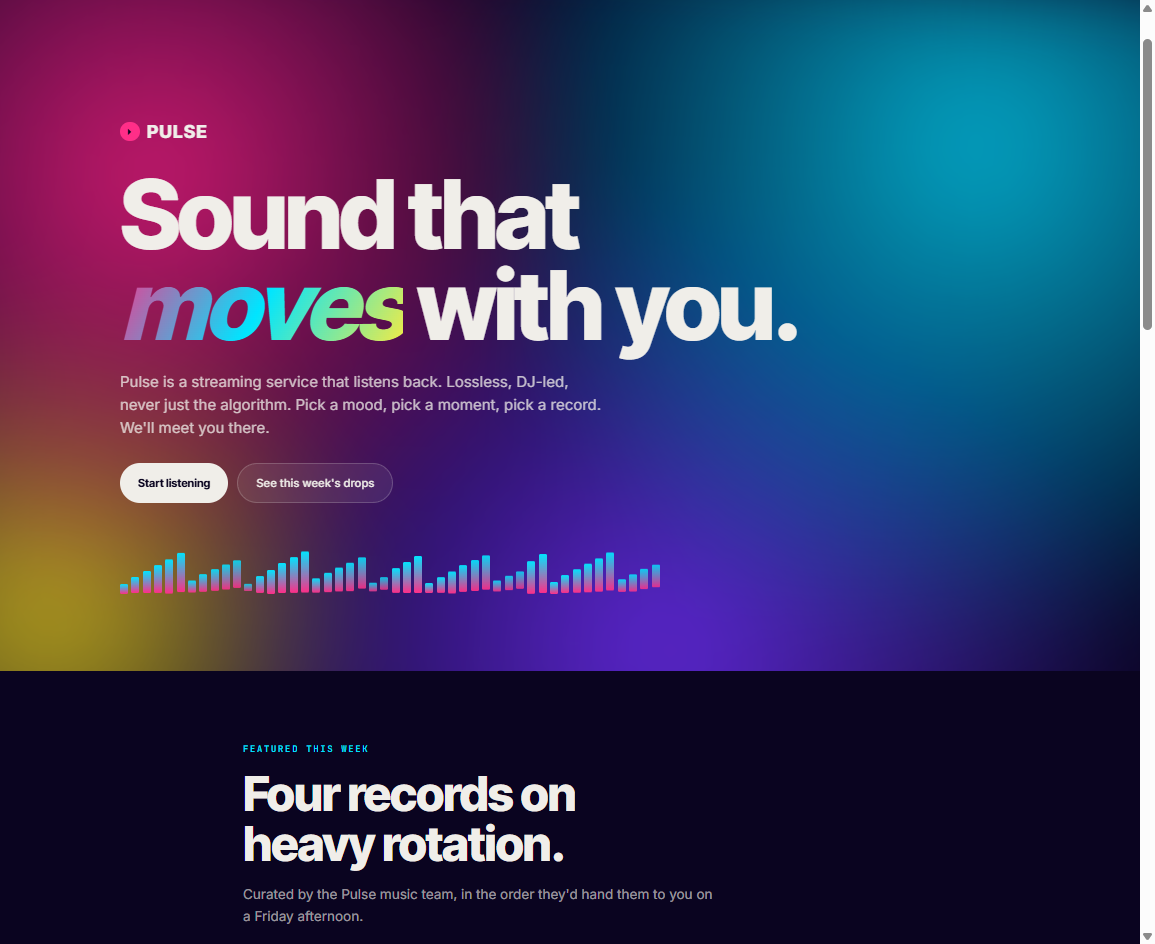
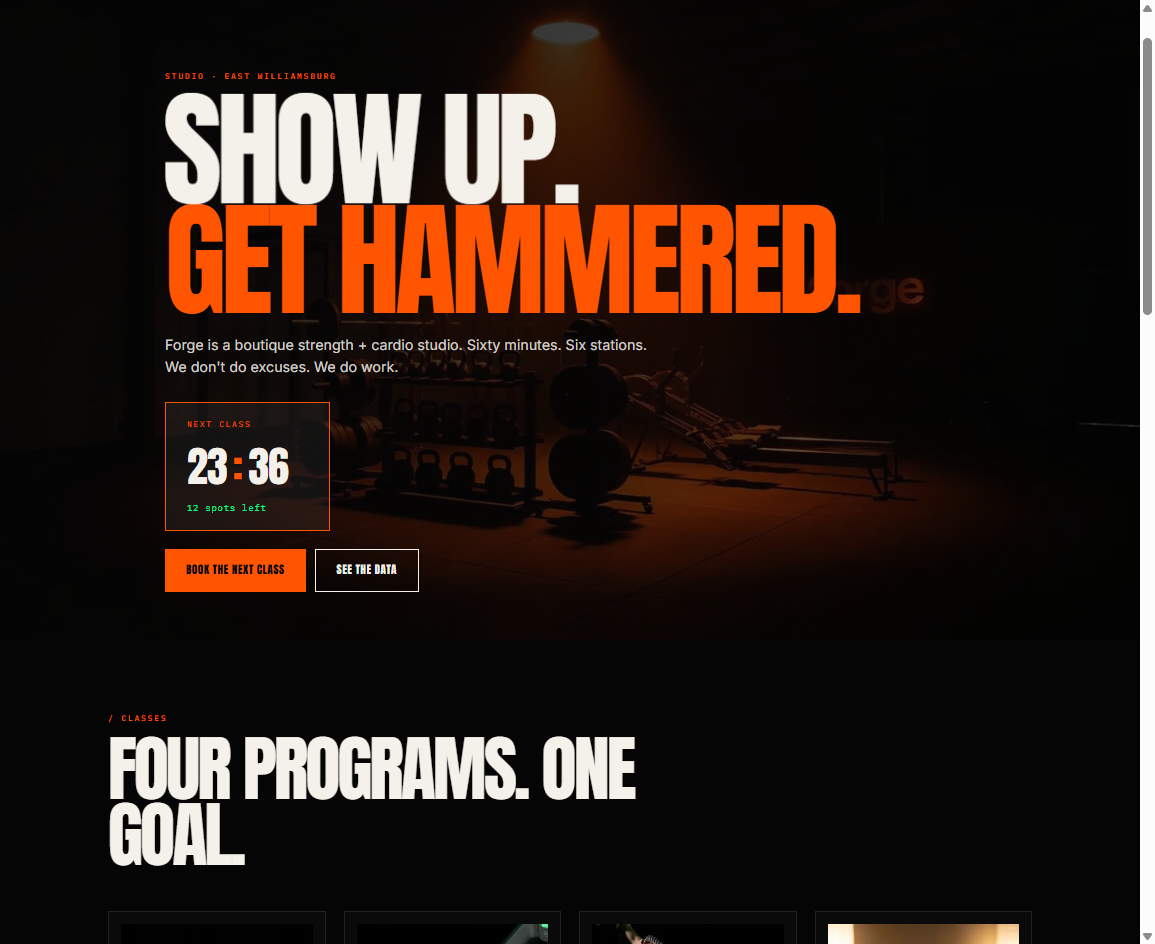
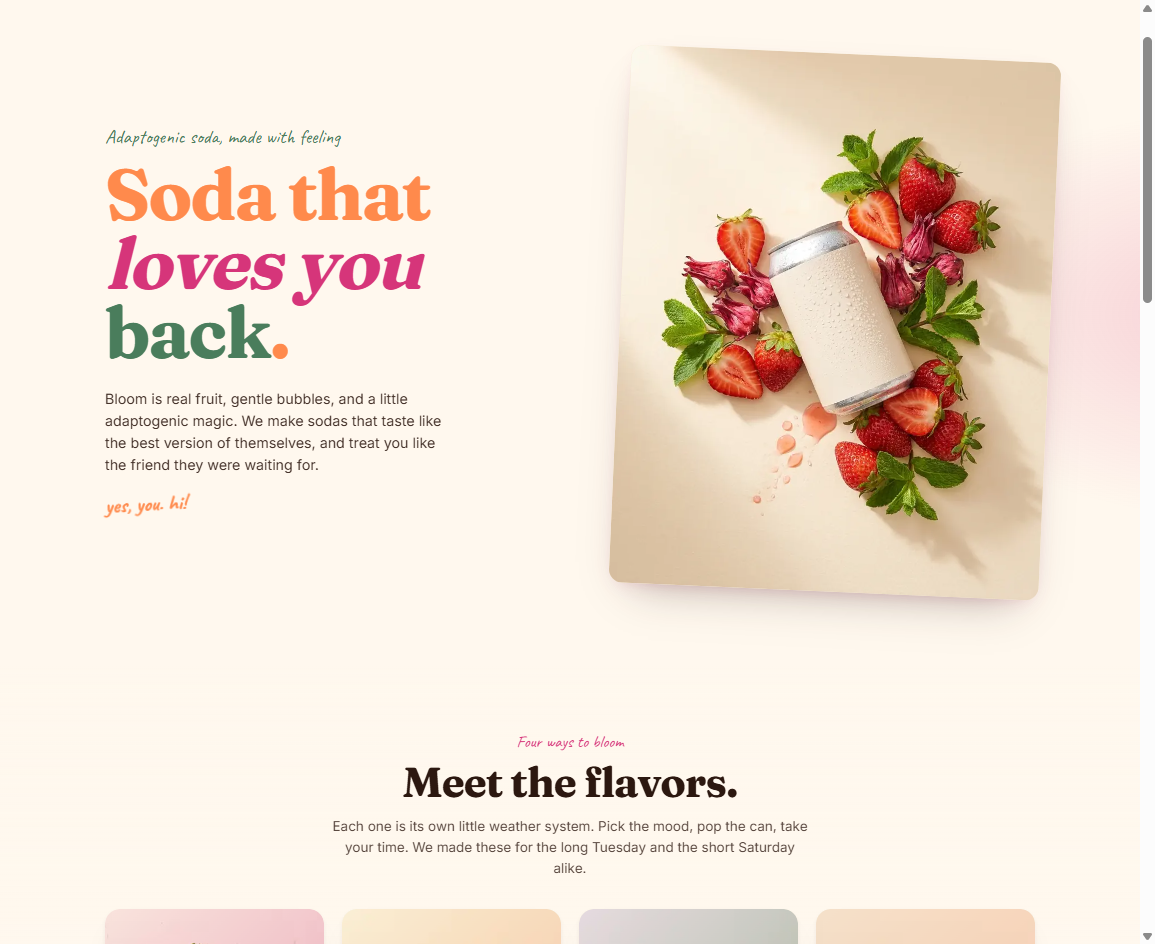
The framework's range
Same skill, same brief format. Four completely different visual systems. Notice that Pulse and Bloom share identical axis positions yet read as opposite visual languages. The reference brands and aesthetic interpretation do the rest.
 |
 |
| Pulse · music streaming Sound that moves with you. Playful / Expressive Maximalist / Companion / Resonant See Pulse demo example → |
Forge · boutique fitness Show up. Get hammered. Provocative / Expressive Maximalist / Coach / Resonant See Forge demo example → |
 |
 |
| Bloom · adaptogenic soda Soda that loves you back. Playful / Expressive Maximalist / Companion / Resonant See Bloom demo example → |
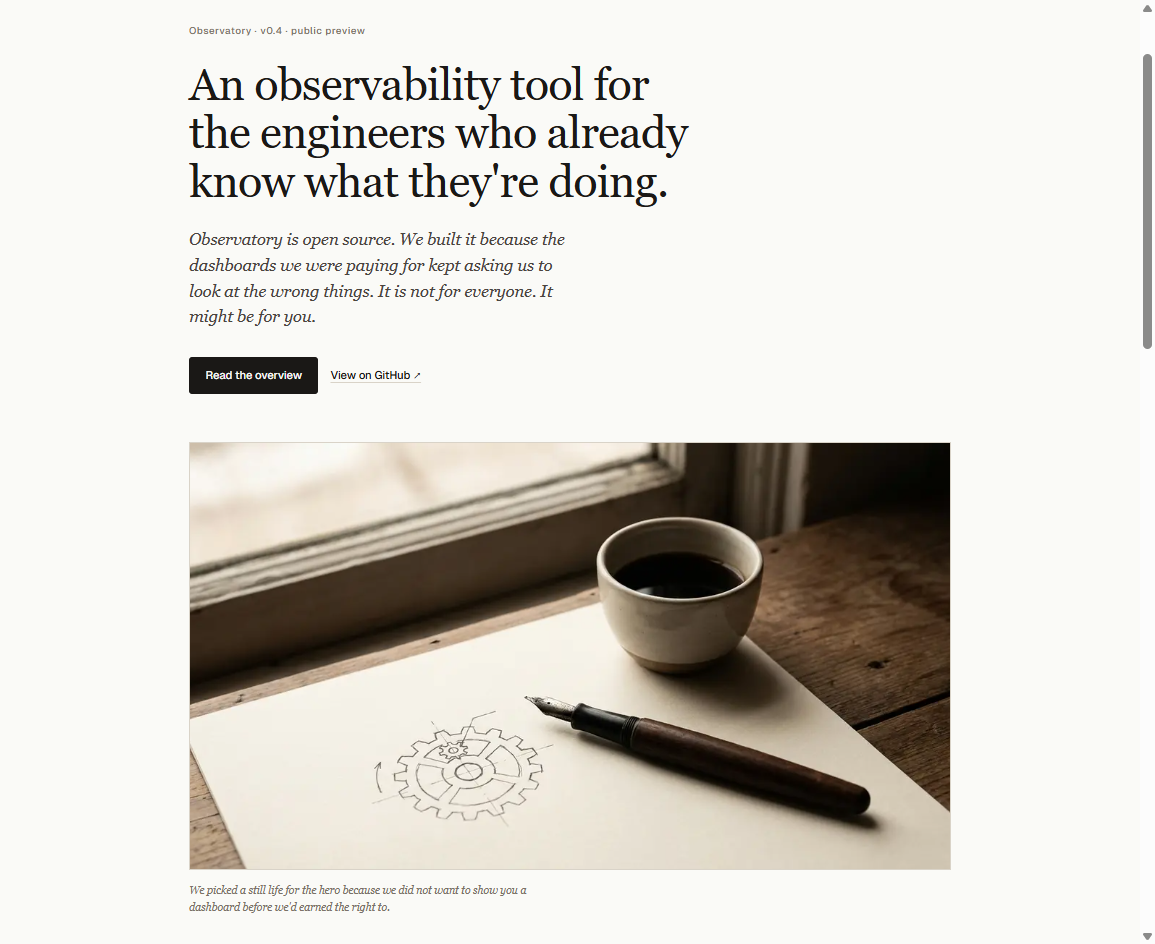
Observatory Editorial · observability tool An open-source tool that respects engineer time. Conversational / Editorial Restrained / Peer / Considered See Observatory demo example → |
See all the brands in the showcase →
Run this on your own brand
The creative-direction skill lives at skills/creative-direction/. Install it (see below), give Claude a project name and a few inspiration references, and the skill walks you through producing a brief that downstream skills can consume. The brand sites in the showcase were built from briefs of exactly that shape.
Logo design in action
The logo-design skill is rendered on rampstack.co as two parallel surfaces. The variant explorer goes deep on one brand at a time: a primary mark, variants across architectures, applied contexts. The taxonomy gallery goes wide across the architecture space: ten fictional marks demonstrating eight mark architectures (wordmark, lockup, monogram, letterform-as-symbol, abstract, pictorial, combination, emblem). Same skill, two different lenses.
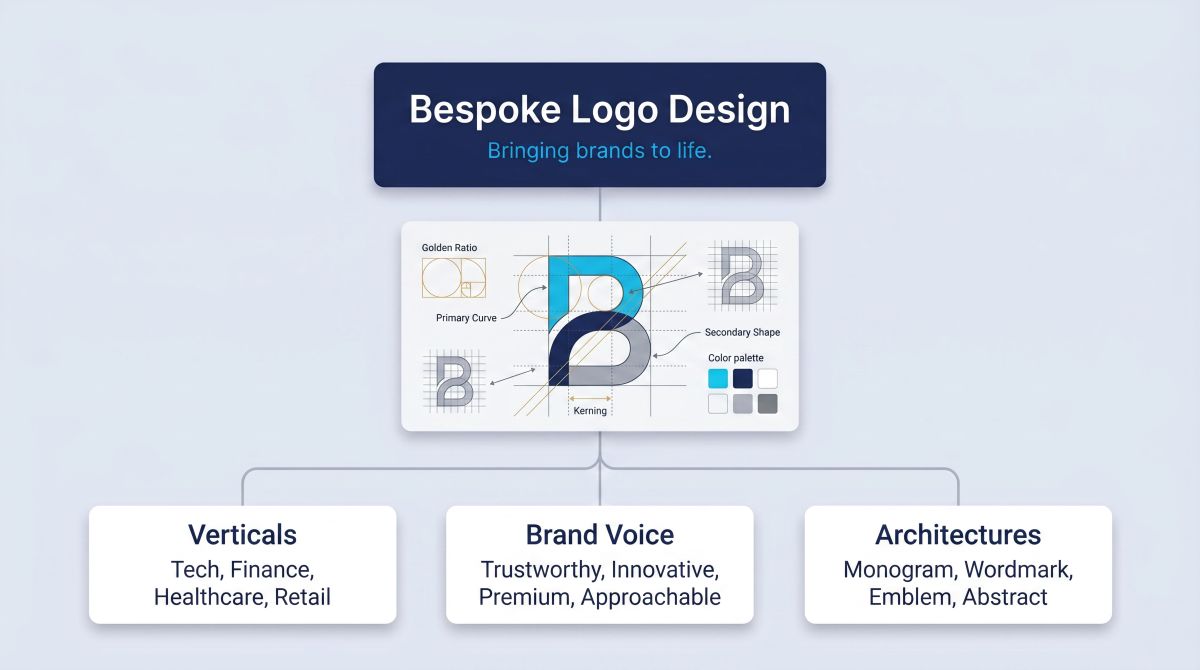
Per-brand depth
Each brand has a primary mark plus variants across architectures and applied contexts. The logo-design skill walks through the discipline of choosing one architecture and rendering it consistently across the system the brand will actually use.
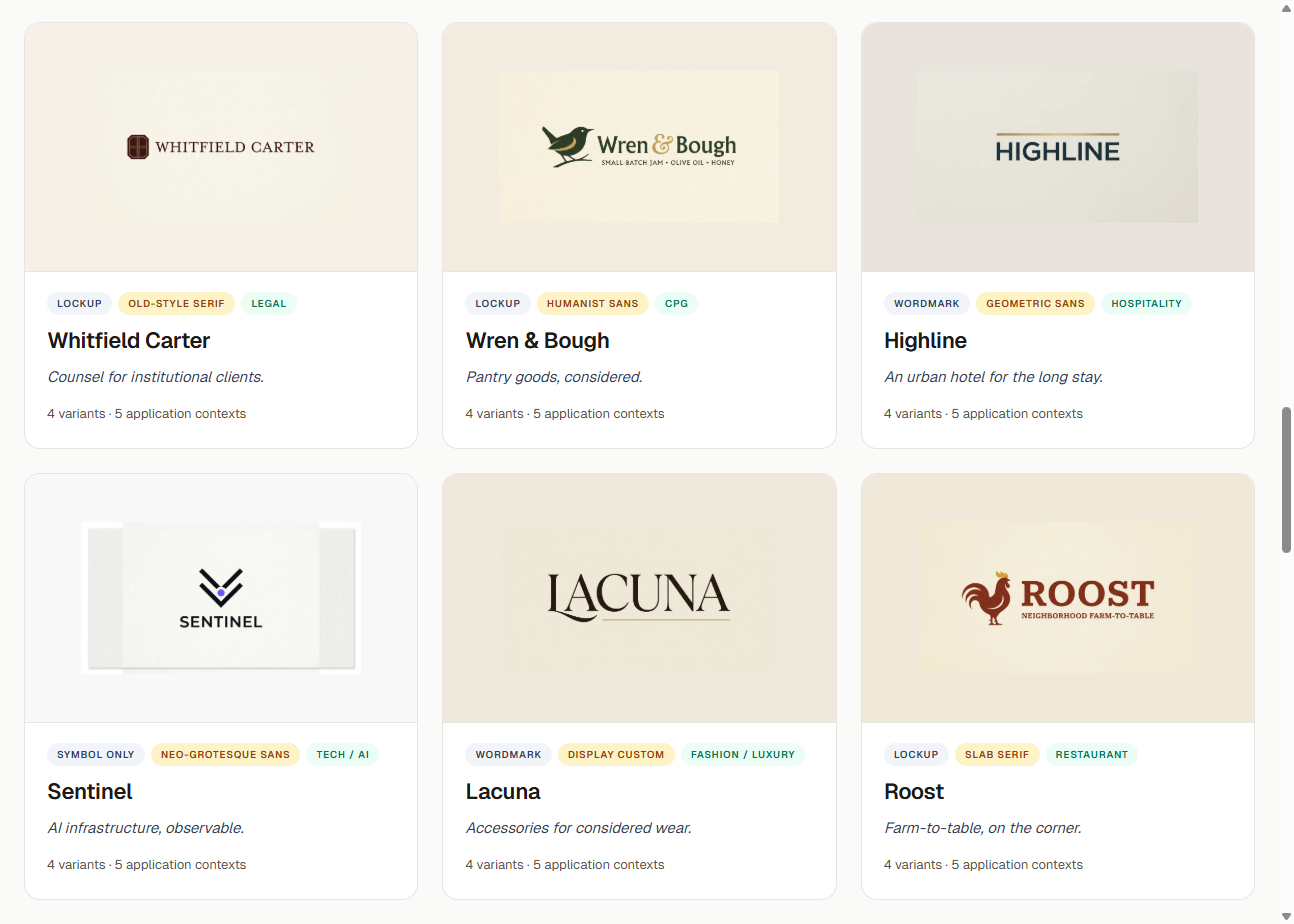
The brands are filterable by architecture, typographic register, and category. The intent is reference work, not consumable templates.
Architectural taxonomy
Ten fictional marks across eight mark architectures: wordmark, lockup, monogram, letterform-as-symbol, abstract, pictorial, combination, emblem. The taxonomy makes the architectural distinctions concrete by showing all eight side-by-side, with three wordmarks at three typographic registers so the architectural label does less work than the execution.
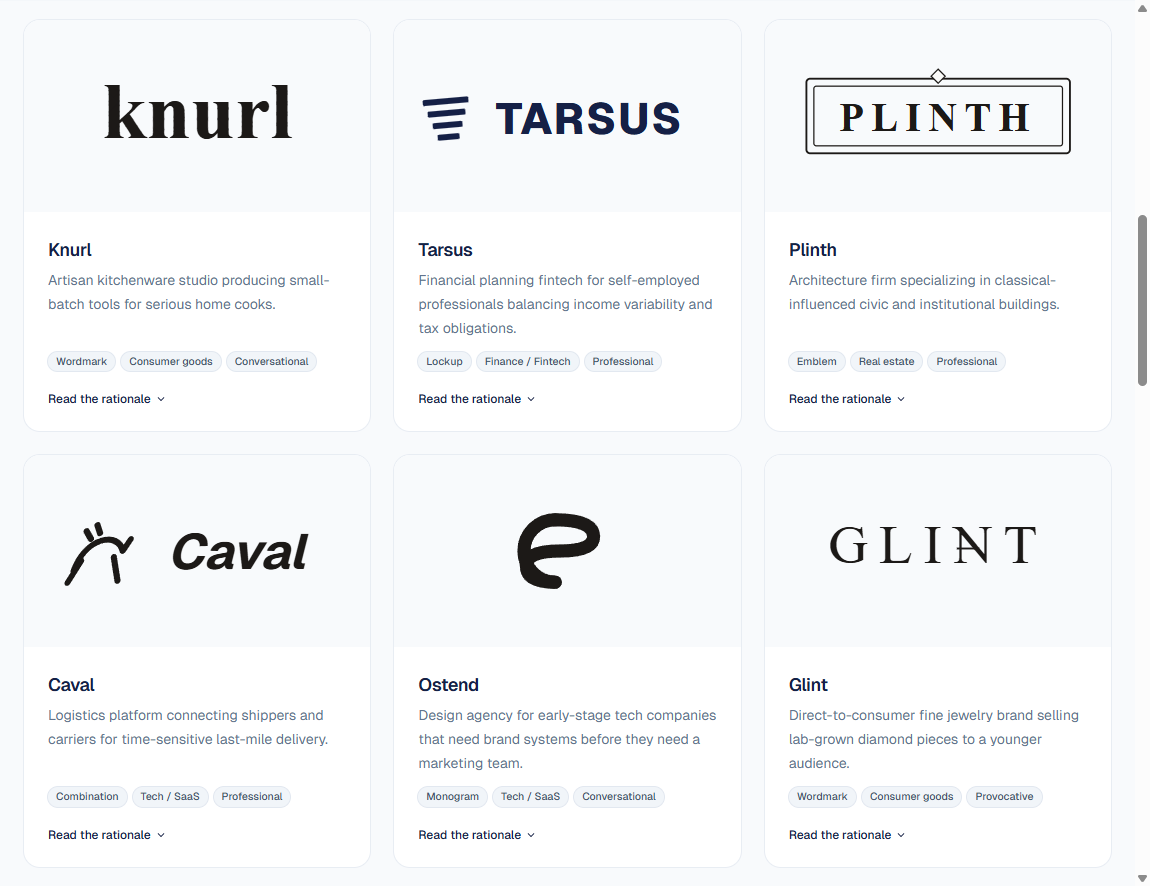
Filter by architecture, vertical, or brand voice; click any mark card to read its design rationale.
Reference build in action
The full catalog rendered as a 4-phase reference build: blank brief through deployed audited launch site. Threshold is a fictional PLG onboarding analytics product, but the research, brand foundations, build, and audit findings are all real. The reference build is the catalog's single strongest demonstration of how the skills compose end-to-end.
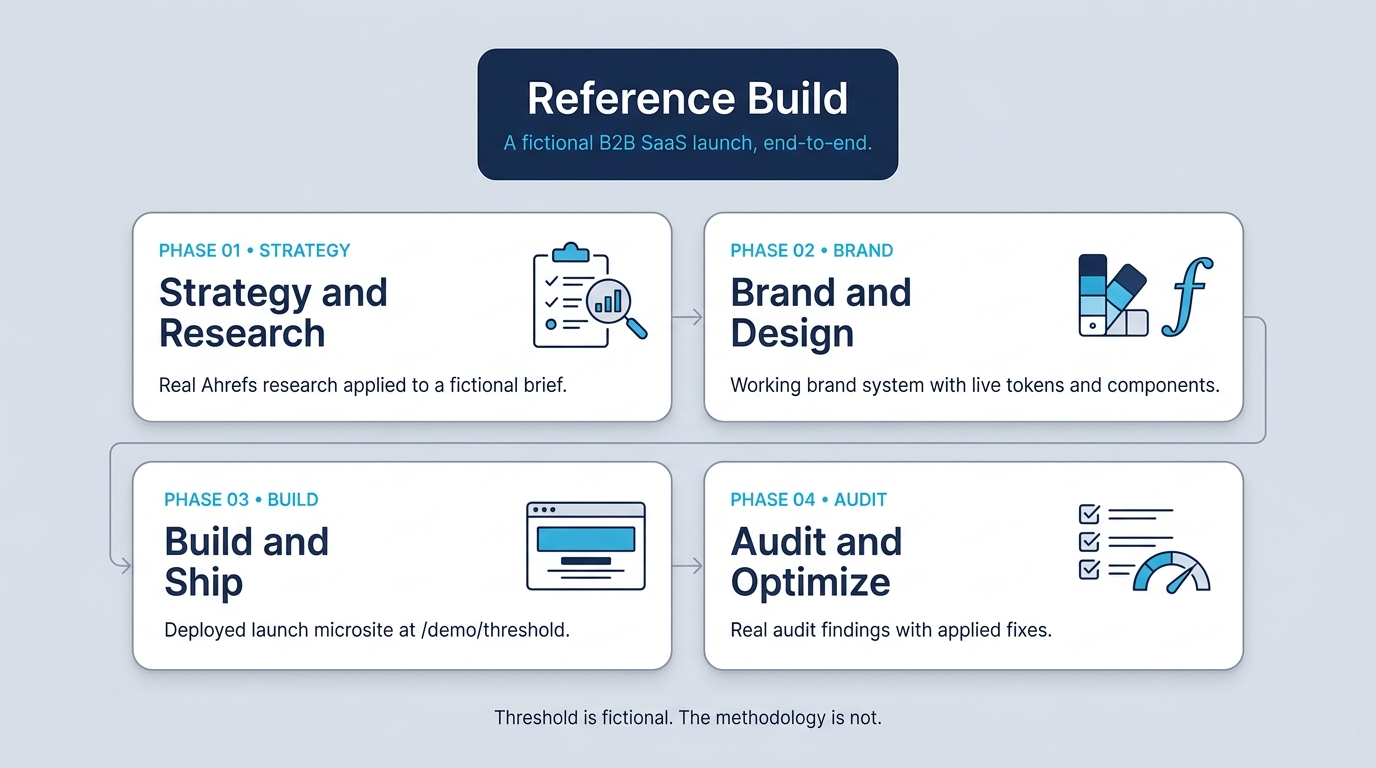
The four phases
Phase 1: Strategy and research → Real Ahrefs keyword research, competitor analysis, content gap audit, and backlink opportunity mapping applied to a fictional B2B SaaS brief. Live data tables sourced from the Ahrefs API.
Phase 2: Brand and design → Logo system, color and typography tokens, working brand component primitives. The brand system renders live on the walkthrough page in real fonts and tokens, not just described.
Phase 3: Build and ship → The actual launch microsite built with Next.js using Phase 2's brand foundations. Live at rampstack.co/demo/threshold. Persistent demonstration banner; noindex; local-only waitlist form.
Phase 4: Audit and optimize → Real audit on the deployed site using the catalog's audit suite (axe-core, Lighthouse, manual checks). Real findings with severity, real fixes applied, real before/after metrics. The closing chapter where the catalog audits its own output.
The deployed result
The four phases compose into a working microsite at rampstack.co/demo/threshold. Real Next.js code, real brand foundations from Phase 2 referenced via cross-route imports, real working multi-step waitlist form (no data stored), persistent demonstration banner, and the inline data visualizations that came out of the post-audit polish pass.
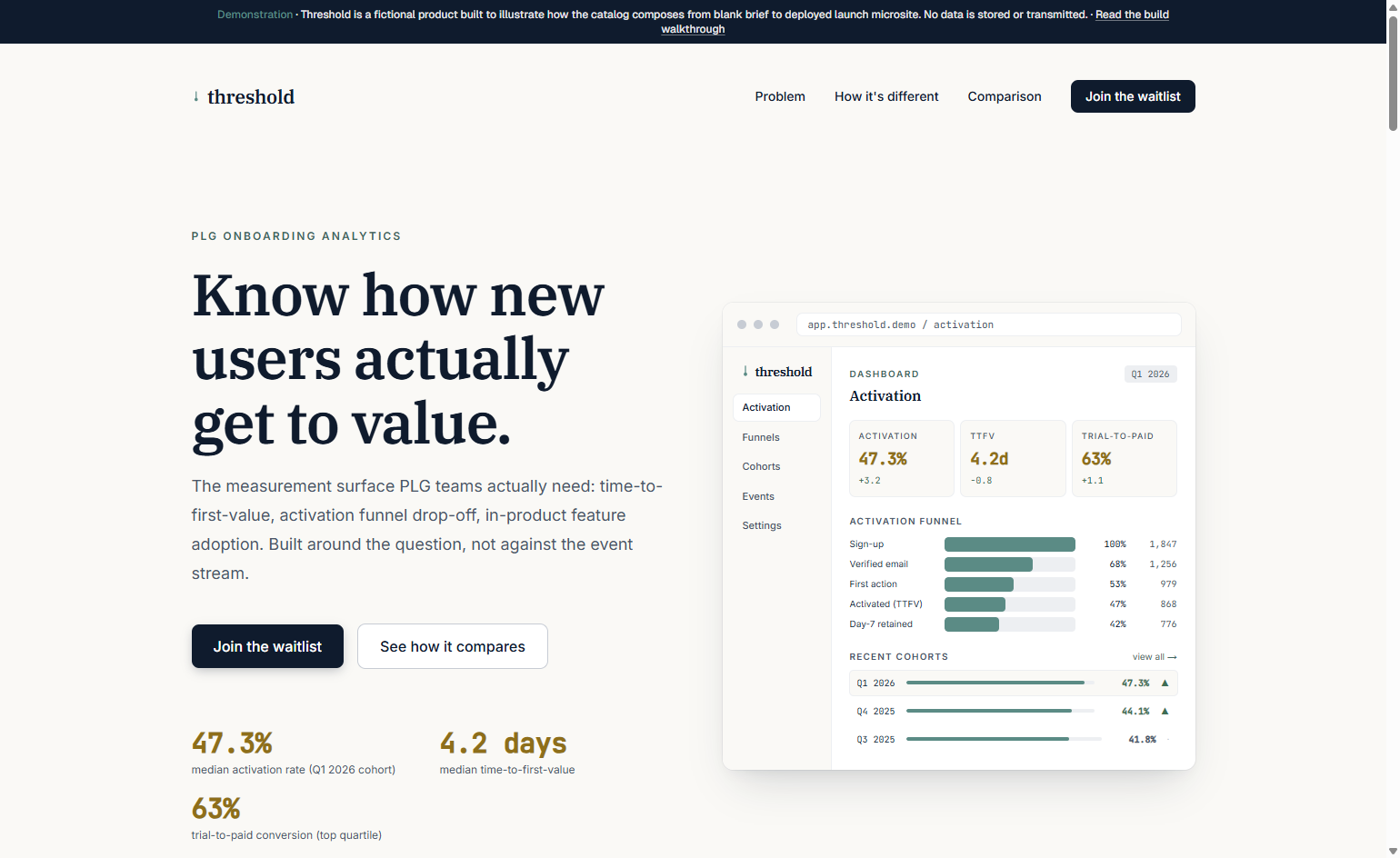
Why a fictional product
Real client work cannot be open-sourced; portfolio claims trigger conflict-of-interest concerns in interviews and consulting conversations. A fictional product with a documented brief plus real research, real brand foundations, real working code, and real audit findings produces a teaching artifact that demonstrates methodology without claiming relationships. Threshold is a measurement tool that does not exist; the methodology that built it is the catalog working end-to-end.
Getting started
Skills install in a different place for each platform. Pick the one that matches your workflow.
Option 1: Claude.ai (web and desktop)
If your Claude.ai plan supports custom Skills:
- Go to Settings → Capabilities → Skills.
- Upload the skill folder you want as a
.zip(one zip per skill folder containingSKILL.mdand thereferences/subfolder). - Enable the skill in the chat interface.
Claude will load the skill automatically when your request matches its description.
For current plan availability and the exact upload UI, see Anthropic's Skills user guide.
Option 2: Claude Code (recommended)
Skills are first-class citizens in Claude Code. Drop them into your skills directory and Claude Code picks them up automatically.
User-level skills (available in every project):
# macOS / Linux
mkdir -p ~/.claude/skills
cp -r skills/* ~/.claude/skills/

# Windows (PowerShell)
New-Item -ItemType Directory -Force -Path "$HOME\.claude\skills"
Copy-Item -Recurse skills\* "$HOME\.claude\skills\"
Project-level skills (available only in a specific project):
mkdir -p .claude/skills
cp -r path/to/this-repo/skills/* .claude/skills/
Start (or restart) Claude Code. Skills load automatically.
For exact current paths and config flags, see the Claude Code documentation.
Option 3: Anthropic API
Use Skills programmatically by referencing them in your API calls. Skills must first be uploaded to your workspace (via the Console or API), then referenced by ID when creating messages.
For the current API surface, request format, and limits, see the Agent Skills API documentation.
Option 4: pi and Codex
Prebuilt distributions install the catalog into a project's .agents/skills folder for two agents outside Claude:
- pi:
dist/pi/README.md - Codex:
dist/codex/README.md
Want only a few skills?
You do not have to install all of them. Pick the categories that match your work. The library is modular: each skill stands on its own.
Quick example
Once installed, skills trigger automatically based on your request. You do not have to name the skill or change how you talk to Claude.
You ask:
"Our organic traffic dropped 30% last week. Help me figure out why."
What happens:
Claude recognizes the request matches seo-traffic-diagnosis, loads the skill, and walks through its 5-layer root cause framework: confirm the change is real → localize the change → page-level analysis → technical analysis → external analysis. By the end, you have a hypothesis statement, evidence, and an action plan, structured the same way every time.
Other natural triggers:
- "Help me write a creative brief" →
creative-brief - "Audit my homepage for SEO" →
seo-onpage - "We need a backlink audit" →
seo-backlink-audit - "Plan our content roadmap for Q3" →
seo-content-gap-auditpluscontent-strategy - "Postmortem template for last night's incident" →
after-action-report - "How do I write my own skill?" →
skill-creation-walkthrough
You can also call a skill explicitly: "Use the seo-audit-orchestration skill to run a full audit on example.com."
How they compose
The skills compose into a full project flow:
brand-discovery → brand-ideation → brand-identity → brand-style-guide → brand-voice
                                                                        ↓
creative-brief → information-architecture → content-strategy → design-system
                                                              ↓
seo-keyword → seo-content-audit → content-and-copy → landing-page-copy
                                                    ↓
seo-onpage → seo-technical → seo-aeo-geo → seo-offpage → seo-competitor
                                          ↓
frontend-component-build → accessibility-audit → performance-optimization
                                                ↓
code-review-web → qa-testing → security-baseline → launch-runbook
                                                  ↓
domain-strategy → monitoring-and-alerting → backup-and-disaster-recovery
                                          ↓
incident-response → after-action-report
                  ↓
analytics-strategy → cro-optimization → ux-research → usability-testing → journey-mapping
The SEO audit suite (Ahrefs MCP-powered) wraps around the SEO foundation skills:
seo-audit-orchestration
  ├── seo-site-health-audit
  ├── seo-backlink-audit
  ├── seo-keyword-gap-audit
  ├── seo-content-gap-audit
  ├── seo-traffic-diagnosis  (also runs standalone for incident-style work)
  └── seo-rank-tracking      (ongoing, feeds the others)
The catalog also includes four audience tracks that compose alongside the foundational lifecycle. Each track has its own internal flow:
Paid media (Marketing track):
paid-media-strategy → ads-creative-development → ads-performance-analytics
Pairs with the paid media platforms in the integrations catalog at rampstack.co (Google Ads, Meta, LinkedIn, TikTok, plus Synter as the multi-platform aggregator).
Growth tooling (interactive web tools):
funnel-flow-architecture (orchestrator)
  ├── lead-magnet-design          (capture)
  ├── calculator-design           (capture / activate)
  ├── quiz-and-assessment-design  (capture / activate)
  ├── multi-step-form-design      (activate)
  ├── chatbot-flow-design         (activate)
  ├── onboarding-wizard-design    (activate)
  ├── interactive-product-tour    (activate / convert)
  ├── upgrade-flow-design         (convert)
  ├── scheduler-and-booking-design (convert)
  ├── comparison-tool-design      (convert)
  └── product-configurator-design (convert)
funnel-flow-architecture is the orchestrator: it sequences which interactive tool fits each audience and funnel stage, distinguishing matched-funnels from kitchen-sink-funnels.
Tier 2 content lifecycle:
content-strategy → pillar-content-architecture → content-brief-authoring
                                                ↓
              content-and-copy / long-form-content-frameworks / email-sequences
                                                ↓
                       editorial-qa → content-distribution → programmatic-seo
                                                ↓
              content-refresh-system → content-repurposing → content-migration
ai-content-collaboration is a workflow layer that runs across every phase rather than a single step. documentation-strategy operates continuously alongside the rest.
Tier 2 product management (two parallel tracks):
Experimentation track:
experiment-design → feature-flagging → experimentation-platform-orchestrator
                                     ↓
                         experimentation-analytics → data-warehouse-experimentation

Gap-closing track:
pm-spec-writing → roadmap-planning → feature-launch-playbook
                                   ↓
       beta-program-management → product-analytics-setup → integration-orchestrator
The experimentation track ships changes with statistical discipline; the gap-closing track ships features with operational discipline. Both compose with the foundational lifecycle above.
Operations, cross-cutting, and team skills (stakeholder-communication, documentation-strategy, vendor-evaluation, team-onboarding-playbook, dependency-management, cost-optimization, etc.) cut across every track.
You can also pull individual skills for one-off work. Need just a backlink audit? Use seo-backlink-audit. Need to write a creative brief? Use creative-brief. Each skill stands on its own.
How the catalog connects
The skills compose with the tools your team already uses. The catalog sits at the center; 35 integrations across 6 integration categories radiating out via MCPs.

Surfaces
This catalog is the open-source methodology layer. Commercial surfaces at rampstack.co extend it:
- Skills directory. Every skill on a curated landing surface with audience tracks, search, and category navigation.
- Walkthroughs. Multi-skill recipes that orchestrate skill clusters end-to-end. Use these when one skill is not enough and a packaged sequence is.
- Integrations directory. Curated MCPs, APIs, and tooling that the skills hook into.
- Showcase. Real brand sites built from these skills, with the brief that produced each one.
The skills in this repository remain free, open-source, and stack-agnostic. The surfaces above are how the same methodology is delivered as a product.
Design principles
claude-skills follows the Agent Skills Specification, the open standard for portable AI agent skills originally developed by Anthropic and adopted across the AI tooling ecosystem (Claude Code, OpenAI Codex, Gemini CLI, GitHub Copilot, Cursor, VS Code, Goose, Spring AI, and 30+ other platforms as of early 2026).
Beyond the format itself, the catalog is designed around three principles aligned with the guidance Anthropic publishes in Building effective agents:
Simplicity. Each skill covers one focused capability rather than trying to be a multi-purpose document. A roadmap-planning skill plans roadmaps. A keyword-research skill researches keywords. Composing them together produces complex workflows; mixing them inside one skill produces unreliable ones.
Transparency. Every skill declares its scope, dependencies, and expected behavior in machine-readable YAML frontmatter. The catalog is inspectable by tooling, not just by humans reading prose.
Quality contracts via tooling. Structural and content quality is enforced through automated checks (run python .github/scripts/lint_skills.py) rather than convention alone. Every skill is validated against a schema. Every catalog change is validated in CI.
Skills in this catalog are designed to compose into the common agentic workflow patterns Anthropic documents: prompt chaining (sequential steps), routing (classify and direct), parallelization (sectioning or voting), orchestrator-workers (dynamic delegation), and evaluator-optimizer (iterative refinement).
Because the catalog conforms to the open Agent Skills standard, skills work across any platform supporting the specification without modification.
Family repos
claude-skills is the parent catalog. Curated subsets and companion repos focus on specific specialties:
| Repo | Focus |
|---|---|
| claude-skills | Full catalog (you are here) |
| claude-skills-starter | General-purpose lite |
| claude-skills-seo | SEO consulting |
| claude-skills-pm | Product management |
| claude-skills-widgets | UI patterns + components |
| awesome-claude-skills | Curated discovery list |
Each family repo is MIT-licensed, conforms to the Agent Skills Specification, and is stack-agnostic. Use the full catalog for breadth; use a specialty subset when working in one domain.
How this org fits together
The table above covers the skill catalogs. They are one part of a larger set, and the rest of it is below. All of it is public.
Skills. This repo is the canonical home for all skill content. Alongside it sits the workflows tier: fifteen multi-skill runbooks with their connectors, a getting-started guide, and published run records for the ones that have been executed as written.
Subsets. The five curated repos in the table above copy from this catalog with attribution and track it upstream.
Design direction themes. Thirteen sibling repos, each shipping annotated design tokens with their measured contrast ratios, a component layer, two Tailwind adapters, and a demo that opens from a file with nothing installed. They come in three artifact classes: seven surface registers, one layout archetype, and five shells, which ship a structure a site lives inside (a window manager or a board, a taskbar or a dock, an enhancement contract and a focus model) with the register they wear left swappable. VivaOcean, the animated-scene shell, is the showcase flagship. What the shell class settled, and why, is public in its class decision log, which every new shell reads first and continues. All thirteen are linked from the gallery at rampstack.co/themes.
Creative direction. The themes are not thirteen moods. Each one states its coordinates in the creative direction framework, which sets brand direction on four axes, and the showcase renders archetypes at each position on it.
Engines. Krine, Tholo, and Basano run on one runtime: Krine decides, Tholo builds, Basano proves. The engines page covers what the three share.
Research. The SERP event registry
…
Releases