
- Stars
- 2.6k
- This week
- —
- Forks
- 426
- Open issues
- 7
- Skills inside
- 181
Get started
Install the skills
npx skills add cbrock84/headcountInstalls into Claude Code, Codex, Cursor, OpenCode and the other agents it finds on your machine.
/plugin marketplace add cbrock84/headcount
/plugin install security@headcountRun inside Claude Code, then pick what to install from /plugin.
git clone --depth 1 https://github.com/cbrock84/headcount.git /tmp/headcount
cp -r /tmp/headcount ~/.claude/skills/headcountClaude Code reads ~/.claude/skills/ (or .claude/skills/ in a project). Other agents read the same SKILL.md format from their own skills folder.
Inside this repo
48 of 181 skills
plugins/corporate-strategy/skills/chief-strategy-officermarket-entryDecides whether and how to enter a new market — sizing demand from the bottom up rather than from a market report, testing whether your advantage transfers, choosing between organic entry, partnership and acquisition, sequencing the operational and regulatory work that entry actually requires, and splugins/corporate-strategy/skills/market-entrymergers-and-acquisitionsRuns corporate development — deal thesis, target screening, valuation framing, diligence, and integration planning. Use this when considering an acquisition or being approached about one, when evaluating build-versus-buy at company scale, when running or reviewing diligence, or when planning how an plugins/corporate-strategy/skills/mergers-and-acquisitionsportfolio-strategyDecides where capital and attention go across business lines, products, and markets — what to fund, hold, harvest, or exit, and on what evidence. Use this to allocate budget across businesses, evaluate whether a product line should continue, decide whether to exit one, structure a portfolio review, plugins/corporate-strategy/skills/portfolio-strategyscenario-planningPlans under genuine uncertainty — building scenarios, identifying which assumptions are load-bearing, setting early-warning indicators, and stress-testing a plan against futures rather than forecasting one. Use this when a decision depends on something unknowable, when a plan assumes conditions thatplugins/corporate-strategy/skills/scenario-planningstrategic-alliancesStructures partnerships that change what the business can do — technology integrations, channel and reseller arrangements, joint ventures, and OEM relationships. Use this to evaluate or structure a strategic partnership, decide between partnering and building, negotiate commercial terms of an allianplugins/corporate-strategy/skills/strategic-allianceschief-customer-officerOwns the customer's experience after the sale — support, success, escalation, and the feedback loop back into product. Use this for a decision spanning support and product, when service quality and cost are in tension, when deciding what to staff or automate, when a customer relationship is at risk plugins/customer-experience/skills/chief-customer-officercustomer-onboarding-and-implementationTakes a new customer from signature to working — setting a definition of live that both sides agreed before the contract was signed, planning and staffing the implementation, running data migration and integration realistically, training the people who will actually use it, and handing over to the oplugins/customer-experience/skills/customer-onboarding-and-implementationcustomer-success-managementRuns the ongoing relationship with accounts after the sale — segmenting coverage against account value, building a health score that predicts rather than describes, running reviews customers find worth attending, forecasting renewals honestly, and finding expansion that follows usage instead of quotplugins/customer-experience/skills/customer-success-managementescalation-managementHandles customer situations that have exceeded normal support — severity assessment, incident communication, executive escalation, and recovering a relationship after a failure. Use this when a customer issue is escalating or has gone to leadership, during a customer-affecting outage, when a major aplugins/customer-experience/skills/escalation-managementself-service-and-knowledgeBuilds the help center, in-product guidance, and knowledge base that let customers resolve problems without contacting anyone — content, findability, maintenance, and deflection measurement. Use this to build or fix a help center, reduce support volume, write documentation for customers, improve finplugins/customer-experience/skills/self-service-and-knowledgesupport-operationsDesigns and runs the support function — channels, queues, routing, staffing, service levels, quality, and the metrics that show whether it is working. Use this to set up or fix support operations, choose channels, size a team, set or renegotiate service levels, reduce cost per contact, diagnose longplugins/customer-experience/skills/support-operationsvoice-of-customerBuilds the loop from what customers say to what gets changed — collecting feedback, distinguishing signal from noise, routing it to owners, and closing the loop back to the customer. Use this to set up a feedback program, design or interpret CSAT/NPS, decide what customer feedback deserves action, gplugins/customer-experience/skills/voice-of-customerai-ml-governanceGoverns models and AI systems in production — intended use, evaluation, monitoring, human oversight, documentation, and the decision to deploy or retire. Use this before deploying a model or AI feature, when defining evaluation criteria, when a model's behavior has drifted, when assessing AI risk orplugins/data-analytics/skills/ai-ml-governancebusiness-intelligenceBuilds reporting and self-serve analytics that people actually use — metric trees, dashboard design, distribution, and the discipline that stops dashboards proliferating. Use this to build a dashboard or report, design a metrics framework, set up self-serve analytics, decide what to measure, or diagplugins/data-analytics/skills/business-intelligencechief-data-officerOwns data as an asset — governance, quality, the warehouse and semantic layer, analytics capability, and the governance of models built on top. Use this for a decision about how data is collected, stored, defined, or shared; when numbers disagree between teams; when deciding what to build in-house vplugins/data-analytics/skills/chief-data-officerdata-engineeringBuilds and operates data pipelines — ingestion, transformation, orchestration, quality testing, and reliability of data delivery. Use this to design or debug a pipeline, decide batch versus streaming, add data quality checks, handle late or duplicate data, or work out why a dashboard's numbers changplugins/data-analytics/skills/data-engineeringdata-governanceEstablishes ownership, definitions, quality, access, and lineage for the organization's data. Use this when metrics disagree between teams, when nobody knows which dataset is authoritative, when setting up data ownership or access policy, when data quality is unreliable, or before opening a dataset plugins/data-analytics/skills/data-governancedata-modelingDesigns the warehouse and semantic layer — source-to-mart structure, dimensional modeling, grain, slowly changing dimensions, and the metric layer analytics reads through. Use this to design or restructure a warehouse, model a new source, decide on grain or table structure, build a semantic or metriplugins/data-analytics/skills/data-modelingquantitative-analysisAnswers a business question with data without fooling yourself — framing the question so an answer would change something, choosing the right comparison, checking the data before trusting it, recognizing the traps that produce confident wrong answers (aggregation reversals, survivorship, regression plugins/data-analytics/skills/quantitative-analysisaccount-based-marketingConcentrates marketing and sales effort on a named set of accounts rather than on volume — qualifying whether the model fits your economics at all, building the account list and the buying group inside each, tiering effort against account value, coordinating so the account experiences one campaign rplugins/demand-generation/skills/account-based-marketingai-search-optimizationOptimizes for AI assistants and AI-generated answers — being retrievable, being cited, and being represented accurately when a model answers on your behalf. Use this when traffic is shifting from links to AI answers, when a brand is misrepresented or absent in AI responses, when planning content forplugins/demand-generation/skills/ai-search-optimizationapp-store-optimizationImproves visibility and conversion in the App Store and Google Play — metadata, keywords, screenshots, ratings, and the listing experience that turns an impression into an install. Use this to audit or optimize an app listing, plan a launch listing, diagnose poor install conversion, or improve storeplugins/demand-generation/skills/app-store-optimizationexperimentationDesigns, runs, and reads A/B tests and growth experiments — hypothesis, sample size, duration, and honest interpretation. Use this to plan a test, judge whether a result is real, build an experimentation program, decide what to test next, or diagnose why tests keep producing inconclusive or non-replplugins/demand-generation/skills/experimentationlanding-page-cro-expertAudits and rewrites landing pages, homepages, and sales pages to increase conversion — diagnosing why a page is not converting, rewriting headlines, hero copy and calls to action, and prioritizing which changes to test first. Use this when a page underperforms, when someone pastes a URL or screenshoplugins/demand-generation/skills/landing-page-cro-expertlead-captureConverts anonymous traffic into known contacts — lead magnets, gated content, free tools, popups, and the forms behind them. Use this to design or improve a lead magnet, plan a free tool, add or fix popups and overlays, improve form conversion, or decide what is worth gating and what should stay opeplugins/demand-generation/skills/lead-capturelifecycle-messagingDesigns automated email and SMS programs — welcome and onboarding sequences, nurture, re-engagement, transactional messaging, and the timing and segmentation behind them. Use this to build or fix an email sequence, plan lifecycle automation, improve open or click performance, set up SMS flows, or deplugins/demand-generation/skills/lifecycle-messaginglisting-distributionGets a product listed where buyers and crawlers look — directories, marketplaces, review sites, comparison pages, and aggregators. Use this to plan a submission push, choose which directories are worth the effort, prepare listing assets, build comparison and alternative pages, or manage presence on plugins/demand-generation/skills/listing-distributionmarketing-analyticsSets up, audits, and reports on marketing measurement — tracking plans, event schemas, attribution models, and the dashboards built on them. Use this to instrument a site or product, audit tracking nobody trusts, choose or interpret an attribution model, build reporting that answers a specific questplugins/demand-generation/skills/marketing-analyticspaid-advertisingPlans, runs, and optimizes paid acquisition across search, social, and display — account structure, targeting, creative, bidding, budget, and the analysis that says whether to scale or stop. Use this to set up or restructure campaigns, write and iterate ad creative, diagnose rising costs or falling plugins/demand-generation/skills/paid-advertisingprogrammatic-seoBuilds large sets of search-targeted pages from a template and a dataset — the location, comparison, integration, and use-case pages that capture long-tail demand at scale. Use this when there is a repeating query pattern with real volume, when a dataset could answer many similar searches, or to judplugins/demand-generation/skills/programmatic-seoseo-strategyAudits and improves organic search performance — technical health, site architecture, internal linking, structured data, and the content decisions that determine what can rank. Use this to run an SEO audit, diagnose why pages are not ranking or were deindexed, plan a site's URL and navigation structplugins/demand-generation/skills/seo-strategyagent-hierarchyDesigns orchestrator-and-subagent hierarchies for a repository — splitting agents by exclusive write surface, pairing every producer with an independent auditor, and enforcing the split with a script that runs in CI. Use this whenever the user wants to set up, expand, audit, or fix a multi-agent or plugins/executive/skills/agent-hierarchyai-research-analystProduces executive-level research — market sizing, competitor mapping, trend analysis, and strategic intelligence — grounded in cited sources with the confidence in each claim made explicit. Use this to analyze a market or industry, map competitors, evaluate a market-entry or build-versus-buy decisiplugins/executive/skills/ai-research-analystbusiness-growth-consultantFinds the single constraint currently limiting a business's growth and the highest-leverage moves against it, rather than producing a list of everything that could be improved. Use this when growth has stalled or slowed, when deciding where to spend limited time or budget, when revenue rises but proplugins/executive/skills/business-growth-consultantceo-advisorPressure-tests a decision, plan, or idea before it is committed to — surfacing the assumption it rests on, the case against it, and what would have to be true for it to work. Use this when weighing options, when a plan needs challenging before commitment, when you have already decided and want a genplugins/executive/skills/ceo-advisorchief-executiveSets direction, allocates capital and attention, and makes the calls no one else can make. Use this when a decision spans more than one function, when priorities conflict and something must be cut, when a plan needs pressure-testing before commitment, or when the question is what the organization shplugins/executive/skills/chief-executivecompany-onboardingInterviews once about the company and writes a short company profile that every other skill reads, so answers are for this company rather than a generic one. Use this when starting to work with a company for the first time, when someone asks to set up, onboard or configure the organization, when ansplugins/executive/skills/company-onboardingfundraising-and-investor-relationsRaises capital and manages the relationship afterward — deciding how much and why, understanding what dilution and preferences actually cost, running a process with real competitive tension, preparing for diligence before it starts, and reporting to investors and a board in a way that keeps support plugins/executive/skills/fundraising-and-investor-relationssaas-idea-validatorEvaluates a software or startup idea against problem, market, competition, monetization, defensibility, and execution, and returns a verdict rather than encouragement. Use this when an idea needs pressure-testing before anyone builds, when deciding whether something is worth pursuing, when assessingplugins/executive/skills/saas-idea-validatorbudgeting-and-forecastingRuns the planning cycle — annual budget, rolling forecast, consolidation of business unit inputs, and the variance analysis that explains actuals against plan. Use this to build or challenge a budget, run a forecast cycle, consolidate departmental submissions, explain why results diverged from plan,plugins/finance/skills/budgeting-and-forecastingcapital-allocationEvaluates where to spend limited capital — investment appraisal, hurdle rates, payback, and comparing proposals that are not alike. Use this to evaluate an investment or major purchase, compare competing funding requests, set a hurdle rate, decide between building and buying, or review whether past plugins/finance/skills/capital-allocationcapital-structure-and-covenantsDecides how the business is financed and what that financing then requires of it — debt versus equity, weighted average cost of capital as a hurdle rate, how much leverage cash flow can carry, and the financial, affirmative and negative covenants, definitions, test dates and cure rights that come atplugins/finance/skills/capital-structure-and-covenantschief-financial-officerOwns the financial position: planning, budgeting, forecasting, unit economics, cash, and the numbers the business is run and reported on. Use this to build or challenge a budget, model a decision's financial consequence, assess unit economics or runway, evaluate an investment or spend request, set fplugins/finance/skills/chief-financial-officercost-accountingEstablishes what something actually costs — fixed, variable and mixed cost behavior, absorption versus variable costing, job-order, process and activity-based methods, breakeven and operating leverage, and price/volume/mix decomposition. Use this to set a price floor, explain why revenue or margin mplugins/finance/skills/cost-accountingfinancial-modelingBuilds and stress-tests financial models for forecasting, scenario planning, and decision support — revenue build, cost structure, driver logic, and the sensitivities that show where a plan breaks. Use this to model a decision's financial consequence, build a forecast or long-range plan, evaluate anplugins/finance/skills/financial-modelingfinancial-reporting-and-closeRuns the period-end close and produces reporting — close calendar, reconciliations, accruals, variance analysis, and reporting that gets read. Use this to shorten or stabilize a monthly close, design a close checklist, investigate a variance, structure management reporting, or work out why the numbeplugins/finance/skills/financial-reporting-and-closefinancial-statement-analysisReads a set of financial statements and establishes what changed and why — fluctuation analysis against prior period and against budget, profitability, liquidity, solvency and efficiency ratios, benchmarking, and the non-GAAP measures presented alongside them. Use this to interpret results, review aplugins/finance/skills/financial-statement-analysisDocumentation
README
headcount
Add a department, not a prompt.






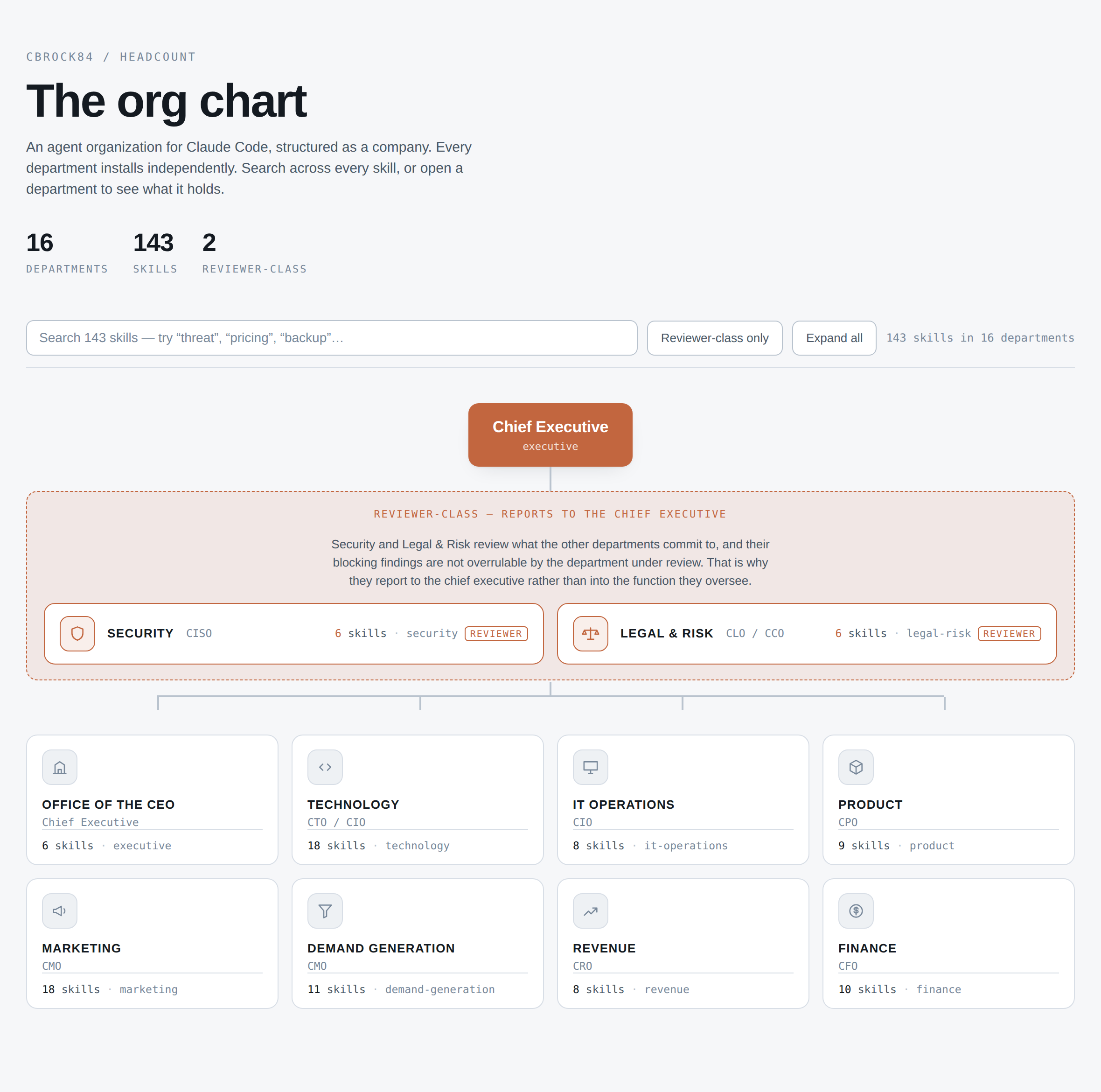
Open the interactive org chart — search every skill, open a department, jump to the source.
An agent organization structured as a company: a chief executive over 16 departments, 173 skills in total.
Every department is an independently installable plugin, so a project loads only the functions it needs rather than all of them at once.
Install
/plugin marketplace add cbrock84/headcount
/plugin install security@headcount
ChatGPT and Codex — the same repository. Add it as a plugin marketplace, or drop the
department you want into .agents/skills/ in your own project.
The skills are identical in both; only the manifests differ, and both sets are generated from
this tree, so a fix reaches both at once. See AGENTS.md.
Install as many departments as the project needs. Skills are addressed as department:skill —
security:threat-modeling, finance:unit-economics — so names never collide.
Use
Skills load themselves when a request matches. Ask a question in the department's territory and the right specialist engages:
| You ask | What loads |
|---|---|
| "why isn't this landing page converting?" | demand-generation:landing-page-cro-expert |
| "review this design before we build it" | security:threat-modeling |
| "can we afford this hire?" | finance:unit-economics |
| "our growth has stalled" | executive:business-growth-consultant |
Invoke one directly by name when you want a specific lens: /finance:financial-modeling.
New to this? docs/GETTING-STARTED.md covers which departments to install first, the three ways to invoke a skill, and what reviewer-class departments do differently.
Eleven situations that cross departments — a SOC 2 demand from an enterprise prospect, a link down between two sites, a renewal that auto-renewed because nobody owned the date — are worked through end to end in docs/USE-CASES.md, including what comes back and where a reviewer-class department stops the work rather than adding an opinion.
Each department also ships an agent charter in .claude/agents/, so a department can be delegated
to as a subagent with its own exclusive write surface.
Departments
Office of the CEO (Chief Executive) — 8 skills
| Skill | What it does |
|---|---|
agent-hierarchy |
Designs orchestrator-and-subagent hierarchies for a repository — splitting agents by exclusive write surface, pairing every producer with an independent auditor, an…. |
ai-research-analyst |
Produces executive-level research — market sizing, competitor mapping, trend analysis, and strategic intelligence — grounded in cited sources with the confidence in…. |
business-growth-consultant |
Finds the single constraint currently limiting a business's growth and the highest-leverage moves against it, rather than producing a list of everything that could…. |
ceo-advisor |
Pressure-tests a decision, plan, or idea before it is committed to — surfacing the assumption it rests on, the case against it, and what would have to be true for i…. |
chief-executive |
Sets direction, allocates capital and attention, and makes the calls no one else can make. |
company-onboarding |
Interviews once about the company and writes a short company profile that every other skill reads, so answers are for this company rather than a generic one. |
fundraising-and-investor-relations |
Raises capital and manages the relationship afterward — deciding how much and why, understanding what dilution and preferences actually cost, running a process with…. |
saas-idea-validator |
Evaluates a software or startup idea against problem, market, competition, monetization, defensibility, and execution, and returns a verdict rather than encourageme…. |
Technology (CTO / CIO) — 19 skills
| Skill | What it does |
|---|---|
ai-workflow-architect |
Designs AI systems, automations, and agent workflows for a business — identifying which manual work is worth automating, how to structure the system, which tools fi…. |
api-design |
Designs interfaces that survive their consumers — resource modeling, errors, versioning, pagination, and compatibility. |
branch-and-worktree-workflow |
Isolates feature work in its own branch or worktree and integrates it cleanly when done. |
chief-technology-officer |
Owns architecture, engineering delivery, infrastructure, data platform, and internal systems. |
cloud-infrastructure |
Designs and runs cloud infrastructure — environments, infrastructure as code, networking and isolation, scaling, and cost. |
code-review |
Conducts and responds to code review — reviewing a change for correctness, design, and risk, and evaluating review feedback received on your own work. |
completion-verification |
Verifies that work is actually complete before it is claimed to be — running the checks, reading the output, and confirming the original request was satisfied rathe…. |
data-migration |
Moves data from one system to another without losing it or corrupting it — profiling the source before mapping, deciding between big-bang and parallel-run cutover,…. |
implementation-planning |
Turns a spec or requirement into a written plan a separate session or agent can execute, then drives that plan through review checkpoints. |
observability-and-reliability |
Makes systems debuggable and reliably operable — instrumentation, alerting that is worth waking for, service objectives, and learning from failure. |
parallel-agent-delivery |
Splits work across multiple agents or sessions running at once, keeping their surfaces disjoint so results merge cleanly. |
prompt-optimizer |
Turns rough intent or a weak prompt into a reliable one — diagnosing why output is inconsistent, restructuring the instruction, and adapting it across models. |
release-and-deployment |
Ships changes safely and often — pipelines, deployment strategies, feature flags, rollback, and database changes. |
skill-authoring |
Writes and revises agent skills so they trigger at the right moments and give usable instruction when they do. |
solution-architecture |
Designs system structure and makes architectural decisions defensible — boundaries, coupling, trade-offs, and recording why. |
solution-exploration |
Explores the problem and the range of possible approaches before any code is written — clarifying what is actually being asked, surfacing options with their tradeof…. |
systematic-debugging |
Finds the root cause of a bug, test failure, or unexpected behavior before proposing any fix. |
technical-debt-management |
Makes technical debt visible and decidable — distinguishing real debt from mess, quantifying its cost, and arguing for remediation in business terms. |
test-driven-development |
Drives implementation by writing a failing test first, then the smallest code that passes it. |
Security (CISO) — 8 skills · **reviewer-class**
| Skill | What it does |
|---|---|
access-and-identity |
Designs and audits who can reach what — authentication, authorization models, privileged access, service credentials, and joiner-mover-leaver process. |
chief-information-security-officer |
Owns the security posture of the organization — architecture, program strategy, risk acceptance, incident command, and the authority to stop work that creates unacc…. |
data-protection-and-encryption |
Protects data itself rather than the systems around it — classifying what you hold, encrypting in transit and at rest and understanding what each actually defends a…. |
detection-and-monitoring |
Builds the capability to notice an attack in progress — deciding what to log and retain, centralizing it somewhere tamper-resistant, writing detections that fire on…. |
incident-response |
Runs a security incident from detection to closure — triage, containment, investigation, communication, and the review afterward. |
security-architecture-review |
Reviews a design or change for security before it ships — authentication and authorization, data handling, secrets, dependencies, and the secure-development practic…. |
threat-modeling |
Identifies what could go wrong in a system before it is built or changed — the assets worth attacking, the entry points, the trust boundaries, and the controls that…. |
vulnerability-management |
Runs the loop from discovering a weakness to confirming it is fixed — scanning, triage, prioritization by real exploitability, remediation tracking, and patch policy. |
IT Operations (CIO) — 12 skills
| Skill | What it does |
|---|---|
backup-and-recovery |
Protects and restores data — backup coverage and scope, retention, immutability against ransomware, and proving restores actually work. |
chief-information-officer |
The CIO's remit — running the technology the company works on, service quality, IT spend, and the boundary with product engineering. |
cloud-administration |
Administers the cloud the company runs on rather than the one it sells — tenant and subscription structure, the SaaS estate and who owns each app, identity as the r…. |
collaboration-platform-administration |
Administers the email, chat, meeting and file-sharing platform the organization runs on — tenant and domain configuration, mail authentication and routing, phishing…. |
endpoint-management |
Manages laptops, desktops and mobile devices — enrollment, configuration, patching, software distribution, and lost or compromised devices. |
identity-lifecycle-administration |
Executes joiner, mover and leaver processes — provisioning, group membership, access changes on role change, and complete deprovisioning. |
it-asset-management |
Tracks hardware and software assets through their life — procurement, ownership, licensing, refresh, and disposal. |
network-administration |
Designs and operates the corporate network — segmentation, remote access, wireless, DNS and addressing, and diagnosing network problems. |
service-desk |
Runs the IT service desk — intake, triage, prioritization, escalation, knowledge, and the metrics that improve service rather than distort it. |
systems-administration |
Runs servers and corporate systems — patching, configuration baselines, change control, capacity, and the routine that prevents incidents. |
telephony-and-conferencing |
Runs voice and meeting infrastructure — phone systems and numbers, emergency calling obligations, conference rooms and their AV, call recording and its retention co…. |
virtualization-operations |
Runs the hypervisor layer beneath the servers — host capacity and consolidation ratios, VM sprawl, snapshot discipline, resilience and live migration, and licensing…. |
Product (CPO) — 11 skills
| Skill | What it does |
|---|---|
brand-identity |
Defines and applies visual brand — logo usage, palette, typography, imagery direction, and the guidelines that keep expression consistent across product and marketi…. |
chief-product-officer |
Owns what gets built and why: product strategy, roadmap, discovery, user experience, and the definition of success for each release. |
design-styles |
Applies a deliberate visual direction to an interface — minimalist editorial, industrial utilitarian, or high-polish commercial — each with its own type scale, pale…. |
design-system |
Builds and maintains the design system a product is assembled from — tokens for color, type, spacing and elevation, component contracts, and the rules that keep the…. |
interface-craft |
Raises the visual and interaction quality of an interface — layout, hierarchy, type, spacing, density, and the details that separate a considered product from a gen…. |
interface-redesign |
Upgrades an existing interface to a higher standard without rebuilding it — auditing what is there, identifying what reads as generic or unfinished, and sequencing…. |
presentation-design |
Designs slide decks and one-pagers that carry an argument rather than decorate one — deck structure, headlines that state the takeaway, charts that make a single po…. |
product-discovery |
Finds out whether a problem is real and a solution would work, before building it — recruiting the right people, interviewing without leading them, separating what…. |
product-requirements |
Writes down what is being built so a team can build it and know when they are done — problem and success measure before solution, scope stated by exclusion, user-vi…. |
ux-product-auditor |
Audits a website, app, onboarding flow, or design for usability, conversion, and product problems, tying every finding to a business outcome and a severity. |
visual-reference-generation |
Produces design reference imagery before implementation — screen concepts, layout directions, and flows for web or mobile that make a verbal brief concrete enough t…. |
Marketing (CMO) — 19 skills
| Skill | What it does |
|---|---|
behavioral-marketing |
Applies decision science and cognitive bias research to marketing and product decisions — how people actually choose under uncertainty, and how framing, defaults, s…. |
brand-voice |
Captures how a person or brand actually writes and turns it into reusable voice instructions every other content skill draws from. |
chief-content-officer |
Runs content as an operation — the production pipeline, editorial calendar, repurposing engine, competitive content intelligence, and audits of what already exists. |
chief-marketing-officer |
Owns brand, demand generation, content, communications, and how the market understands what the business does. |
content-strategy |
Decides what content to make and why — topic territory, format mix, cadence, and how content connects to a business outcome rather than to traffic. |
customer-research |
Plans, runs, and synthesizes customer research — interviews, surveys, win-loss analysis, and message testing — into findings that change decisions. |
events-and-field-marketing |
Plans and runs events that produce pipeline — conferences, trade shows, webinars, field programs, and measuring whether any of it worked. |
marketing-campaign-planner |
Designs a coordinated multi-channel campaign or product launch around one story — objective, message, channel sequencing, timeline, assets, and the checklist that g…. |
marketing-copywriting |
Writes and edits marketing copy for any surface — homepage, product and pricing pages, ads, emails, and collateral — and sharpens existing copy that is not working. |
marketing-planning |
Builds the marketing plan of record — objectives, channel mix, budget allocation, sequencing, and the measurement that says whether it worked. |
newsletter-writer |
Writes and edits newsletters and marketing emails people actually open — subject lines, opening, structure, voice, and the conversion turn where there is one. |
partnership-marketing |
Builds reach through other people's audiences — co-marketing partnerships, creator and influencer programs, and community building. |
positioning-and-messaging |
Establishes what a product is understood to be, for whom, and instead of what — then turns that into the messaging every other surface inherits. |
product-launch |
Takes something built and gets it into the market — tiering the launch to match what it actually warrants, sequencing internal readiness before external announcemen…. |
public-relations |
Plans and executes earned media — press strategy, journalist outreach, announcements, commentary, and crisis response. |
social-post-craft |
Writes, structures, and evaluates social posts end to end — hooks, body, formatting for how each platform renders, and a quality check before publishing. |
video-content |
Plans and scripts short-form and long-form video, and designs the packaging — titles, thumbnails, and openings — that determines whether it gets watched. |
visual-content |
Designs and directs the visual assets that carry content — carousels, infographics, quote graphics, diagrams, and social imagery — including the generation prompts…. |
youtube-producer |
Plans, packages, and scripts long-form video for retention and channel growth — idea selection, titles and thumbnails, script structure, and diagnosing why a video…. |
Demand Generation (CMO) — 12 skills
| Skill | What it does |
|---|---|
account-based-marketing |
Concentrates marketing and sales effort on a named set of accounts rather than on volume — qualifying whether the model fits your economics at all, building the acc…. |
ai-search-optimization |
Optimizes for AI assistants and AI-generated answers — being retrievable, being cited, and being represented accurately when a model answers on your behalf. |
app-store-optimization |
Improves visibility and conversion in the App Store and Google Play — metadata, keywords, screenshots, ratings, and the listing experience that turns an impression…. |
experimentation |
Designs, runs, and reads A/B tests and growth experiments — hypothesis, sample size, duration, and honest interpretation. |
landing-page-cro-expert |
Audits and rewrites landing pages, homepages, and sales pages to increase conversion — diagnosing why a page is not converting, rewriting headlines, hero copy and c…. |
lead-capture |
Converts anonymous traffic into known contacts — lead magnets, gated content, free tools, popups, and the forms behind them. |
lifecycle-messaging |
Designs automated email and SMS programs — welcome and onboarding sequences, nurture, re-engagement, transactional messaging, and the timing and segmentation behind…. |
listing-distribution |
Gets a product listed where buyers and crawlers look — directories, marketplaces, review sites, comparison pages, and aggregators. |
marketing-analytics |
Sets up, audits, and reports on marketing measurement — tracking plans, event schemas, attribution models, and the dashboards built on them. |
paid-advertising |
Plans, runs, and optimizes paid acquisition across search, social, and display — account structure, targeting, creative, bidding, budget, and the analysis that says…. |
programmatic-seo |
Builds large sets of search-targeted pages from a template and a dataset — the location, comparison, integration, and use-case pages that capture long-tail demand a…. |
seo-strategy |
Audits and improves organic search performance — technical health, site architecture, internal linking, structured data, and the content decisions that determine wh…. |
Revenue (CRO) — 10 skills
| Skill | What it does |
|---|---|
activation |
Gets new users from signup to first real value — signup flow, onboarding, time-to-value, and the early experience that determines whether someone becomes a user or…. |
chief-revenue-officer |
Owns the revenue engine end to end: sales, monetization, pricing, customer success, retention, and partnerships. |
deal-negotiation |
Negotiates a commercial deal without giving away the terms that matter — preparing your walk-away and theirs, trading concessions rather than conceding them, recogn…. |
outbound-prospecting |
Finds, qualifies, and reaches prospects through cold outreach — list building, qualification criteria, cold email and multi-channel sequences, and the follow-up tha…. |
pricing-and-packaging |
Sets price, structures packages and tiers, and designs the monetization surfaces that carry them — upgrade paths, paywalls, and offer construction. |
referral-programs |
Designs and improves referral, affiliate, and word-of-mouth programs — incentive structure, mechanics, timing, and fraud control. |
retention |
Diagnoses and reduces churn — cancellation flows, save offers, failed-payment recovery, at-risk detection, and the product and service causes underneath. |
revenue-operations |
Runs the mechanics of the revenue engine — lead lifecycle definitions, routing, CRM hygiene, forecasting process, pipeline reporting, and the marketing-to-sales han…. |
sales-compensation-and-territory |
Designs quotas, territories and commission plans that produce the behavior the business needs — sizing territories against real potential, setting quotas people can…. |
sales-enablement |
Builds what a sales team needs to sell — pitch decks, one-pagers, objection handling, competitive battlecards, demo scripts, and case studies. |
Finance (CFO) — 13 skills
| Skill | What it does |
|---|---|
budgeting-and-forecasting |
Runs the planning cycle — annual budget, rolling forecast, consolidation of business unit inputs, and the variance analysis that explains actuals against plan. |
capital-allocation |
Evaluates where to spend limited capital — investment appraisal, hurdle rates, payback, and comparing proposals that are not alike. |
capital-structure-and-covenants |
Decides how the business is financed and what that financing then requires of it — debt versus equity, weighted average cost of capital as a hurdle rate, how much l…. |
chief-financial-officer |
Owns the financial position: planning, budgeting, forecasting, unit economics, cash, and the numbers the business is run and reported on. |
cost-accounting |
Establishes what something actually costs — fixed, variable and mixed cost behavior, absorption versus variable costing, job-order, process and activity-based metho…. |
financial-modeling |
Builds and stress-tests financial models for forecasting, scenario planning, and decision support — revenue build, cost structure, driver logic, and the sensitiviti…. |
financial-reporting-and-close |
Runs the period-end close and produces reporting — close calendar, reconciliations, accruals, variance analysis, and reporting that gets read. |
financial-statement-analysis |
Reads a set of financial statements and establishes what changed and why — fluctuation analysis against prior period and against budget, profitability, liquidity, s…. |
internal-controls-and-audit |
Designs and tests controls over financial reporting — segregation of duties, approval limits, evidence, and preparing for audit. |
revenue-recognition |
Determines when and how revenue is recognized — performance obligations, contract terms that change the answer, and the deal structures that create accounting probl…. |
tax |
Structures the tax questions a growing business faces — corporate income, sales and use, payroll, nexus, and the obligations created by hiring or selling somewhere…. |
treasury-and-liquidity |
Manages cash and liquidity — cash forecasting, runway, working capital, banking structure, and currency and counterparty exposure. |
unit-economics |
Establishes whether the business makes money on each customer or unit — contribution margin, acquisition cost, payback period, lifetime value, and the cohort behavi…. |
Operations (COO) — 12 skills
| Skill | What it does |
|---|---|
business-continuity-and-resilience |
Plans for operating through disruption — impact analysis, recovery objectives, continuity plans, and the exercises that prove they work. |
capacity-and-demand-planning |
Matches operational capacity to expected demand — forecasting load, sizing teams and systems, managing queues, and deciding when to add capacity. |
chief-operating-officer |
Owns execution: how work actually gets done across the organization, including process, program management, capacity, vendors, supply chain, and service delivery. |
facilities-and-workplace |
Runs the physical and hybrid workplace — space planning, leases, health and safety, office services, and the operational side of where people work. |
incident-management |
Runs an operational incident from detection to closed action — declaring it and naming a commander, separating the people restoring service from the people communic…. |
operating-cadence |
Designs the rhythm an organization runs on — which reviews happen weekly, monthly and quarterly, what each one decides, who owns the numbers presented, and how a si…. |
process-design |
Designs, documents, and fixes operational processes — mapping the current state, finding where work actually stalls, redesigning the flow, and building controls tha…. |
procurement-and-sourcing |
Buys well — specifying need, running competitive sourcing, negotiating, and category strategy before a contract exists. |
quality-management |
Builds quality into operations — defining standards, catching defects at the right point, root cause analysis, and continuous improvement. |
service-level-management |
Defines and manages service levels — setting targets that reflect what customers need, measuring honestly, and handling breaches. |
supply-chain-and-logistics |
Manages the flow of goods and inputs — sourcing, inventory, lead times, fulfillment, and supply risk. |
vendor-management |
Selects, contracts, and manages suppliers and vendors — requirements, evaluation, negotiation support, onboarding, performance management, and exit. |
Program Management Office (EPMO / COO) — 9 skills
| Skill | What it does |
|---|---|
benefits-realization |
Ensures projects deliver the value they were approved on — defining measurable benefits, baselining, tracking after delivery, and honest post-implementation review. |
change-and-adoption |
Gets people to actually use what was delivered — stakeholder analysis, communication, training, resistance, and measuring adoption. |
dependency-and-risk-management |
Manages delivery risk and cross-team dependencies — identifying, sizing, mitigating and escalating what could stop the work. |
estimating-and-contingency |
Produces a cost or effort estimate someone can defend — decomposing the work, choosing between analogous, parametric and bottom-up methods, documenting the basis an…. |
head-of-pmo |
The EPMO lead's remit — what the PMO governs, what it must never become, and how it earns standing rather than compliance. |
portfolio-governance |
Governs the portfolio of work — intake, prioritization, stage gates, resource contention, and stopping things. |
program-management |
Plans and drives cross-functional programs to delivery — scope, sequencing, dependencies, status, risk, and the escalations that keep work moving. |
project-delivery |
Plans and delivers a single project — scope, estimation, scheduling, critical path, tracking, and recovering when it slips. |
schedule-development-and-analysis |
Builds and interrogates a project schedule — logic-driven sequencing, dependency types and lags, float and the critical path, resource loading and leveling, schedul…. |
Customer Experience (CCO) — 7 skills
| Skill | What it does |
|---|---|
chief-customer-officer |
Owns the customer's experience after the sale — support, success, escalation, and the feedback loop back into product. |
customer-onboarding-and-implementation |
Takes a new customer from signature to working — setting a definition of live that both sides agreed before the contract was signed, planning and staffing the imple…. |
customer-success-management |
Runs the ongoing relationship with accounts after the sale — segmenting coverage against account value, building a health score that predicts rather than describes,…. |
escalation-management |
Handles customer situations that have exceeded normal support — severity assessment, incident communication, executive escalation, and recovering a relationship aft…. |
self-service-and-knowledge |
Builds the help center, in-product guidance, and knowledge base that let customers resolve problems without contacting anyone — content, findability, maintenance, a…. |
support-operations |
Designs and runs the support function — channels, queues, routing, staffing, service levels, quality, and the metrics that show whether it is working. |
voice-of-customer |
Builds the loop from what customers say to what gets changed — collecting feedback, distinguishing signal from noise, routing it to owners, and closing the loop bac…. |
Data & Analytics (CDO) — 7 skills
| Skill | What it does |
|---|---|
ai-ml-governance |
Governs models and AI systems in production — intended use, evaluation, monitoring, human oversight, documentation, and the decision to deploy or retire. |
business-intelligence |
Builds reporting and self-serve analytics that people actually use — metric trees, dashboard design, distribution, and the discipline that stops dashboards prolifer…. |
chief-data-officer |
Owns data as an asset — governance, quality, the warehouse and semantic layer, analytics capability, and the governance of models built on top. |
data-engineering |
Builds and operates data pipelines — ingestion, transformation, orchestration, quality testing, and reliability of data delivery. |
data-governance |
Establishes ownership, definitions, quality, access, and lineage for the organization's data. |
data-modeling |
Designs the warehouse and semantic layer — source-to-mart structure, dimensional modeling, grain, slowly changing dimensions, and the metric layer analytics reads t…. |
quantitative-analysis |
Answers a business question with data without fooling yourself — framing the question so an answer would change something, choosing the right comparison, checking t…. |
Corporate Strategy (CSO) — 6 skills
| Skill | What it does |
|---|---|
chief-strategy-officer |
Owns where the business plays and how it wins over a multi-year horizon — portfolio choices, corporate development, strategic partnerships, and planning under uncer…. |
market-entry |
Decides whether and how to enter a new market — sizing demand from the bottom up rather than from a market report, testing whether your advantage transfers, choosin…. |
mergers-and-acquisitions |
Runs corporate development — deal thesis, target screening, valuation framing, diligence, and integration planning. |
portfolio-strategy |
Decides where capital and attention go across business lines, products, and markets — what to fund, hold, harvest, or exit, and on what evidence. |
scenario-planning |
Plans under genuine uncertainty — building scenarios, identifying which assumptions are load-bearing, setting early-warning indicators, and stress-testing a plan ag…. |
strategic-alliances |
…