
Pack · #57 trending skills repo · ↗ +512 stars this week
Pstack
backnotprop/pstack
Use pstack with claude, codex, pi - Skills and principles for rigorous AI-assisted engineering
- Stars
- 3.8k
- This week
- +512
- Forks
- 265
- Open issues
- 1
- Skills inside
- 61
Get started
Install the skills
npx skills add backnotprop/pstackInstalls into Claude Code, Codex, Cursor, OpenCode and the other agents it finds on your machine.
/plugin marketplace add cursor/plugins
/plugin install pstack@cursor-pluginsRun inside Claude Code, then pick what to install from /plugin.
git clone --depth 1 https://github.com/backnotprop/pstack.git /tmp/pstack
cp -r /tmp/pstack ~/.claude/skills/pstackClaude Code reads ~/.claude/skills/ (or .claude/skills/ in a project). Other agents read the same SKILL.md format from their own skills folder.
Inside this repo
48 of 61 skills
automations/benny/skills/reproduce-and-fix-issuessetup-bennyConfigure Benny and prepare its triage and repro automations. Use when installing Benny or changing its Slack, tracker, repository, routing, control, model, or budget settings.automations/benny/skills/setup-bennytriage-issue-reportsTriage Slack issue reports with one thread-only verdict, evidence review, cause-aware routing, tracker dedupe, and fail-closed ticket creation. Use only from the configured Benny triage automation.automations/benny/skills/triage-issue-reportsarchitectSketch types, signatures, and module structure before code, then stay in the loop while implementation fills in. Use for /architect, 'architect this', 'design this', or non-trivial work where jumping to code would lock in the wrong shape.skills/architectarenaSpawn N parallel candidates at the same task, pick a base, graft the strongest parts of the losers into it. Use for /arena, 'arena this', 'throw it in the arena', or when one attempt at a non-trivial artifact would lock in the wrong shape.skills/arenaautomate-meUse for \"automate me\", \"create/update/refresh my -mode skill\", \"turn/capture my preferences or working style into a skill\", or wanting agents to follow how the user works. Drafts or revises a personal -mode skill via create-skill + unslop, optionally pulling fresh evidence from recent transcriskills/automate-mebenchmark-checklistVet a perf measurement (limiter, tuning, limits, errors, repeatability, relevance, and whether the work happened) before you report or act on it. Use when you run a benchmark or report a speedup or regression you measured.skills/benchmark-checklistblast-radiusFind what a change could break somewhere else before it ships, beyond the diff, and prove the one fact it's safe because of by running real code instead of writing it up. Use for 'blast radius of X', 'what could this break', or reviewing a small diff you don't trust.skills/blast-radiusbroRestate the last message in plain human language, with no jargon.skills/brocorrectFind the mistakes agents keep repeating in this repo and make each one impossible. Try architecture first, then types, then a lint whose error names the fix, then a test, and write docs last. Prove each check fails on a real past mistake. Repeat this each time the operator corrects you. Use for /corskills/correctcreate-formal-verification-skillGenerate a project-local skill that formally verifies the code where a bug costs the most and tests reach the least, in any language, with whichever verification tool fits. Use for /create-formal-verification-skill, \"model-check this race\", \"prove this invariant\", or when concurrency, retries, sskills/create-formal-verification-skillcreate-verification-skillGenerate a project-local verification skill that drives your app the way a user does — any language, framework, or platform. Use for /create-verification-skill, \"make a control skill for this repo\", or when a project has no scripted way to prove UI/CLI/service behavior.skills/create-verification-skillfigure-it-outDesign an auditable playbook when no narrower one fits: a large migration, an ambitious multi-part change, or work a human reviews after stepping away. Scales rigor to the task, runs a hypothesis loop, and logs decisions. Use for /figure-it-out or 'figure it out'.skills/figure-it-outhowUse for \"how does X work\", code walkthroughs before changing something, and placement / ownership / layering questions (\"where should this live\", \"which package owns this\", \"is this the right layer\"). Explains subsystem architecture, runtime flow, onboarding mental models. Use why for motivaskills/howin-your-own-wordsRestate in your own words what you think the user's goals are and what problem they're trying to solve. Use for /in-your-own-words.skills/in-your-own-wordsinterrogateUse for \"interrogate\", \"adversarial review\", \"multi-model review\", \"challenge this\", \"stress test this code\", \"find blind spots\", or \"tear this apart\". Adversaries try to break a change or design, and only findings proven by a run survive.skills/interrogateketchup-videoCatch the user up like /ketchup, with a short subtitled video of slides for what happened and the waiting calls as text under it. Use for /ketchup-video.skills/ketchup-videoketchupCatch the user up on what changed in this chat since their last message, in plain words and small visuals. List every item waiting on them with what they need to decide it from the reply alone. Use for /ketchup.skills/ketchupmaintain-formal-verification-skillBring a project's formal verification back in line with the code after the code changes: find the commits that touched verified code, update the model, harness, or properties to describe the code as it is now, rerun, and say whether each failure is drift in the verification or a bug in the code. Useskills/maintain-formal-verification-skillmaintain-verification-skillPeriodic pass that keeps a project's verification skill and feature map honest: parallel source readers per feature, one live session driving every feature, at most one PR of proven corrections. Use for /maintain-verification-skill or \"audit the verify skill\".skills/maintain-verification-skillmake-bot-ui- Use when building a custom UI (page, dashboard, buttons) that should wake a Grok Bot over a webhook, when the user must provide a webhook sender key, or when exposing that UI on Tailscale.skills/make-bot-uino-commentsSpawn Comment Sicko, fix accepted findings, and offer encodings for claimed constraints.skills/no-commentspoteto-helpGuides users through pstack setup, /poteto-mode, and picking the skill, playbook, or principle for a task. Type /poteto-help with a question.skills/poteto-helppoteto-modepoteto's agent style for concise, detailed responses, deliberate subagents, unslopped prose, simple code, and verified work. Use for poteto, /poteto-mode, or requests to work in this style.skills/poteto-modeprinciple-attack-the-premiseApply when two or more fixes that share one premise have failed the same gate. Write the premise down and test it directly before you write another fix that assumes it.skills/principle-attack-the-premiseprinciple-boundary-disciplineApply when wiring validation, error handling, or framework adapters. Concentrate guards at system boundaries (CLI, config, network, external APIs); trust internal types and keep business logic in pure functions.skills/principle-boundary-disciplineprinciple-build-the-leverApply to any non-trivial work, not just bulk work: edits, migrations, analyses, checks. Build the tool that does it or proves it (codemod, script, generator, or a skill your subagents follow) instead of working by hand. The tool is the artifact a reviewer can rerun.skills/principle-build-the-leverprinciple-encode-lessons-in-structureApply when you catch yourself writing the same instruction a second time, or notice a recurring correction. Encode the rule as a lint, metadata flag, runtime check, or script instead of more text.skills/principle-encode-lessons-in-structureprinciple-exhaust-the-design-spaceApply when facing a novel UI interaction or architectural decision with no precedent in the codebase. Build 2-3 competing prototypes and compare side by side before committing.skills/principle-exhaust-the-design-spaceprinciple-experience-firstApply when product, UX, or feature-scope tradeoffs come up. Choose user delight over implementation convenience; ship fewer polished features over more rough ones.skills/principle-experience-firstprinciple-explain-the-numberApply before you measure, and before you trust, report, or act on a number you measured: a speedup, a regression, a throughput, a latency, or an eval result. Find what limits it, and rule out that it measured something other than the work you think.skills/principle-explain-the-numberprinciple-fix-root-causesApply when debugging. Trace each symptom back to the first place the system went wrong and fix it there. A guard is a fix only when the state it handles is legitimate.skills/principle-fix-root-causesprinciple-foundational-thinkingApply before writing logic: choosing core types and data structures, sequencing scaffold-vs-feature work, asking what concurrent actors share. Get the data structures right so downstream code becomes obvious.skills/principle-foundational-thinkingprinciple-guard-the-context-windowApply when context is filling up: large outputs, long files, repeated reads, fan-out planning. Route bulk to subagents; keep summaries in the main thread, not raw payloads.skills/principle-guard-the-context-windowprinciple-laziness-protocolApply when refactoring, evaluating diff size, or tempted to add abstractions, layers, or signal threading. Bias toward deletion and the smallest change that solves the problem.skills/principle-laziness-protocolprinciple-make-operations-idempotentApply when designing commands, lifecycle steps, or processing loops that run amid crashes, restarts, and retries. Converge to the same end state regardless of partial prior runs.skills/principle-make-operations-idempotentprinciple-migrate-callers-then-delete-legacy-apisApply when introducing a new internal API while old callers still exist. Migrate callers and delete the old API in the same wave instead of preserving compatibility layers.skills/principle-migrate-callers-then-delete-legacy-apisprinciple-minimize-reader-loadApply when reviewing or shaping code that's hard to trace. Count layers between question and answer, and hidden state in the reader's head; collapse one-caller wrappers and shrink mutable scope.skills/principle-minimize-reader-loadprinciple-model-the-domainApply when writing stateful logic, or when code branches a lot or repeats a shape assumption across files.skills/principle-model-the-domainprinciple-never-block-on-the-humanApply when tempted to ask 'should I do X?' on reversible work.skills/principle-never-block-on-the-humanprinciple-outcome-oriented-executionApply during planned rewrites and migrations with explicit phase boundaries. Converge on the target architecture; don't preserve smooth intermediate states with throwaway compatibility code.skills/principle-outcome-oriented-executionprinciple-prove-it-worksApply after completing a task, before declaring done. Verify against the real artifact (run the feature, read the actual value, inspect the diff), not a proxy, self-report, or 'it compiles.'skills/principle-prove-it-worksprinciple-redesign-from-first-principlesApply when integrating a new requirement into an existing design.skills/principle-redesign-from-first-principlesprinciple-separate-before-serializing-shared-stateApply when concurrent actors might write to the same file, branch, key, or state object. Eliminate the sharing first; serialize structurally only when one shared writer is a real invariant.skills/principle-separate-before-serializing-shared-stateprinciple-sequence-verifiable-unitsApply to multi-step work (sweeps, migrations, runs of similar edits) and to how you stack commits and PRs. Break work into small units that each end in a verifiable state, check each before the next, and order delivery so the sequence proves itself to a reviewer.skills/principle-sequence-verifiable-unitsprinciple-subtract-before-you-addApply when sequencing an addition, refactor, or rewrite. Remove dead code, redundant validators, and stub references first, then build on the simpler base.skills/principle-subtract-before-you-addprinciple-test-behavior-not-implementationApply when you write, change, or keep a test. Assert what the code's users can observe, so that the test fails when that behavior breaks and keeps passing when only the internals change.skills/principle-test-behavior-not-implementationprinciple-type-system-disciplineApply when designing types, reviewing a function signature, or writing code in any statically-typed language. Make illegal states unrepresentable, brand semantic primitives, parse external data at boundaries, exhaust variants, derive from authoritative schemas.skills/principle-type-system-disciplineDocumentation
README
pstack — standalone mirror
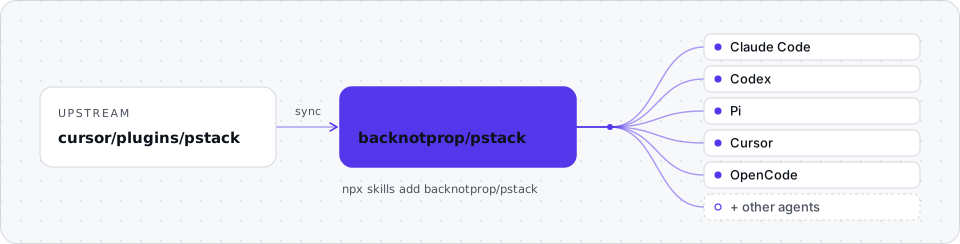
Mirror of cursor/plugins/pstack by Poteto — kept in sync for standalone use. Sponsored by Plannotator.


Poteto's Bro Skill was created by me, backnotprop/bro
Install
pstack is a folder of plain Agent Skills (skills/<name>/SKILL.md). You don't need Cursor. The skills CLI installs them into Claude Code, Codex, Pi, Cursor, OpenCode, and other agents:
npx skills add backnotprop/pstack
The CLI shows every skill in a list you can search. Select the skills you want, then select your agents.
Skills
Cursor's original README is further down this page.
These skills don't call other pstack skills, so each one works alone:
unslop, bro, how, tdd, typescript-best-practices, arena, swarm, interrogate, reflect, show-me-your-work, figure-it-out, automate-me, correct, benchmark-checklist, in-your-own-words, sharpen, statechart
Some skills call other skills. Install these together:
| Skill | Also install |
|---|---|
teach |
how, why |
why |
how |
technical-writing |
unslop |
architect |
arena, how |
blast-radius |
arena, how, why, unslop |
create-verification-skill |
maintain-verification-skill |
create-formal-verification-skill |
maintain-formal-verification-skill, statechart |
ketchup |
bro |
ketchup-video |
ketchup, bro |
poteto-mode |
all principle-* skills and most of the other skills |
poteto-help |
the skills you want help with |
Skills that spawn subagents point to the Subagents section of poteto-mode to pick each subagent's effort. Without poteto-mode, they use the default effort.
What this mirror changes
Many skills were Cursor-specific. They've been rewritten to work in any harness.
The mirror also carries two community fixes that aren't upstream yet:
no-commentskeeps a comment about an outside rule (a dependency, platform, or protocol) when it can't check the rule, and marks it for review instead of deleting it. A rejected review no longer stops the whole run. (#14)statechartruns on Windows: it no longer needs/bin/sh, reads TLC output with Windows line endings, and cleans up its temp folder after a killed run. Patch by @yasuyuki. (#17)
pstack
i'm poteto. i'm not a president or ceo, but i've worked with millions of lines of code at Meta, Netflix, and Cursor. i'm also on the react core team where i help build and maintain react compiler.
there's a growing sense that ai writes too much slop code. i agree. i don't want to ship like a team of twenty slop artists. throughput without quality is not a goal i aspire to. if you want to go fast, go deep first.
pstack is my answer. these are the same skills i use every day to ship high quality code at Cursor. this turns cursor into a real engineering team. the goal is not to maximize loc, in fact it's the opposite. pstack helps you write less, but higher quality code.
pstack gives you fearless parallelism. when you can go deep on one agent and trust it to write good, verifiable code, you can truly parallelize with confidence. start multiple agents up with poteto-mode and trust that they'll apply rigorous engineering principles to their work.
cursor gives you the best of all worlds. every frontier model has its strengths and weaknesses. use any model with pstack. in fact, many of my skills use multi-model workflows to take advantage of each model's unique strengths.
fork it. improve it. make it yours. PRs are welcome!
install
/add-plugin pstack
in claude code:
/plugin marketplace add cursor/plugins
/plugin install pstack@cursor-plugins
claude code leaves auto-update off for third-party marketplaces, so pstack stays on the version you installed. to turn it on, run /plugin, open the marketplaces tab, select cursor-plugins, and choose enable auto-update. to update once by hand, run claude plugin update pstack@cursor-plugins.
claude code prefixes plugin commands and agents, so /poteto-mode is /pstack:poteto-mode. the claude code adapter maps every other cursor name. in claude code, /pstack:setup-pstack writes your model choices to ~/.claude/rules/pstack-models.md, and a step that needs a cursor-only feature, such as bugbot or automations, is skipped with a one-line note.
claude code installs a generated copy of pstack, including this readme and the guide, from harness/pstack/ at the repository root. after you change pstack, run node scripts/generate-pstack-harness-trees.mjs from the repository root and commit the result. ci fails while the generated copy is out of date.
get started
two steps:
- run
/setup-pstack, pick a reasoning budget, and choose which models you want. - use
/poteto-modewhenever you're doing anything that requires rigor.
new here? the pstack guide walks you through a first real task, from setup and prompting through verification and overnight runs. stuck, or unsure which skill fits? ask /poteto-help.
that's it. the other skills are situational, and the mode skill uses them for you as needed. out of the box the mode splits work by model strength: code delegates (feature, refactoring, bug fix, perf, hillclimb) go to grok, while the hardest changes, prose, and judgment go to opus 5.5. the default panel is opus 5.5 / grok. /setup-pstack changes any of it.
usage
use /poteto-mode at the start of a task. it reads your request, picks from a set of playbooks, and runs the other skills as the steps need them.
pick /poteto-mode from the / menu before you type your task, so cursor attaches the skill to the message.
just use /poteto-mode
this skill is the main shortcut. i use it whenever i need the agent to do rigorous engineering work. it comes with twenty-three playbooks:
/poteto-mode this pr has a subtle bug where the scroll drifts every 750ms even when idle. repro
first, then fix and verify.
/poteto-mode i'm going to bed. land the stack even if ci flakes. i want everything merged by
morning.
the twenty-three playbooks
| playbook | for |
|---|---|
| investigation | a read-only question. how does x work, why was y built this way, are we sure. |
| bug fix | reproduce a defect, root-cause it, and fix with runtime evidence. |
| perf | trace a measured slowness and improve it against a baseline. |
| hillclimb | sustained, scientific improvement of one metric against a target, looping hypotheses with before/after measurement and one commit per accepted win. |
| runtime forensics | diagnose a live symptom (leak, idle-cpu spin, glitch) from instrumentation. |
| trace forensics | diagnose a captured profiling artifact (cpuprofile, trace, spindump, heap snapshot). |
| feature | new or changed behavior, built from a named data shape. |
| refactoring | a behavior-preserving change to structure or shape. |
| prototype | a throwaway sketch to make a design or behavioral decision cheaply, or to settle an empirical fork by observing it. |
| visual parity | pixel-exact ui equivalence between two implementations. |
| authoring a skill | writing or editing a SKILL.md. |
| eval | test how a skill or prompt change affects agent behavior, blinded. |
| babysit | drive a pr or a stack to merge-ready: conflicts, review threads, ci. |
| shipping | independently verify a green stack, then land the contiguous verified run bottom-up through github by default or origin when available. |
| autonomous run | drive a long task to completion without stopping. |
| orchestrate | a standing project handed to one coordinator chat: multi-day, many stacked prs, fleets of subagents. |
| autopilot-full | run independent prs to merged with one owner per pr. a swarm verifies each code-ready head, and every later change to the patch gets a fresh check. |
| autopilot-stack | autopilot-full without the merge. build and verify prs for the operator to review and land, stacking a pr only on a pr it builds on. |
| session pickup | resume or take over a prior agent's in-flight work. |
| pause safely | suspend in-flight work cleanly so it can be resumed later. |
| multi-phase plan | work that spans phases or stacked PRs. |
| worktree cleanup | reclaim disk by pruning merged or abandoned worktrees and stale ios simulators, safety-gated. |
| opening a pr | open a ready pr from small ordered commits with a conventional commits title and a briefing-style body. invoked at the end of every other playbook. |
when invoked it:
- matches your task to a playbook and opens a todo list whose first items are its steps, copied in verbatim.
- routes to the other skills as the steps fire.
- writes unslopped replies framed for the consumer and the maintainer.
the full rules and playbooks live in skills/poteto-mode/SKILL.md.
to keep /poteto-mode on across turns, pick it from the / menu and press option+enter (mac) or alt+enter (windows) instead of enter. that makes it a custom mode, which cursor offers in the agents window and the cli. it stays in context every turn until you exit the mode. plain enter attaches it to one message only.
/poteto-mode works extremely well with cursor's /loop command. you can make cursor work for many hours without sacrificing rigor.
skills
/poteto-mode runs most of these for you when a step needs them (how, why, architect, arena, swarm, interrogate, unslop, no-comments, technical-writing, tdd, and the principles). the table below is for when you want one directly:
/how do we cancel runs? do we have an n+1 when we look up every run to cancel?
/interrogate review this pr.
all skills
| skill | use it when |
|---|---|
/poteto-mode |
default entry point for any non-trivial task. |
/poteto-help |
you're new to pstack, or unsure which skill, playbook, or principle fits. finds out what you're trying to do, answers that part, and hands you a prompt to type. runs only when you type /poteto-help. |
/in-your-own-words |
you want the agent to play back your goal and the problem before it starts. runs only when you type /in-your-own-words. |
/sharpen |
you want a prompt made deeper, not bigger, before you send it: what a top professional would do that you didn't ask for, the raw material they'd start from, their methods and tools, and an outside check that the result is right. hands back the rewritten prompt and leaves your choices open. doesn't do the task. runs only when you type /sharpen. |
/how |
you want a walkthrough of how a subsystem works. |
/why |
you want to know why something was built this way. discovers available MCPs at run time and queries each evidence category in parallel (source control, issue tracker, long-form docs, real-time chat, infra observability, error tracking, analytics warehouse). |
/recall |
you're starting or resuming work and want your recent context on a topic rebuilt from your own chat history and the shared record, handed back as a tight current-state brief. |
/ketchup |
you want what changed in this chat since your last message, in plain words and small visuals, with every item waiting on you listed and decidable from the reply alone, even when that makes the reply long. |
/ketchup-video |
you want the /ketchup catch-up as a short subtitled video of slides, with the calls waiting on you as text under it. |
/blast-radius |
you have a small-looking change and want to know what else it could break, with the one fact it's safe because of proven by running code, not asserted. |
/architect |
you're about to write code that crosses a function boundary and want the caller's usage, types, and module shape settled first. |
/arena |
you want N parallel attempts at the same thing, then to grab the best parts of each. |
/swarm |
you want N parallel workers across different slices or races, then one aggregated report. |
/interrogate |
you have a diff and want different models to try to break it, keeping only findings a run proves. |
/automate-me |
you want your own -mode skill, drafted from how you've actually worked. |
/make-bot-ui |
you want a page or dashboard whose buttons wake a Grok Bot over a webhook, including the sender-key handoff and Tailscale. |
/setup-pstack |
you want to pick which models pstack uses per role. detects your models and writes a config rule. |
/reflect |
a long task landed and you want the recipe captured as a skill edit. |
/correct |
you keep correcting agents for the same mistakes. mines history for mistake classes, fixes each at the highest level that works (architecture, then types, lint, and ci, then tests, with docs last), and keeps a table pairing each rule with what enforces it. |
/teach |
you want to actually understand a change or subsystem, not just have it summarized. runs how + why and weaves one plain explanation, built up diagram by diagram. |
/tdd |
you're fixing a bug and there's a cheap local test path. write the failing test first, then the fix. |
/benchmark-checklist |
you ran a benchmark or measured a speedup or regression. vets the number (limiter, tuning, errors, repeat runs, end-to-end relevance) before you report or act on it. |
/no-comments |
strip comments before review; spawns Comment Sicko, fixes accepted findings, offers encodings for claimed constraints. |
/typescript-best-practices |
you're reading or editing typescript. grounds the type-system-discipline principle in syntax. |
/figure-it-out |
no bundled playbook fits. designs a rigorous, auditable playbook for the task. |
/show-me-your-work |
you want a reviewable decision trail. logs decisions to a tsv you can commit. |
/create-verification-skill |
your project has no scripted way to prove app behavior. generates a project-local verify skill with a feature map, for any language or platform. |
/maintain-verification-skill |
your verify skill's feature map has drifted from the app. source wave + one live pass, at most one PR of proven corrections. |
/create-formal-verification-skill |
tests can't reach the case that breaks a race, retry, state machine, parser, or unsafe code. verifies one property with the tool that fits and generates a project-local skill to recheck it on every change. |
/maintain-formal-verification-skill |
code your formal verification covers has changed since it was last checked. updates the model, harness, or properties to match the code, reruns, and says whether each failure is drift in the verification or a bug in the code. |
/statechart |
someone who owns the behavior needs to see it, not read a spec. checks a tla+ model, draws what the user sees as a mermaid statechart, marks each state that breaks a rule, and gives the shortest path to each one. |
/unslop |
you're cleaning up writing. removes AI tells. |
/bro |
you want the last message restated in plain human language, no jargon. |
/technical-writing |
layered doc standard (Diátaxis + Google developer style + STE + Global English) for docs, RFCs, readmes, PR descriptions, commit messages. |
examples
mostly i type /poteto-mode at the start of a task and let it route to a playbook. the other skills fire as the steps need them. a few i reach for directly.
all the examples
bug fix:           /poteto-mode this pr has a subtle bug where the scroll drifts every 750ms even
                   when idle. repro first, then fix and verify.
perf:              /poteto-mode a big list takes a second or two to load even though we virtualize.
                   run a cpu trace and tell me why.
feature:           /poteto-mode build a small feature behind a feature flag. verify it really works.
prototype:         /poteto-mode build two prototypes of the markdown renderer so we can compare.
                   spawn an agent for each.
multi-phase:       /poteto-mode open source these skills as a plugin. nothing internal leaks, work
                   in a temp dir, show me the dependency graph first.
overnight run:     /poteto-mode i'm going to bed. land the stack even if ci flakes. i want
                   everything merged by morning.
babysit:           /poteto-mode check on pr 123. anything outstanding?
visual parity:     /poteto-mode the row spacing is too tall when this flag is on. the second image
                   is correct. repro and fix until it matches.
figure it out:     /poteto-mode i'm stepping away. migrate every caller from the synchronous store
                   to the new async one, keeping behavior identical. i want to trust it was done
                   right when i'm back.
how:               /how do we cancel runs? do we have an n+1 when we look up every run to cancel?
why:               /why is this feature flag not on yet?
architect:         design this instrumentation to be high signal with no false positives. /architect
                   this first.
arena:             /arena take my prompt to the arena verbatim. i want to compare their proposals
                   with yours.
swarm:             /swarm check every package under packages/ against its check.sh. one worker per
                   package. one report.
interrogate:       /interrogate review this pr.
tdd:               /tdd implement
unslop:            can we unslop and tighten the new changes?
reflect:           /reflect that took too long. capture what we learned so the next run doesn't
                   repeat it.
correct:           /correct
show-me-your-work: /show-me-your-work keep a decision trail i can review when i'm back.
automate-me:       /automate-me
help:              /poteto-help which skill should i use to review this branch?
the poteto-agent and Comment Sicko subagents
/poteto-mode runs in the chat that receives it. that chat owns the playbook, the todo list, and every subagent spawn.
pstack also ships subagent_type: "poteto-agent" as the wrapper for delegates spawned during a run. it reads poteto-mode in full, including its inline principles index, before doing any work. substituting generalPurpose skips that read and drifts. do not spawn poteto-agent to run the playbook itself.
/poteto-mode and subagent_type: "poteto-agent" route through the same wrapper.
pstack also ships Comment Sicko, a read-only comment reviewer available as subagent_type: "comment-sicko". usually invoke it through /no-comments, not directly.
principles
twenty-four short skills, one principle each. poteto-mode indexes them inline and reads that index at task start. the standalone files are there so other skills can reference a principle by name, and so the index can point at the full rule for each.
all twenty-four principles
| principle | group | rule |
|---|---|---|
| laziness-protocol | core | Bias toward deletion and the smallest change that solves the problem. |
| foundational-thinking | core | Apply before writing logic: choosing core types and data structures, sequencing scaffold-vs-feature work, asking what concurrent actors share. Get the data structures right so downstream code becomes obvious. |
| redesign-from-first-principles | core | Redesign as if the requirement had been a foundational assumption from day one, instead of bolting it on. |
| attack-the-premise | core | Apply when two or more fixes that share one premise have failed the same gate. Write the premise down and test it directly before you write another fix that assumes it. |
| subtract-before-you-add | core | Remove dead weight, redundant validators, and stub references first, then build on the simpler base. |
| minimize-reader-load | core | Count layers between question and answer, and hidden state in the reader's head; collapse one-caller wrappers and shrink mutable scope. |
| outcome-oriented-execution | core | Apply during planned rewrites and migrations with explicit phase boundaries. Converge on the target architecture; don't preserve smooth intermediate states with throwaway compatibility code. |
| experience-first | core | Choose user delight over implementation convenience; ship fewer polished features over more rough ones. |
| exhaust-the-design-space | core | Build 2-3 competing prototypes and compare side by side before committing. |
| build-the-lever | core | Apply to any non-trivial work, not just bulk work: edits, migrations, analyses, checks. Build the tool that does it or proves it (codemod, script, generator, or a skill your subagents follow) instead of working by hand. The tool is the artifact a reviewer can rerun. |
| model-the-domain | architecture | Encode the domain in a structure instead of scattered conditionals. |
| boundary-discipline | architecture | Concentrate guards at system boundaries (CLI, config, network, external APIs); trust internal types and keep business logic in pure functions. |
| type-system-discipline | architecture | Make illegal states unrepresentable, brand semantic primitives, parse external data at boundaries, exhaust variants, derive from authoritative schemas. |
| make-operations-idempotent | architecture | Converge to the same end state regardless of partial prior runs. |
| migrate-callers-then-delete-legacy-apis | architecture | Migrate callers and delete the old API in the same wave instead of preserving compatibility layers. |
| separate-before-serializing-shared-state | architecture | Eliminate the sharing first; serialize structurally only when one shared writer is a real invariant. |
| prove-it-works | verification | Apply after completing a task, before declaring done. Verify against the real artifact (run the feature, read the actual value, inspect the diff), not a proxy, self-report, or 'it compiles.'. |
| fix-root-causes | verification | Trace each symptom back to the first place the system went wrong and fix it there. A guard is a fix only when the state it handles is legitimate. |
| sequence-verifiable-units | verification | Apply to multi-step work (sweeps, migrations, runs of similar edits) and to how you stack commits and PRs. Break work into small units that each end in a verifiable state, check each before the next, and order delivery so the sequence proves itself to a reviewer. |
| test-behavior-not-implementation | verification | Apply when you write, change, or keep a test. Assert what the code's users can observe, so the test fails when that behavior breaks and keeps passing when only the internals change. |
| explain-the-number | verification | Apply before you trust, report, or act on a number you measured: a speedup, a regression, a throughput, a latency, or an eval result. Find what limits it, and rule out that it measured something other than the work you think. |
| guard-the-context-window | delegation | Route bulk to subagents; keep summaries in the main thread, not raw payloads. |
| never-block-on-the-human | delegation | Proceed, present the result, let the human course-correct after the fact; reserve confirmation for irreversible actions. |
| encode-lessons-in-structure | meta | Encode the rule as a lint, metadata flag, runtime check, or script instead of more text. |
not shipped here
a few things poteto-mode references but doesn't bundle:
/deslopand thedeslopskill ship in thecursor-team-kitplugin.control-cli(for CLIs and TUIs) andcontrol-ui(for browser, Electron, web) ship incursor-team-kittoo./create-skillis a cursor built-in. cursor also ships a built-in/autopilotthat watches a pr. insidepoteto-mode
…