
Server · #330 trending MCP repo · ↗ +3 stars this week
Adobe Indesign MCP
nutriandrea/adobe-indesign-mcp
MCP server for Adobe InDesign — 194 tools across 33 handlers, with UXP plugin, macOS JXA and Windows COM bridges
- Stars
- 44
- This week
- +3
- Forks
- 8
- Open issues
- 2
- Skills inside
- 2
Get started
Add it to your agent
claude mcp add adobe-indesign -- npx -y indesign-nutria-mcpRun in your terminal. Add --scope project to share it with your team through .mcp.json.
codex mcp add adobe-indesign -- npx -y indesign-nutria-mcpSaved to ~/.codex/config.toml.
{
  "mcpServers": {
    "adobe-indesign": {
      "command": "npx",
      "args": [
        "-y",
        "indesign-nutria-mcp"
      ]
    }
  }
}Add to ~/.cursor/mcp.json (or .cursor/mcp.json in a project).
{
  "servers": {
    "adobe-indesign": {
      "type": "stdio",
      "command": "npx",
      "args": [
        "-y",
        "indesign-nutria-mcp"
      ]
    }
  }
}Add to .vscode/mcp.json, then start it from the MCP view in Copilot Chat.
gemini mcp add adobe-indesign npx -y indesign-nutria-mcpSaved to .gemini/settings.json.
Inside this repo
2 skills
marketplace/agensi/indesign-layoutindesign-mcp-layoutUse when driving Adobe InDesign through this MCP server. Prefer the typed tools; read before using export_executeScript or script_run.skills/indesign/indesign-mcp-layoutDocumentation
README
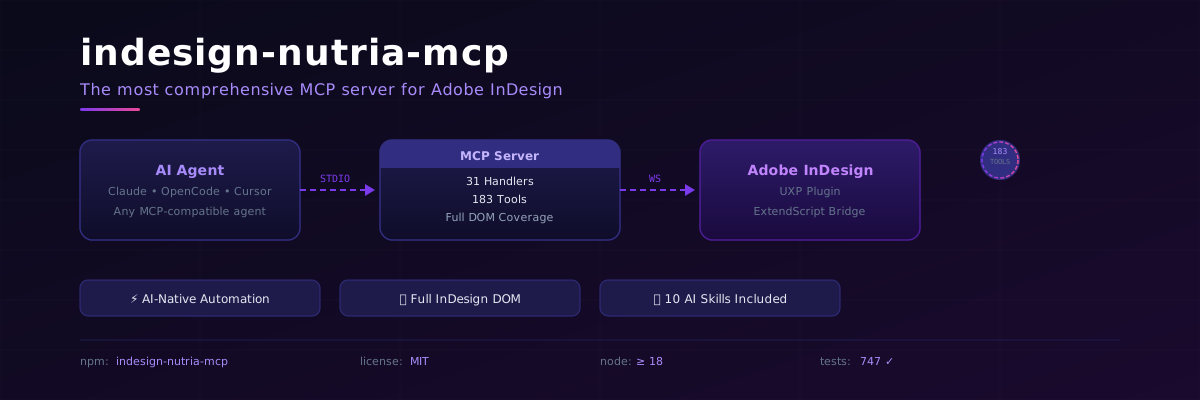
Say "Create an A4 document with 5 pages, add a red circle on page 3" — and it happens.
The most comprehensive MCP server for Adobe InDesign. 199 tools. 35 handlers. Full DOM coverage.
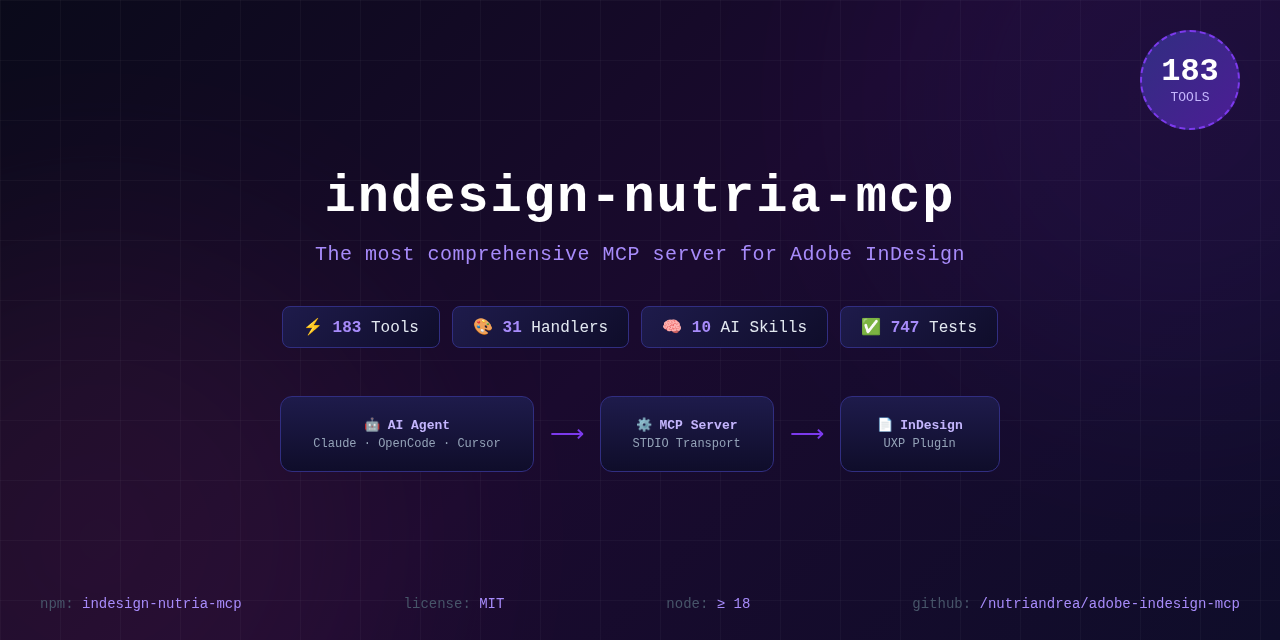
⚡ Click for a quick demo · v1.1.0 release



Published to npm as
indesign-nutria-mcp. Your agent starts it withnpx -y indesign-nutria-mcp— see Quick Start. InDesign still runs on your machine: the server reaches it over a local bridge, and nothing leaves the box.
🚀 Why This Exists
InDesign automation has been broken for 20 years. ExtendScript is ancient. CEP panels are over-engineered. UXP scripting requires a CS degree. You just want AI to do the layout.
This MCP server fixes that. Clone it, point your agent at it, and InDesign is yours to drive like a puppeteer.
🆚 MCP vs The Old Ways
| MCP (this) | ExtendScript | CEP Panels | UXP Scripts | Manual | |
|---|---|---|---|---|---|
| Learn in | 30 seconds | 3 weeks | 2 months | 1 month | 0 (slow) |
| AI-native | ✅ Any MCP agent | ❌ | ❌ | ❌ | ❌ |
| Tool count | 199 | Unlimited (you write them) | 5-20 typical | 5-20 typical | ∞ (manual) |
| Error messages | Human-readable | Opaque crashes | Varies | Better | N/A |
| Setup time | 5 minutes | 10 minutes | 2 hours | 30 minutes | Instant |
| Undo support | ✅ Built-in | ❌ | Varies | ❌ | ✅ |
| Search text | text_search("pattern") |
Write 50 lines | Maybe | Maybe | Ctrl+F |
| Debug mode | ✅ Stack traces | ❌ | Varies | Limited | N/A |
| Remote control | ✅ Anywhere STDIO works | ❌ InDesign-only | ❌ | ❌ | N/A |
| Maintenance | Zero (we handle 199 tools) | You write+test everything | Fragile | Fragile | N/A |
✨ What It Can Do
📝 Text & Typography (27 tools)
Create frames, set content, apply paragraph/character styles, control formatting, search with GREP, find/replace, apply fonts, set columns, insets, auto-size, vertical justification, drop caps, keep options, hyphenation, tabs, paragraph rules, text wrap, baseline, linking/unlinking.
🎨 Shapes & Objects (20 tools)
Rectangles, ellipses, polygons, lines, groups, anchored objects — create, modify, delete, list, arrange.
🖼️ Images (5 tools)
Place from disk, query metadata, fit/proportional, adjust brightness/contrast, relink.
🎭 Colors & Swatches (6 tools)
CMYK/RGB/LAB/spot swatches, ink list, gradients, apply to fill/stroke.
📄 Pages & Documents (15 tools)
Create, open, save, close, getInfo, listOpen — plus page add/delete/duplicate/move/getInfo/listAll/applyMaster, sections.
📊 Tables (20 tools)
Create, set cells, add/delete rows/columns, merge/split, alignment, fills, strokes, insets, header/footer, row/column sizing, table styles, cell styles.
🧬 Styles (10 tools)
Paragraph, character, object styles — create, list, duplicate, delete, apply.
🏗️ Masters & Books (10 tools)
Master spreads — create, duplicate, apply, delete, list, getPages. Books — list, open, getDocuments, synchronize.
📤 Export (9 tools)
PDF, EPUB, HTML, JPG, PNG, package — plus preflight, font/swatch/table lists, and script_run() for custom ExtendScript.
🔍 Find & Replace (5 tools)
GREP find/replace, format-aware find/replace.
🔄 Transform (5 tools)
Align, distribute, rotate, scale, flip.
🔗 Interactive (5 tools)
Hyperlinks, buttons, cross-reference anchors.
📚 References (10 tools)
Footnotes, endnotes, cross-references, index entries/topics/generation.
📋 Lists (6 tools)
Define, apply to paragraph/selection, remove, restart numbering.
🧩 XML & Data Merge (11 tools)
XML tags, import/export, data merge with CSV/TSV/XML sources.
🔧 Other
Layers, effects (drop shadow, feather, transparency), TOC, sections, undo/redo, undo groups.
🧠 Included AI Skills
Ten skills ship with the repo, auto-loaded by trigger keywords when you use any AI agent:
| # | Skill | What it does for you |
|---|---|---|
| 1 | Aesthetic Preference | Asks 8 questions before any creative work — font, palette, style, margins. Builds a persistent JSON profile. |
| 2 | Layout Readability | Validates overlays, contrast, orphans/widows, hierarchy, spacing, overflow before delivery. |
| 3 | Export & Verify | Mandatory modify → export JPG → analyze pixels → fix → repeat cycle. |
| 4 | Import Word | Imports .docx, maps Word styles to InDesign paragraph styles. |
| 5 | Batch Operations | Applies the same modification across N pages. |
| 6 | Image Optimize | Place, resize, DPI check, relink. Profiles for print (300dpi CMYK) vs web (72dpi RGB). |
| 7 | Table Format | Creates and styles tables — columns, rows, borders, fills, merge cells. |
| 8 | Template Manager | Save/load reusable page templates. |
| 9 | Export Batch | Export same document to multiple formats at once with different profiles. |
| 10 | Style Extractor | Scans .indd files, extracts full style profile (fonts, colors, styles, masters, margins) as JSON, replicates on new layout. |
🏗️ Architecture
┌─────────────────────┐       STDIO        ┌──────────────────────┐     WebSocket     ┌──────────────────┐
│  Any AI Agent       │ ◄────────────────► │  indesign-nutria-mcp │ ◄───────────────► │  Adobe InDesign   │
│  (Claude, OpenCode, │                    │  (Node.js MCP Server) │     port 8120     │  + UXP Plugin     │
│   Cursor, etc.)     │                    │  35 handlers         │                    │  + ExtendScript    │
└─────────────────────┘                    │  199 tools           │                    └──────────────────┘
                                           │  10 AI skills        │
                                           └──────────────────────┘
Two ways to reach InDesign
The MCP protocol always speaks stdio. Only the last hop differs, and you pick one per platform:
| macOS | Windows | |
|---|---|---|
| With plugin | UXP panel in plugin/ |
UXP panel in plugin/ |
| Without plugin | node bridge-proxy.mjs (JXA/osascript) |
COM_BRIDGE_ENABLED=true (in-process COM) |
Both are supported. The plugin is the richer path (it also emits change
events); the proxy exists for setups where you cannot or do not want to load a
UXP panel. See WINDOWS.md for the Windows bridge and
start-bridge.sh for the macOS one.
Full breakdown: the four macOS processes, the request lifecycle, the error contract and the trust boundaries are in docs/architecture.md.
Full Handler Catalog
| Handler | Tools | Key Features |
|---|---|---|
| AnchoredObject | 5 | create, getSettings, release, setPosition, setProperties |
| Book | 4 | list, open, getDocuments, synchronize |
| Changes | 1 | getStatus — what changed since T?, without touching InDesign |
| Color | 6 | swatch CRUD, inks, gradients, apply |
| DataMerge | 5 | selectDataSource, listFields, mergeRecords, export, removeDataSource |
| Document | 9 | create/open/save/close, getInfo, listOpen, getState, getPageStories, getStoryPages |
| Effect | 4 | drop shadow, feather, transparency, gradient feather |
| Export | 11 | multi-format export, print packaging, batch folder, preflight, fonts/swatches/tables/masters/XML, executeScript, script_run |
| Font | 5 | list, find, change, missing check, glyph insert |
| Grep | 4 | find, replace, findFormat, replaceFormat |
| Image | 5 | place, info, adjust, fit, relink |
| Index | 4 | addEntry, createTopic, generate, listTopics |
| Interactive | 5 | hyperlinks, buttons, anchors |
| Layer | 5 | create, delete, list, reorder, setProperties |
| List | 6 | define, apply, remove, restart numbering |
| Master | 6 | create, duplicate, apply, delete, list, getPages |
| Note | 4 | footnotes, endnotes |
| Object | 6 | shapes, groups, image links |
| Page | 7 | add, delete, duplicate, move, getInfo, listAll, applyMaster |
| Preview | 1 | document — render a page as an image the agent can see |
| Recipe | 2 | flow a placed text story across pages, export with a named PDF preset — each in one undo group |
| Resources | 6 | list/update/embed/unembed links, getLinkInfo |
| Section | 4 | create, list, setNumbering, delete |
| Shape | 6 | rectangle/ellipse/line/polygon create, delete, modify |
| Style | 7 | paragraph/character/object styles CRUD |
| Table | 16 | create, cells, rows/columns, merge/split, alignment, fills, strokes, header/footer |
| TableStyle | 4 | tableStyle, cellStyle CRUD |
| Text | 7 | frames, content, stories, findReplace, BOM filtering, timeout |
| TextAdvanced | 20 | columns, wrap, links, drop caps, rules, tabs, formatting read/write, search |
| Typography | 1 | read-only audit of fonts in use, size/leading pairs, style usage and overrides |
| Toc | 4 | createStyle, generate, update, listStyles |
| Transform | 5 | align, distribute, rotate, scale, flip |
| Undo | 5 | undo, redo, history, beginGroup, endGroup |
| Xml | 6 | tags CRUD, tag/untag items, import/export |
| Xref | 3 | create, list, updateFormat |
| 199 | 35 handlers, no duplicates |
tests/contract/toolInventory.test.ts pins this number, so the table cannot
drift from the code without failing CI.
Verified end-to-end against InDesign 2026 (21.3) on the plugin-free macOS path: MCP stdio → WebSocket bridge → JXA proxy → InDesign, creating a document, adding a text frame, reading it back, and closing.
Closing documents from an agent?
document_closedefaults tosaveOptions: "no"— the only value that cannot raise a modal dialog."ask"opens a save prompt, and"yes"opens a Save As dialog for a document that was never saved; both block the script until the bridge times out. Save first withdocument_save { filePath }, then close.
MCP Resources
| URI | What it gives you |
|---|---|
mcp://session/status |
Active document session state |
mcp://bridge/status |
WebSocket bridge health + queue depth |
mcp://tools/inventory |
Full 199-tool catalog for agent self-discovery |
mcp://document/active |
Currently active document info |
🎯 Use Cases
🏢 Agency Production
"Create a 200-page catalog from this CSV. Product name in 14pt Arial Bold, price in 12pt Arial Regular, description in 10pt. Add a red 'SALE' badge on page 1, 50, 100, 150. Export as PDF."
📚 Book Publishing
"Import this Word document. Map Heading 1 to 'Chapter Title' style, Normal to 'Body Text'. Add running headers with page numbers. Generate a TOC. Export to PDF with crop marks."
🎨 Creative Automation
"Take this InDesign template and generate 50 variations with different colors and text from this spreadsheet. Export each as a separate PDF."
🏭 Print Production
"Check all 200 files for missing fonts and broken links. Fix them. Export as PDF/X-1a."
🔄 Continuous Publishing
"Every morning at 8am, update the daily newspaper template with fresh content from our CMS, preflight, and upload to the web server."
⚡ Quick Start (30 seconds)
Two halves: the server your agent runs — one line from npm, no clone and no build — and the bridge that reaches InDesign on this machine.
1️⃣ Connect InDesign
The server listens on 127.0.0.1:8120; something still has to drive InDesign.
Pick by platform:
macOS — with the UXP panel (also emits change events)
- Open UXP Developer Tool
- Load the
plugin/directory — it ships in this repository, so clone it once:git clone https://github.com/nutriandrea/adobe-indesign-mcp(no build step) - Open the MCP Bridge panel — it connects on its own
macOS — without the panel
git clone https://github.com/nutriandrea/adobe-indesign-mcp
cd adobe-indesign-mcp
npm install            # gives the proxy its `ws` dependency; nothing to build
./start-bridge.sh      # launches InDesign, then the JXA proxy
Windows — no bridge process. The COM bridge drives InDesign in-process, so
Windows needs neither the clone nor a second process; it is enabled by the env
var in the config you use in step 2 (see
examples/claude-desktop.windows.json).
See WINDOWS.md for the details and caveats.
2️⃣ Connect your AI agent
Both hosts start the same published package — nothing to clone, nothing to build.
Claude Desktop:
{
  "mcpServers": {
    "indesign": {
      "command": "npx",
      "args": ["-y", "indesign-nutria-mcp"]
    }
  }
}
OpenCode (project opencode.json, or the same block in
~/.config/opencode/opencode.json):
{
  "mcp": {
    "servers": {
      "indesign": {
        "type": "local",
        "command": ["npx", "-y", "indesign-nutria-mcp"]
      }
    }
  }
}
On OpenCode the servers live under mcp.servers, not mcpServers, and the
command is an array — that is the documented V2 shape.
Ready-made files for Claude Desktop, Cursor and Claude Code — including the
Windows COM variant — are in examples/. Each one is
copy-paste.
3️⃣ Start creating
🤖 "Create a landscape A3 document with 3 pages."
🤖 "Add a blue rectangle covering the top half of page 1."
🤖 "In the rectangle, add text 'Hello World' in white, Arial Bold 72pt."
🤖 "Export page 1 as JPG."
📝 Notes for MCP client developers
Building a custom client (script, harness, test runner) against this server? Two lessons from real-world integration:
| Pitfall | Fix |
|---|---|
Large responses arrive split across stdout chunks. preview_document at 150ppi returns ~100+ KB of base64 — more than one pipe chunk. Parsing each data event with JSON.parse(chunk) silently drops the pieces and the call appears to hang forever. |
Accumulate stdin into a buffer and only JSON.parse complete newline-delimited lines: buf += chunk; while ((i = buf.indexOf('\n')) >= 0) { parse(buf.slice(0, i)); buf = buf.slice(i + 1); } |
Image tools return image content, not text. preview_document responds with { type: 'image', mimeType: 'image/png', data: '<base64>' } — reading .text yields undefined. |
Read the base64 payload from content[0].data (check content[0].type). |
Every message is a single-line JSON-RPC object terminated by \n; there is no framing beyond the newline.
🆕 What's New in v1.6.0
Fixed
| ⚠️ | Read this before you script |
|---|---|
| The layout skill named tools that do not exist | skills/indesign/indesign-mcp-layout/SKILL.md advertised an mcp_indesign_* prefix the registry never used, and pointed connectivity checks at health_check and list_ai_skills — neither is registered by any handler. A skill is instruction, so naming a tool that does not resolve sends a model into a second failure on top of the one it was recovering from. |
| Change | What it means for you |
|---|---|
| The skill names real tools now | It points at the bare tool names the registry actually exposes, and documents the read-only resources (mcp://bridge/status and friends), which never touch InDesign and cost no round-trip. |
| Skills are guarded like the instructions are | tests/unit/skillGuidance.test.ts walks every SKILL.md under skills/ and marketplace/ and fails on a tool name the registry does not know — and on a skill whose frontmatter name disagrees with its folder. Regression-proven against the bug above. |
| Marketplace counts are checked too | verify:tool-counts now reads the markdown under marketplace/, so the number quoted to a buyer is checked alongside the README, llms.txt and the package description. |
Added
| Change | What it means for you |
|---|---|
| Client configs | examples/ holds copy-paste configs for Claude Desktop (macOS, and the Windows COM variant), Cursor and Claude Code, plus examples/README.md. |
| Registry and bundle metadata | server.json — generated from package.json and gated by verify:server-json — and mcpb/manifest.json, so the MCP Registry and an MCP Bundle can be published from the same release. |
| Release automation | release.yml takes a tag through verify and verify:pack, publishes to npm with provenance, builds the .mcpb and attaches it to the GitHub Release with the CHANGELOG notes. publish-mcp-registry.yml chains off the release, so the registry never advertises a version npm does not have. validate-release-tag.sh refuses a tag that disagrees with package.json or has no CHANGELOG section. |
| A packaged companion skill | marketplace/agensi/ prepares the skill for a third-party marketplace, with npm run build:agensi asserting the archive shape the reviewer requires — one top-level folder, SKILL.md at its root, text files only. Like mcpb/, it does not ship to npm. |
v1.5.0
For AI agents
| ⚠️ | Read this before you script |
|---|---|
Pass document_id — don't trust the front tab |
Every tool takes an optional document_id: a document name (as document_listOpen reports it) or a 0-based index. With more than one document open the front tab is not reliably the intended target, and a call that lands on the wrong document edits the wrong file. Call document_getState, then pass document_id on everything that follows. |
| Change | What it means for you |
|---|---|
document_id on every tool |
199 tools, one extra optional parameter. Omit it and a tool acts on the front document — exactly the previous behaviour, so nothing you already send changes. |
| A target that is not open fails loudly | document_id 'Gone.indd' is not open. Open documents: A.indd, B.indd, classified document_not_found and suggesting document_listOpen. Previously the script silently edited whichever document happened to be frontmost. |
| One shared resolver | app.activeDocument was written inline in 197 places across 32 handlers; __resolveDocument() is now injected with every script and every document-scoped handler resolves through it, so the target holds for the whole call — even if the front tab changes mid-script. |
| Safe by construction | document_id reaches InDesign as a JSON string literal and is matched by name, so it is never executable. It is bound per call in AsyncLocalStorage, so a call that awaits before dispatching cannot be hijacked by a concurrent one. |
Changed
| Change | What it means for you |
|---|---|
| The "pin the document" advice is now executable | The connect-time contract used to tell the host to ask which document was meant. It now names document_id and how to pass it, and the shipped indesign-mcp-layout skill points at it too. |
v1.4.3
For AI agents
| ⚠️ | Read this before you script |
|---|---|
| Failures now tell you how to recover | A failing call returns a JSON envelope { ok: false, code, message, suggested_next_tool?, suggested_args? } instead of prose. Branch on code, and call suggested_next_tool when it is present rather than guessing. |
| State before action | document_getState returns the front document's geometry, its index, every open document, the active layer and the selection count in one round-trip. Call it before mutating instead of assembling that state from four separate calls. |
| A recipe is one call, not a chain | recipe_flowTextStory places a text file and flows it across pages; recipe_exportPreset applies a named PDF preset and exports. Measured live, the flow cost 1 call / 215 bytes against 6 calls / 786 bytes for the nearest atomic chain — which cannot place the text at all. |
| Change | What it means for you |
|---|---|
| Structured error envelopes | Sixteen failure classes, each with a suggested_next_tool checked against the live registry (a bad frame index suggests document_getInfo; a timeout suggests document_listOpen). ExtendScript errors carry line, file and stack. |
| A workflow contract on connect | The server advertises roughly 680 tokens of instructions — bridge bootstrap, state-before-action, the document_close save trap, the error-envelope shape and undo grouping. |
document_getState |
One round-trip replaces the document_getInfo + document_listOpen + layer + selection sequence. |
preview_document takes documentIndex |
Render any open document, not only the front one. Exports are capped at 4 MB and re-rendered once at a fitting resolution before failing with output_too_large. |
| Two new recipes | recipe_flowTextStory and recipe_exportPreset, bringing the catalog to 197. |
| Opt-in success envelope | RESPONSE_ENVELOPE_SUCCESS (or responseEnvelope.success) wraps successful results as { ok: true, ... }, so a single key covers success and failure. Off by default, because it changes the response shape. |
| A smaller, correct package | A files allowlist replaces the .npmignore denylist: 1.6 MB unpacked, down from 4.4 MB — and the bridge-proxy.mjs that the macOS launcher execs is now actually shipped. |
Changed
| Change | What it means for you |
|---|---|
| Error responses are JSON text | The failure message is preserved verbatim inside the envelope; isError: true is unchanged. |
document_close defaults saveOptions to "no" |
"ask" raised a modal save dialog that blocked until the bridge timed out and could leave InDesign wedged; "no" cannot prompt. Call document_save first when you want the work kept. |
Fixed
| Fix | What it means |
|---|---|
Every call after undo_beginGroup failed |
wrapExtendScript set app.scriptPreferences.undoMode, a property InDesign does not have. Undo groups now run through app.doScript(..., UndoModes.ENTIRE_SCRIPT). |
undo, redo and undo_history threw on every call |
They read document.undoable / document.redoable, which are not part of the DOM. |
| The server reported itself as v1.0.0 | Four releases after v1.0.0 it advertised the old literal on initialize. SERVER_VERSION is now the single source of truth, and two gates keep it honest. |
v1.4.2
For AI agents
| ⚠️ | Read this before you script |
|---|---|
| Prefer the typed tools | export_executeScript and script_run have no cancellation. A hung script leaves the bridge busy and every later call queues behind it until the host restarts. Loops, font enumeration and multi-mutation probes belong in the typed tools, which validate arguments and time out. See skills/indesign/indesign-mcp-layout. |
| Change | What it means for you |
|---|---|
| The bridge protocol is now canonical | Responses are { type: 'result', id, result } or { type: 'error', id, error }. Legacy success/response types are still accepted on input, but an unknown type with a valid id is now an explicit error instead of a silently resolved promise. |
| Plugin-free macOS setup | start-bridge.sh launches InDesign and the JXA proxy — no UXP panel to load. |
| The JXA proxy no longer blocks or corrupts | Scripts reach osascript through a temp file instead of shell-quoted -e strings, and execution is asynchronous with a FIFO queue. A script containing a quote, backslash or newline can no longer be mangled, and the MCP server keeps answering while InDesign works. |
| Configurable InDesign version | INDESIGN_APP replaces the hardcoded "Adobe InDesign 2024" process name. |
| The panel connects itself | The MCP Bridge panel connects on open, so there is no Connect click to miss. |
| InDesign 2026 anchoring | Creating an anchored object no longer depends on move(), which 2026 rejects for insertion-point targets. |
| The shipped config starts everywhere | It declared the wrong MCP transport and would have aborted startup on macOS and Linux had it enabled the Windows COM bridge. Both are now covered by a test. |
v1.4.0
| Change | What it means for you |
|---|---|
Agent vision: preview_document |
Render any page as an image the agent can actually see — layout mistakes get caught in the loop, not after export. |
Batch PDF: export_batchFolder |
Export every .indd in a folder to PDF in one call, with per-file results. |
| Windows COM bridge | Run with zero plugins via COM_BRIDGE_ENABLED=true. See WINDOWS.md. |
| Hardened file paths | Every file-touching tool validates paths up front — traversal attempts (..) and system directories are rejected before InDesign ever sees them (now 11 guarded call sites). |
v1.3.0
| Change | What it means for you |
|---|---|
| InDesign 2026 ready | Color and anchored-object tools work on 2026's renamed enums — no more silent failures after upgrading. |
| Real env var config | Every setting in .env.example is now honored: BRIDGE_PORT, HTTP_BRIDGE_ENABLED, LOG_LEVEL, … Invalid values never block startup. |
| No more 30s hangs | If the plugin isn't connected, tool calls fail instantly with "Bridge is not connected" instead of timing out. |
| One escaping path | All handlers share a single battle-tested ExtendScript string escaper. |
| Hardened path validation | File-path checks now use true containment (no prefix-collision escapes). |
| Honest status | getStatus().connected reflects actual plugin connectivity, and CI enforces coverage gates. |
What's New in v1.1.0
| Feature | Tools | What it solves |
|---|---|---|
| Text formatting read | text_getFormatting |
Get font/size/style per text range. No more custom scripts. |
| Character style apply | text_applyCharStyle |
Apply to a range in one call. |
| Font apply | text_applyFont |
Apply font family/style/size to a range. |
| Text search | text_search, text_searchFormatting |
GREP + format-aware search with paragraph-relative positions. |
| Story→Page map | document_getPageStories, document_getStoryPages |
Which stories are on which pages. |
| Undo groups | undo_beginGroup, undo_endGroup |
Group operations into one undo step. |
| Debug mode | script_run(code, debug=true) |
Full ExtendScript stack traces. |
| BOM filtering | Text reads | \ufeff and \u0004 filtered by default. |
| Timeout/maxResults | text_getStories, etc. |
Custom limits for large documents. |
| MCP resources | mcp://tools/inventory |
Agent auto-discovers all tools. |
⚙️ Configuration
All settings have defaults — zero config required. To customize, copy .env.example to .env or pass a JSON file; environment variables win over the file:
BRIDGE_PORT=8120            # WebSocket port the UXP plugin connects to
HTTP_BRIDGE_ENABLED=false   # optional REST fallback bridge
HTTP_BRIDGE_PORT=3000
SERVER_TRANSPORT=stdio      # stdio | websocket
LOG_LEVEL=info              # debug | info | warn | error
COM_BRIDGE_ENABLED=false    # Windows only: drive InDesign over COM, no plugin
RESPONSE_ENVELOPE_SUCCESS=false  # wrap successful results as { ok: true, ... }
The plugin-free macOS proxy takes its own variables:
INDESIGN_APP="Adobe InDesign 2026"     # matches your installed version
BRIDGE_WS_URL=ws://127.0.0.1:8120
BRIDGE_TIMEOUT_MS=120000               # a long export is not a hang
BRIDGE_RECONNECT_DELAY_MS=3000
Precedence: environment variables > JSON config file > defaults. Invalid values are ignored, never fatal.
🪟 Windows
Two ways to run on Windows: the standard UXP plugin flow (identical to macOS) or the new opt-in COM bridge that needs no plugin at all. See WINDOWS.md.
📦 Project Structure
…
Releases