
Directory · #17 trending MCP repo · ↗ +408 stars this week
Gentle AI
Gentleman-Programming/gentle-ai
Gentle-AI configures the AI coding agents you already use: Claude Code, Cursor, OpenCode, Codex, Pi, and more. Choose persistent memory, Organic-Driven Development, curated skills, MCP servers, personas, and optional bounded review. Open source, no agent lock-in.
- Stars
- 8.6k
- This week
- +408
- Forks
- 886
- Open issues
- 393
- Skills inside
- 26
Inside this repo
26 skills
internal/assets/skills/branch-prchained-prTrigger: PRs over 400 lines, stacked PRs, review slices. Split oversized changes into chained PRs that protect review focus.internal/assets/skills/chained-prcognitive-doc-designDesign docs that reduce cognitive load. Trigger: writing guides, READMEs, RFCs, onboarding, architecture, or review-facing docs.internal/assets/skills/cognitive-doc-designcomment-writerWrite warm, direct collaboration comments. Trigger: PR feedback, issue replies, reviews, Slack messages, or GitHub comments.internal/assets/skills/comment-writergentle-ai-benchTrigger: bench, journey, journeys, driven mode, gentle-ai-bench, journey corpus, j-numbers, bench axis. Author and verify gentle-ai bench journeys; go test ./bench never proves driven execution.internal/assets/skills/gentle-ai-benchgo-testingTrigger: Go tests, go test coverage, Bubbletea teatest, golden files. Apply focused Go testing patterns.internal/assets/skills/go-testinghermes-ephemeral-delegationTrigger: a mapping need, parallel units, context backstop, high-risk verify, fresh review, or multi-step debug. Delegate via delegate_task for a named reason.internal/assets/skills/hermes-ephemeral-delegationissue-creationTrigger: issue creation, bug reports, feature requests, or issue approval. Create and triage GitHub issues from repository evidence.internal/assets/skills/issue-creationjudgment-dayTrigger: judgment day, dual review, adversarial review, juzgar. Run explicit blind dual review with at most two scoped fix/re-judgment rounds.internal/assets/skills/judgment-dayrdd-defect-workflowTrigger: RDD, receipt-driven development, review authority, receipt/lineage, correction/recovery, delivery gate/kill switch, bounded review defects. Guide work.internal/assets/skills/rdd-defect-workflowskill-creatorTrigger: new skills, agent instructions, documenting AI usage patterns. Create LLM-first skills with valid frontmatter.internal/assets/skills/skill-creatorskill-improverTrigger: improve skills, audit skills, refactor skills, skill quality. Audit and upgrade existing LLM-first skills.internal/assets/skills/skill-improverskill-registryTrigger: update skills, skill registry, actualizar skills, after skill changes. Index available skills by trigger and path.internal/assets/skills/skill-registrysystemic-issue-triageTrigger: new issue, bug report, triage, backlog, issue flood, community report, root cause, dead-end, blocked user. Attack issues by root class, never one-by-one; fixes must shrink the system, not grow it.internal/assets/skills/systemic-issue-triagework-unit-commitsPlan commits as reviewable work units. Trigger: implementation, commit splitting, chained PRs, or keeping tests and docs with code.internal/assets/skills/work-unit-commitsgentle-ai-branch-prTrigger: preparing branches or PRs for Gentleman-Programming/gentle-ai. Apply this repository's issue-first contribution policy.skills/branch-prgentle-ai-chained-prTrigger: PRs over 400 lines, stacked PRs, review slices. Split oversized changes into chained PRs that protect review focus.skills/chained-prcognitive-doc-designDesign docs that reduce cognitive load. Trigger: writing guides, READMEs, RFCs, onboarding, architecture, or review-facing docs.skills/cognitive-doc-designcomment-writerWrite warm, direct collaboration comments. Trigger: PR feedback, issue replies, reviews, Slack messages, or GitHub comments.skills/comment-writergentle-ai-benchTrigger: bench, journey, journeys, driven mode, gentle-ai-bench, journey corpus, j-numbers, bench axis. Author and verify gentle-ai bench journeys; go test ./bench never proves driven execution.skills/gentle-ai-benchgentle-ai-collab-perfectTrigger: contributing to Gentleman-Programming/gentle-ai as an external collaborator. Strict issue-first workflow, honest PR bodies, contributor-vs-maintainer scope, chained-PR strategy, verification protocol, docstring coverage. Load whenever the active repo is Gentleman-Programming/gentle-ai and askills/gentle-ai-collab-perfectissue-root-resolutionTrigger: root audit, atacar la raíz, issue roots, backlog roots, mechanism map, deletion-driven fix, resolver issues de raíz, close outdated issues. Audit and resolve issue clusters by verified root cause.skills/issue-root-resolutionrdd-advisory-transportTrigger: reviewer transport, advisory transport, review adapter, lens prompt/schema, OpenCode reviewer plugin, Codex reviewer, ReviewProviderContract. Enforce the shared Go advisory reviewer transport contract.skills/rdd-advisory-transportrdd-defect-workflowTrigger: RDD, receipt-driven development, review authority, receipt/lineage, correction/recovery, delivery gate/kill switch, bounded review defects. Guide work.skills/rdd-defect-workflowsystemic-issue-triageTrigger: new issue, bug report, triage, backlog, issue flood, community report, root cause, dead-end, blocked user. Attack issues by root class, never one-by-one; fixes must shrink the system, not grow it.skills/systemic-issue-triagework-unit-commitsPlan commits as reviewable work units. Trigger: implementation, commit splitting, chained PRs, or keeping tests and docs with code.skills/work-unit-commitsDocumentation
README

Gentle-AI™
The deterministic engineering environment for the AI agent you already use.





Website • Quickstart • Docs • Wiki
Your agent writes code, then forgets everything. It has no opinion about your project, and no way to prove what it did beyond asking you to read every line. Gentle-AI gives it memory, a workflow, and evidence.
See it in action
One prompt, from idea to reviewed commit: memory, workflow, and evidence in a real session.
https://github.com/user-attachments/assets/fa5c0cfe-06e7-4c0d-bd6e-8ac7cb934339
Prefer Spanish subtitles?
https://github.com/user-attachments/assets/6d2bc422-a4dd-4ecf-a04b-fcd3bea7fea9
If Gentle-AI made your agent worth trusting, a star helps other people find it.
WORKS WITH THE AGENT YOU ALREADY HAVE
Pi ·
OpenCode ·
Claude Code ·
Codex ·
Cursor ·
VS Code Copilot ·
Gemini CLI ·
Kilo Code
Kimi Code ·
Kiro IDE ·
Qwen Code ·
Hermes ·
Antigravity ·
Windsurf ·
OpenClaw ·
Trae ·
Conductor
17 integrations · native configuration · compare capabilities →

Features
Engram™ — Keep your project context
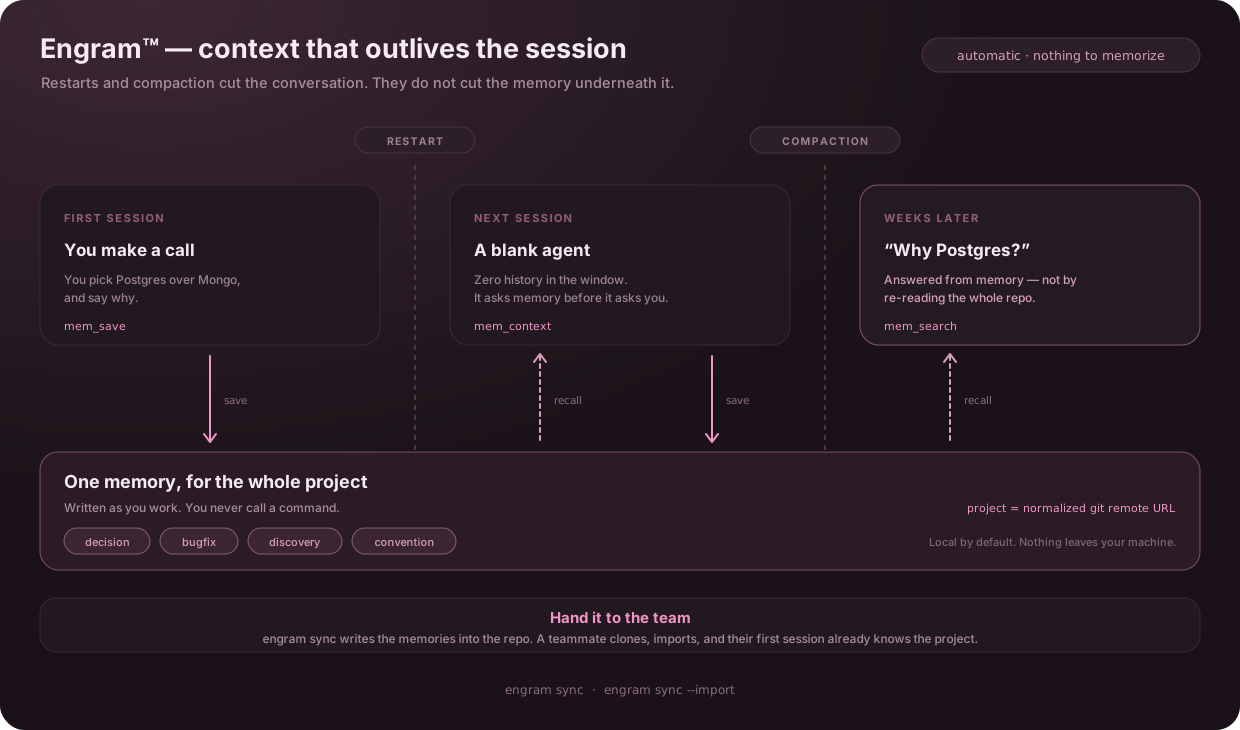
The cost of a fresh session is not the tokens — it is you, re-explaining the same decisions every morning. Engram removes that: your agent writes down what it learns as it goes and reaches for it before it reaches for you, so context accumulates instead of resetting.
ODD — Keep small work small
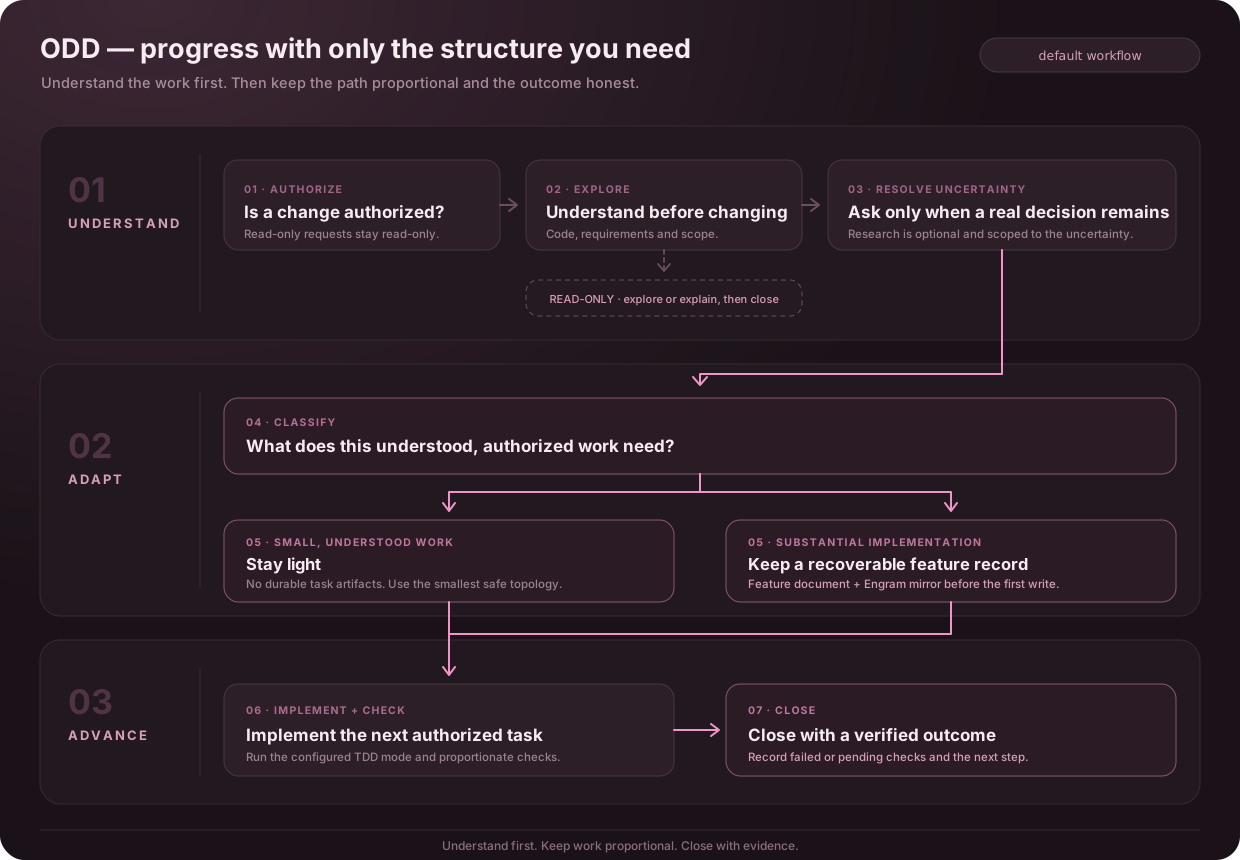
Small changes should not need a planning pipeline, and larger work should not lose its context between sessions. Organic Driven Development (ODD) keeps understood changes lightweight and gives substantial, authorized work one recoverable feature document. Questions, reviews and proposals stay read-only until you ask for a change. The agent explores before changing code, checks the results, and keeps progress current so work can resume without rebuilding the plan.
Tasks are sized by understanding, risk, and resumability, never by file count. A small task — understood, with contained risk, and resumable from the diff alone — runs inline: no subagents, no task document. Work becomes large only when it can't be resumed from the diff — several sessions, external waits, or requirements too long to survive compaction — never because of its size. The feature document of a large task holds your spec verbatim, and every handoff points at it instead of paraphrasing it.
https://github.com/user-attachments/assets/857a2195-34b8-4720-87af-f71bca3dec92
Delegate for a reason — Not for size
A subagent costs a fresh session, uncached reads, and a handoff. So the orchestrator delegates only when it can name the reason:
| Reason | When it applies |
|---|---|
| Exploration | Understanding needs more than one inline batch (about 3 calls and 10k tokens) or more than about five sequential lookups; one read-only explorer returns a short map with path:line evidence |
| Parallel writers | Two or more independent units of behavior (code, tests, and docs together) with disjoint edit surfaces, each needing several minutes of work: several files or roughly 100+ changed lines, because a subagent spends one to two minutes reading before it writes. A delivery that depends on another is not independent |
| Context backstop | A long session hands its next bounded unit to a fresh worker |
| Independent verifier | A change that names a high-risk item (data, security, shared contracts, concurrency, delivery, or no test that would catch a regression); never a native risk tier alone, an unclear or failed assessment, or the model that wrote the change |
A trigger holds only when its condition truly holds; none holds by default, and when in doubt the parent works inline. Without a reason the parent writes inline, following its feature document. File count, task size, or a model price ratio never decide the route on their own.
https://github.com/user-attachments/assets/ccd96c9e-e0fd-4504-ad94-0302398f13a9
Measured — What proportional routing changed
The routing rules above came from benchmarks, not intuition. These are Gentle Shell runs on a local benchmark with hidden acceptance suites; each cell is a single run (n=1), and cost is API-equivalent.
| Scenario | Before | After |
|---|---|---|
| 3-line bug in one function | 335 s · 56 turns · $0.339 | 77 s · 10 turns · $0.105 — inline, no subagents |
| Bug rooted in shared logic | 479 s · $0.361 | 276 s · $0.207 — one explorer |
| Data migration (high risk) | 559 s · $0.403 · needed a feedback round | 539 s · $0.555 · accepted on the first round — one independent verifier |
| 73-line spec, 26 hidden checks | Paraphrased handoffs: 13 failing, still 23/26 after two feedback rounds | Spec passed by reference (gentle-shell#1718) |
Against the same model in Codex CLI, with blind review of every solution, Gentle Shell was accepted on the first round in every cell and ranked higher on the medium (3 of 3 runs) and large tasks; it was close on the small one. The large task still took about three times longer (17.5–17.9 min vs 6.1 min) — that gap is open work. Sources: gentle-shell#1723, #1794, #1713.
Test-first by default — Prove each requested rule
ODD applies test-first development by default when a relevant runnable test and a clear expected outcome exist: capture a failing behavior test before implementation, make it pass, then refactor while tests stay green. Each requested rule gets one RED test, each touched existing command or option gets one test proving its previous behavior still holds, and nothing else is padded in. Without a meaningful runnable test, the agent explains the exception and runs applicable functional checks anyway.
RDD — Check finished work at the right depth
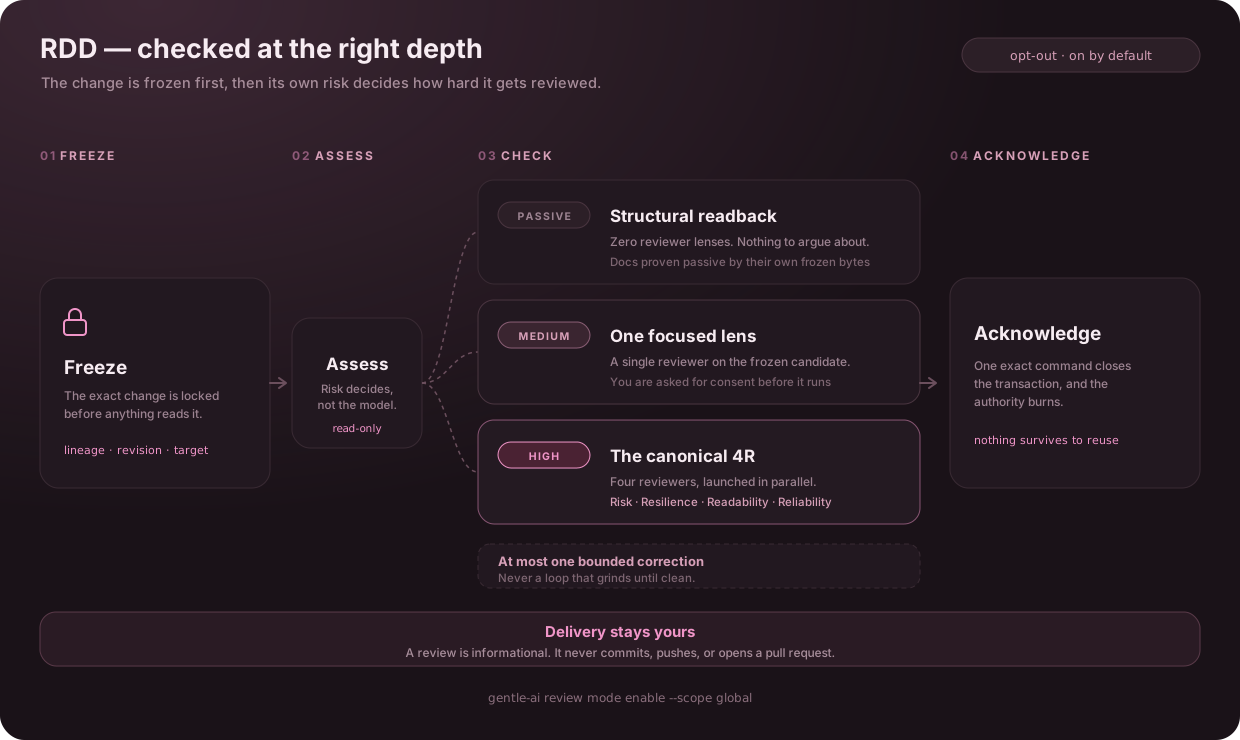
Receipt-Driven Development (RDD) is on by default and opt-out: run gentle-ai review mode disable to turn it off. Explicit global or clone-local OFF choices remain OFF. Its point is that a review cannot drift: the candidate is frozen before anything reads it, so the evidence belongs to the exact version you are about to rely on — not to whatever the worktree looked like a moment later. The depth comes from that frozen candidate rather than from the model's judgment, and the result is informational. Commit, push and release stay your call.
Review is proportionate: an automatic review is due only for a high-risk candidate, and the agent can name the 4R lenses that fit what it touched — with a reason frozen alongside the authority — instead of paying for all four. Verification by risk tier covers the rest.
https://github.com/user-attachments/assets/9d3b176f-6e59-48f3-aba2-1196f20a4a6f
Deterministic by design — Know the next valid step
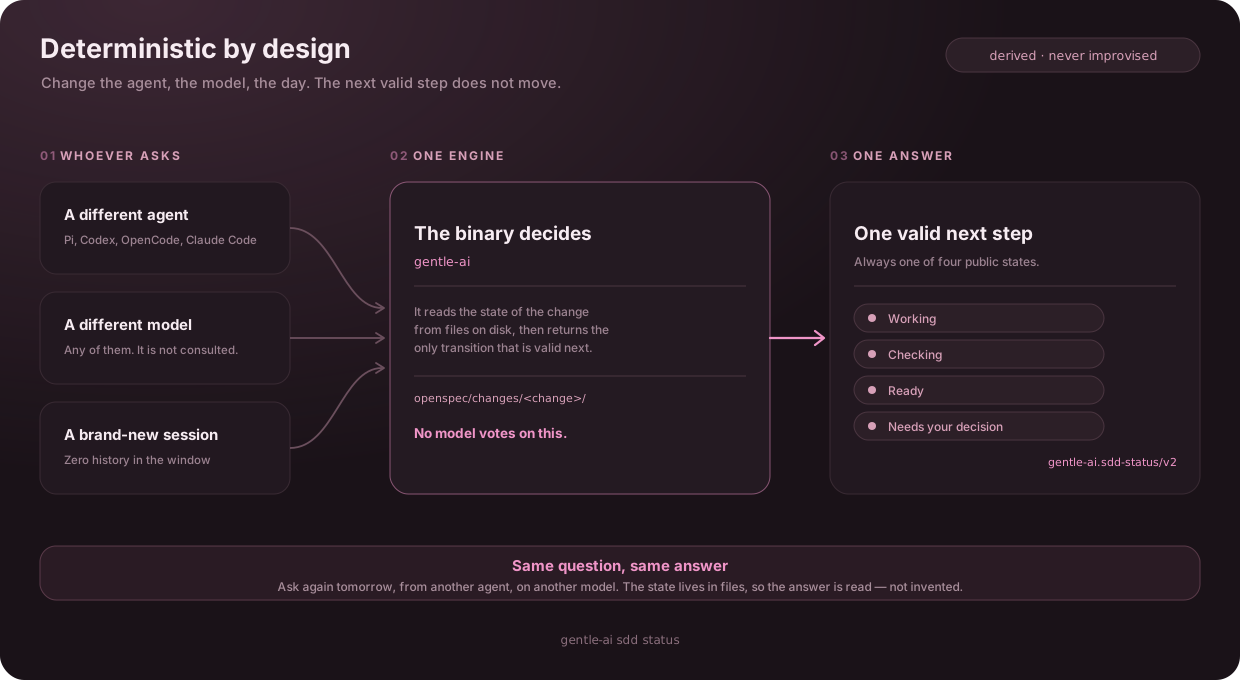
A model that guesses the next step guesses differently tomorrow, and differently again for your teammate. That is the gap between a workflow and a suggestion. The gentle-ai binary owns native RDD review transitions; ODD guidance keeps ordinary work proportional to the request. Review evidence is bound to the candidate rather than a model's recollection.
Gentle Shell — A complete workspace for Pi
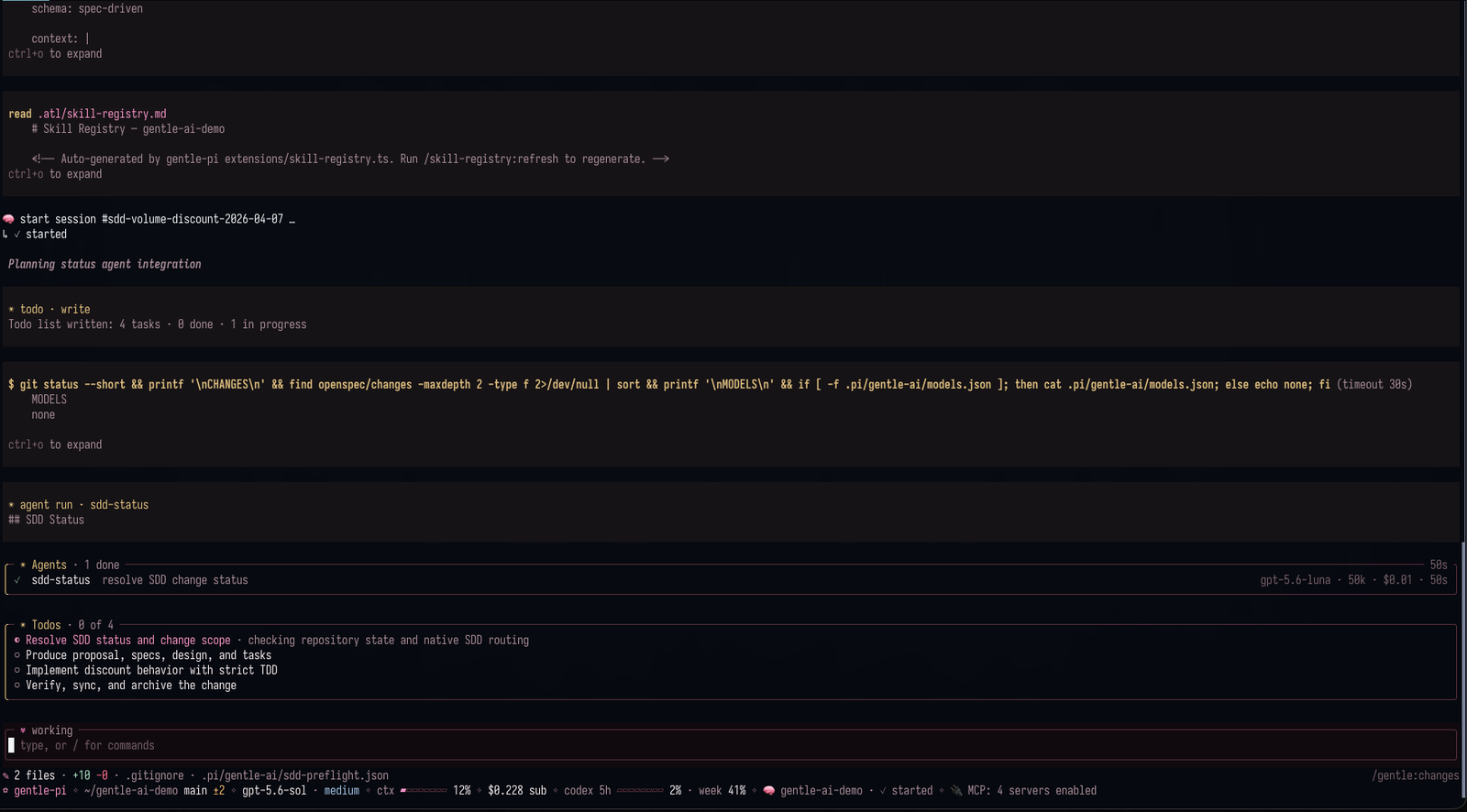
Gentle Shell is a separate Pi integration package. Gentle AI configures supported agents; Gentle Shell owns its own Pi runtime, agents, and interface. Installing or updating this binary does not itself establish Pi behavior parity.
On a clean machine, the Gentle Shell installers set up a self-contained, bundled Gentle Shell with its exact Pi, its pinned Gentle AI, and Engram.
17 agents — Keep the agent you already use
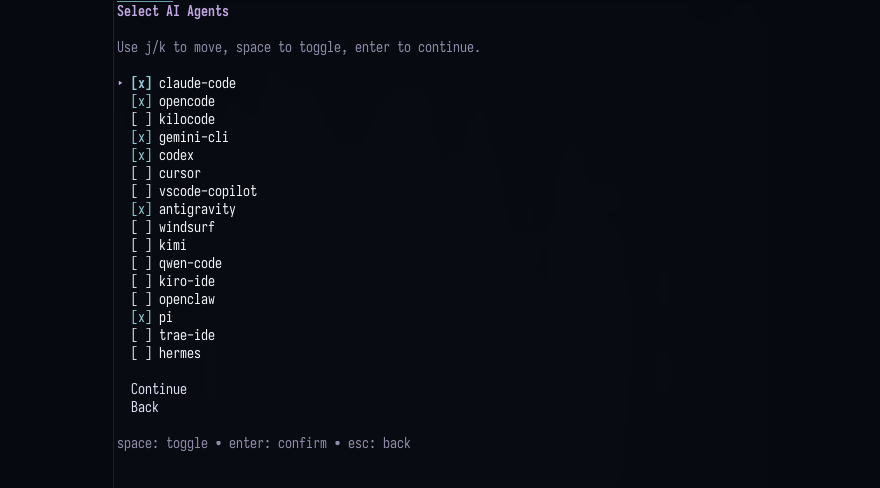
Gentle-AI brings its shared workflow to Pi, OpenCode, Claude Code, Codex, and thirteen more agents. Each integration uses that agent's native capabilities, so available features such as delegation and RDD review can differ.
Also in the box
| Component | What it does |
|---|---|
| Skills library | Loaded automatically when the task matches |
| Context7 MCP | Optional, selectable live framework and library documentation |
| CodeGraph | Read-only symbol graph of your codebase |
| Security deny-list | Blocks ~/.ssh, .env and credential files |
| Config backups | Snapshotted before every single write |
| Doctor | gentle-ai doctor — read-only health report |
| Personas | Optional personas; Gentleman is a caring but rigorous mentor who guides you toward your goal |
| Themes | Gentleman and Gentleman-Cute |
| Model assignment | Configure supported agent and review-role models where available |
Back to topEvery component, skill and preset: Full breakdown →
Get started
# macOS (Homebrew)
brew install gentleman-programming/tap/gentle-ai

# macOS / Linux (curl)
curl -fsSL https://raw.githubusercontent.com/Gentleman-Programming/gentle-ai/main/scripts/install.sh | bash

# Windows (PowerShell) — source install of the latest release, needs Go 1.25.10+
go install github.com/gentleman-programming/gentle-ai/v4/cmd/gentle-ai@v4.1.1
When the install directory is not on your PATH yet, install.sh adds one marked line (# gentle-ai installer) to the startup file your shell reads: ~/.zshrc for zsh, ~/.bashrc for bash on Linux, for bash on macOS the first existing of ~/.bash_profile, ~/.bash_login, or ~/.profile (else ~/.bash_profile), a conf.d file for fish, and ~/.profile otherwise. install.ps1 adds the directory to your user Path. Open a new terminal afterwards, or run the command the installer prints under Current terminal: to use gentle-ai in the current one. If the startup file is a symlink or cannot be edited, nothing is written and the installer prints the line to add yourself.
go install never changes your PATH. It puts gentle-ai in $(go env GOBIN) or, when that is unset, in $(go env GOPATH)/bin (usually ~/go/bin), and Go's Linux and macOS setups do not add that directory for you. If gentle-ai is not found after go install, add it once and open a new terminal (use your GOBIN directory instead when it is set, and ~/.zshrc for zsh):
echo "export PATH=\"$(go env GOPATH)/bin:\$PATH\"" >> ~/.bashrc
To install main with the PATH set up for you, use install.sh --channel beta, which runs go install from main and then adds its directory as described above:
curl -fsSL https://raw.githubusercontent.com/Gentleman-Programming/gentle-ai/main/scripts/install.sh | bash -s -- --channel beta
gentle-ai          # pick your agents, components and persona
gentle-ai doctor   # verify — read-only, changes nothing
If doctor cannot read state.json, inspect the reported file and parent directory's access; for permission errors, check permissions and ownership. Keep the existing state file. For invalid JSON, restore a valid backup or repair the content while preserving your installation settings. Then re-run gentle-ai doctor; it never changes the file or its permissions.
Then use your agent normally. Your configs are snapshotted before every write, and Gentle-AI never installs an AI agent for you — it configures what you already have.
Back to topBeta channel and per-distro prerequisites: Quickstart → · Signature verification: Release signing →
Documentation
| Where to go | What you'll find |
|---|---|
| Intended Usage | The mental model. If you read one page, read this one. |
| Quickstart · Usage | Install, prerequisites, every CLI command and flag |
| Agents | Feature matrix and per-agent notes for all 17 |
| ODD · Routing | Everyday direct and delegated work |
| Review · Architecture | The RDD contract, lifecycle and threat model |
| Engram · Components | Memory commands, skills, presets and personas |
| Contributing · Codebase Guide | Extend or contribute |
| Telemetry | What we count, and how to turn it off |
Community
Everything labelled up-for-grabs is scoped, approved and unclaimed — pick one and it's yours.


This project exists because of these people.
Back to topBuilt with Gentle-AI
Shipped something with Gentle-AI? Wear the rose. Paste this into your README and the badge links back here:

<a href="https://github.com/Gentleman-Programming/gentle-ai">
  <img width="220" src="https://raw.githubusercontent.com/Gentleman-Programming/gentle-ai/main/docs/assets/brand/built-with-gentle-ai.png" alt="Built with Gentle-AI" />
</a>
Prefer plain Markdown?
[](https://github.com/Gentleman-Programming/gentle-ai)
Keep the image URL exactly as shown — it is how I find and feature the projects that carry the badge.
Back to topAbout the author
Built by Alan Buscaglia (Gentleman Programming): 15 years of enterprise architecture, a community of thousands of developers testing these tools daily, and one rule for AI-assisted work — verifying beats generating.
Teams adopting AI and finding it isn't working — resistance, everyone prompting their own way, no shared quality bar — can reach out about engagements built on these same open-source tools →.


Gentle-AI is crafted with Gentle-AI

Trademark notice: The Gentle AI™ and Engram™ names and logos are trademarks of Alan Buscaglia. Both marks are used throughout this document; the symbol appears on the first prominent mention of each, and this notice covers the rest. The MIT License applies to the code; it does not permit implying endorsement or official affiliation. See TRADEMARKS.md.
Releases
Recent versions
v4.4.0v4.4.0 — Antigravity 1.4 Parity, Faster Gentle Shell Launches and Safer Windows Restoresv4.3.1v4.3.1 — Gentle Shell Installs and Updates from the TUI on Every Platformv4.2.0v4.2.0 — Gentle Shell's Routing Ships in the Provider Contractv4.1.1v4.1.1 — Consistent Module Checksum for the v4.1 Linev4.1.0v4.1.0 — Proportionate Native Review and a Clean SDD Exitv4.0.0v4.0.0 — SDD Retires, ODD Leads, Module Path Moves to /v4