
Directory · #277 trending MCP repo
MCP Gateway Registry
agentic-community/mcp-gateway-registry
Enterprise-ready MCP Gateway & Registry that centralizes AI development tools with secure OAuth authentication, dynamic tool discovery, and unified access for both autonomous AI agents and AI coding assistants. Transform scattered MCP server chaos into governed, auditable tool access with Keycloak/Entra integration.
- Stars
- 1.0k
- This week
- —
- Forks
- 259
- Open issues
- 128
- Skills inside
- 18
Inside this repo
18 skills
.claude/skills/agentcore-registerbenchmark-reportGenerate a benchmark report from stress test results (registration, API performance, search concurrency). Reads JSON result files and produces a markdown report suitable for docs/benchmarks/..claude/skills/benchmark-reportcreate-milestoneCreate a GitHub milestone for an upcoming release. Suggests the next version based on the latest release, gathers all merged PRs and closed issues since that release, presents a draft with two tables (Issues and PRs) for user approval, then creates the milestone and assigns all approved items..claude/skills/create-milestonedebugDebug issues in the MCP Gateway Registry using first-principles thinking. Invoke when something is broken, timing out, returning errors, or behaving unexpectedly. Forces structured root-cause analysis before any code change is proposed..claude/skills/debugexplainerExplain a GitHub issue or pull request at 100, 200, and 300 level. Verifies every claim against the code, then writes a markdown and a self-contained HTML version into .scratchpad/issue-NNNN/ or .scratchpad/pr-NNNN/ and opens it for preview. Starts no server; offers a command for anyone who wants on.claude/skills/explainergenerate-agent-cardGenerate an A2A agent card JSON by analyzing agent source code in a folder or GitHub URL. Studies the code to detect agent name, skills, tools, auth, protocol, and generates a spec-compliant agent card..claude/skills/generate-agent-cardgenerate-server-cardGenerate an MCP server card JSON (mcp-gateway-registry format) by analyzing server source code in a folder or GitHub URL. Studies code to detect server name, tools, transport, auth, and generates a registry-compatible config..claude/skills/generate-server-cardinfra-syncKeep Terraform and CDK infrastructure in sync. Compares terraform/aws-ecs/ and infra/ to identify discrepancies in ECS services, networking, storage, secrets, IAM, and configuration. Reports parity gaps and generates fixes for the target IaC tool. Use when changes are made to either Terraform or CDK.claude/skills/infra-syncmacos-setupComplete macOS setup and teardown for MCP Gateway & Registry (AI-registry). Clones the repository, installs all services, configures Keycloak auth, registers the Cloudflare docs server, and verifies the full stack. Also supports complete teardown. Can be run directly from its GitHub URL without the .claude/skills/macos-setupnew-feature-designDesign and document new features with GitHub issue, low-level design (LLD), expert review, and testing plan. Creates structured documentation in .scratchpad/ with issue spec, technical design with diagrams and pseudo-code, multi-persona expert review, and a testing plan covering functional (curl and.claude/skills/new-feature-designpr-reviewReview a GitHub pull request using multiple expert personas. Takes a PR URL as input, analyzes the changes, and generates comprehensive review feedback from different perspectives (Merge Specialist, Frontend, Backend, Security, DevOps, AI/Agent, SRE, Chief Architect)..claude/skills/pr-reviewrelease-notesCreate release notes for a new version tag. Gathers all commits, PRs, issues fixed, and breaking changes since a previous release. Creates the release notes markdown file, tags the repo, and pushes. Asks the user to confirm the base version to diff against..claude/skills/release-notessearch-benchmarkGenerate a search quality benchmark for the AI Registry. Generates ground truth from the registry's assets, runs 100+ queries against the semantic search API, evaluates results using NDCG@10/MRR/Recall, and produces a markdown report. Use when you want to measure search quality after changes to the .claude/skills/search-benchmarksearch-registrySearch the MCP Gateway Registry using semantic search. Takes a natural language query, calls the /api/search/semantic endpoint, and returns formatted results directly in the conversation..claude/skills/search-registryterraform-setupInstall (deploy) MCP Gateway & Registry on AWS using the Terraform aws-ecs stack (ECS Fargate, Aurora, DocumentDB, Keycloak). Asks whether you are running from an EC2 instance or a local laptop, confirms the required AWS IAM permissions are in place, clones the repository, bootstraps the toolchain (.claude/skills/terraform-setupusage-report-v0ARCHIVED - LLM-driven usage report generation (pre-deterministic refactor). Kept as a reference for comparing prose, structure, and content philosophy against the current /usage-report skill. NOT MEANT TO BE INVOKED..claude/skills/usage-report-v0usage-reportGenerate a usage report for MCP Gateway Registry by SSHing into the telemetry bastion host, exporting telemetry data from DocumentDB, and producing a formatted markdown report with deployment insights..claude/skills/usage-reportwritingWrite prose people will actually read. Use for any prose you produce - docs, READMEs, release notes, blog posts, PR descriptions, issue text, commit bodies, design docs, emails, chat answers. Applies Orwell's six rules and strips the LLM tells - passive voice, dead metaphors, and -ly padding..claude/skills/writingDocumentation
README
Unified Agent & MCP Server Registry – Gateway for AI Development Tools




Get Running Now | Docs | Executive Brief | Slide Deck | Demo Videos | AWS Workshop | Community
The MCP Gateway & Registry is a single, governed control plane for every AI asset in your organization, from MCP servers and AI agents to skills and any custom asset your teams build. It is open source, licensed under Apache 2.0, and runs on Kubernetes (Amazon EKS), fully managed serverless (Amazon ECS), or Docker Compose (Amazon EC2).
It began as a gateway and registry for the Model Context Protocol (MCP): one secure entry point to many MCP servers, with centralized discovery and governance. As teams started registering agents, skills, and other assets alongside their servers, it grew into a general-purpose AI asset registry on the same gateway, access-control, and audit model it started with.
Why we built this
Without a control plane, every team wires its own MCP servers and agents by hand: separate credentials in every dotfile, no shared inventory, no audit trail, and no way to discover or govern what exists. Agents can't find other agents; servers and agents live in separate registries that can't share policy.
This platform replaces that with one governed entry point for every AI asset. Register a server, agent, skill, or custom entity once; discover it by natural-language search; reach it through a single authenticated gateway that enforces access and records every call. One control plane, one access model, one audit trail, across all asset types.
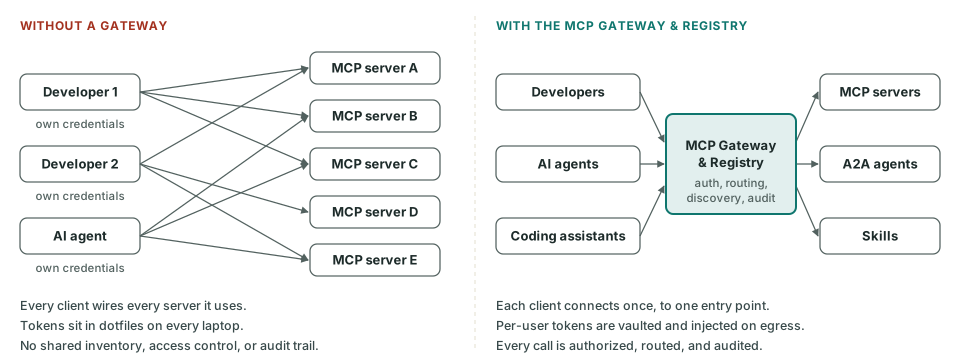
Onboard third-party OAuth MCP servers, the enterprise way. Because the gateway provides per-user egress authentication, you can connect OAuth-protected SaaS MCP servers such as Slack, Atlassian, and GitHub without every user setting up network access to those services or storing credentials on their laptop. Each user connects their account once; the gateway runs the OAuth (3LO) flow, vaults the per-user token in a secrets manager, and injects it on egress. That collapses onboarding to a single, auditable choke point, so a team can adopt a new SaaS MCP server across the enterprise without per-laptop plumbing or scattered long-lived tokens.
How it works
The gateway is the data plane (a generic nginx reverse proxy: TLS, auth validation, routing to backends) and the registry is the control plane (a FastAPI service that owns the inventory, access model, and audit trail, and decides what the gateway may route to). An auth server integrates your identity provider (Keycloak, Entra ID, Okta, Auth0, Cognito, PingFederate) for OAuth2/OIDC, and MongoDB / DocumentDB stores configuration, embeddings, sessions, and audit records.
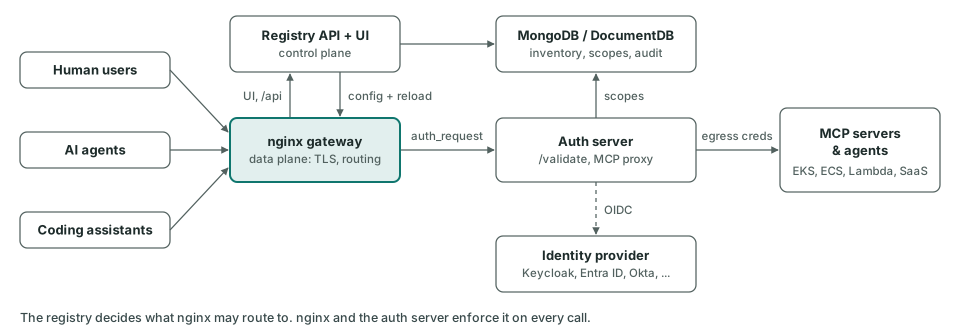
By default, the registry handles A2A discovery, authentication, and access control, and agents then communicate directly (peer-to-peer) rather than routing every call through the gateway. For the full design and its invariants, read the Theory of the System; for layered diagrams, see Architecture Diagrams.
See it in action
Watch how MCP servers, A2A agents, and external registries work together for dynamic tool discovery:
https://github.com/user-attachments/assets/97c640db-f78b-4a6c-9662-894f975f66e2
More walkthroughs are in the demo videos.
Start here if you are a...
| You are a... | Start here |
|---|---|
| Developer | Start with the Complete Setup Guide; you can also try the macOS setup skill to get it running on your MacBook. Then connect your AI coding assistant with the AI Coding Assistant Integration guide. For programmatic access, see the OpenAPI spec plus a Python registration client (registry_client.py) and CLI (registry_management.py). |
| Platform / security / ops team | See the deployment guides for Amazon EKS (Helm), Amazon ECS (Terraform), and Docker Compose; the authentication guide; the configuration reference; and access control & scopes. |
| Decision-maker evaluating adoption | Read the Executive Brief, watch the demo videos, and try the AWS Workshop. |
Quick Start
The fastest path is the pre-built Docker images. Clone, set a few secrets, and run:
git clone https://github.com/agentic-community/mcp-gateway-registry.git
cd mcp-gateway-registry
cp .env.example .env

# Edit .env and set the required secrets (e.g. KEYCLOAK_ADMIN_PASSWORD, SECRET_KEY).
# See docs/configuration.md for the full list.
nano .env

# Deploy with pre-built images (pulled from Amazon ECR Public by default)
./build_and_run.sh --prebuilt

# Open the Registry UI (served by nginx on port 80)
open http://localhost        # macOS  (Linux: xdg-open http://localhost)
The Complete Installation Guide has the full walkthrough for Amazon EC2 (prerequisites, MongoDB and Keycloak initialization, first user and service account, registering a server, and testing the gateway).
Deploying somewhere else?
- Amazon ECS: see the Terraform stack README, or better, use the Terraform setup skill to have your AI coding assistant run the deployment for you.
- Amazon EKS: see the Helm charts.
- Just want to try it on macOS?: use the macOS setup skill to get it running on your MacBook end to end.
What's in the box
The registry holds four built-in asset types plus admin-defined custom ones, all on one control plane:
- MCP servers: register, discover, and govern access to MCP servers behind a single authenticated gateway.
- Agents (A2A): register agents and let them discover each other by capability; by default agent-to-agent traffic runs peer-to-peer.
- Skills: register, version, and discover reusable
SKILL.mdskills, with security scanning at registration. - Custom entities: admins define their own schema-driven entity types (n8n workflows, policies, prompt templates, model cards, and more); see Custom Entity Types.
Across all of them you get semantic + lexical search, UI, REST, and MCP-native interfaces, and uniform governance. Key features worth calling out:
- Use it as an AI gateway for anything HTTP: one authenticated entry point in front of model inference (OpenAI, Amazon Bedrock, any OpenAI-compatible endpoint), MCP servers, A2A agents, and any generic REST endpoint. Callers hold a gateway token; the backend URL and its credential stay in the registry, encrypted at rest and injected at egress, with per-entity streaming and the same scopes, audit, and rate limits as everything else. Off by default. Design · FAQ: OpenAI and Bedrock
- Single authenticated gateway: one entry point; OAuth against your existing IdP (Keycloak, Entra ID, Okta, Auth0, Cognito, PingFederate) with fine-grained scopes.
- Dynamic tool discovery: agents and coding assistants find tools at runtime by natural-language semantic search, not hard-coded config.
- Virtual MCP servers: aggregate tools from many backends behind one endpoint, with per-tool access control.
- Per-user egress auth (3LO / OBO / PAT): the gateway brokers third-party SaaS credentials so tokens never live on a user's laptop.
- Security scanning + fail-closed admission gate: every registered server, agent, and skill is scanned; unsafe items are held for review.
- External-registry federation: pull in Anthropic's MCP Registry, AWS Agent Registry, and peer registries for one unified surface.
- Audit logging: a full, attributable audit trail of access and admin events, with credential masking, for compliance and incident review.
- Observability: OpenTelemetry metrics and health monitoring built in.
What's New
- MCP 2026-07-28 Support - The gateway serves MCP 2026-07-28 clients, which send no
initializeand no session id, and clients of earlier revisions on the same URLs. Virtual servers answerserver/discoverand bridge a 2026-07-28 client to handshake-era backends, and nginx rejects a request whoseMcp-MethodorMcp-Nameheader disagrees with its body. Tool discovery, the health check, the security scanner and mcpgw move to MCP SDK 2.x. A scope withtools: ["*"]now grants tools only, so check custom scopes that relied on it for other methods before upgrading. See the 1.37.0 release notes and MCP 2026-07-28 support. - Pooled mcpgw Connections, Calling Tools Found by Search, and an Opt-In OBO Token Cache - mcpgw keeps one pooled HTTP client for its registry and token traffic instead of opening a new connection for every tool call, with its own copy of the registry's egress guard, and the registry and auth-server pools now use their configured 30-second keep-alive instead of the httpx default of 5. An agent that finds a tool with
search_registrycan call it right away: coding agents get curl steps in mcpgw's instructions, and applications get a helper that calls the tool through the gateway as the user, with the application keeping the token. The auth server can now cache exchanged on-behalf-of tokens per user and audience for up to five minutes, off by default.NGINX_DISABLE_API_AUTH_REQUEST=trueworks again, so remove it unless you want cookie-only/api/. See the 1.36.0 release notes and the OBO token cache guide. - Keycloak OBO Token Exchange, Users in Many Groups, and Bounded Registrant Metadata - Egress on-behalf-of now works with Keycloak: the auth server exchanges the user's token for one scoped to the target client (RFC 8693), verifies it, and refuses it if the gateway itself would accept it, so the upstream cannot replay it against the gateway. Users in about 180 or more IdP groups no longer get a 500 from registry API calls, because groups now cross nginx once inside the signed token and the auth subrequest has room for them. The Helm stack chart now owns
keycloak-client-secret, so ArgoCD can sync it; existing installs adopt the Secret once before upgrading. Registrant metadata is capped at 10 KB and 8 levels, and the mcpgw discovery tools return it only when a caller names the keys it wants. See the 1.35.0 release notes, which list four breaking changes and the Helm adoption commands. - Embeddings Without LiteLLM, Extra Request Headers, and Long Entries That Get Indexed - Remote embeddings no longer go through LiteLLM: the registry calls OpenAI and any OpenAI-compatible endpoint, Azure OpenAI, and Amazon Titan and Cohere on Amazon Bedrock with about 500 lines of its own code, sends the same requests so stored vectors stay valid, and rejects a model name it cannot serve at startup instead of on the first call. Operators can add up to five headers to every embeddings request for an endpoint behind an API gateway, and set the request timeout and retry count. An entry whose text is longer than the model accepts, typically a server with many tools, used to stay out of semantic search; the registry now retries a failed embedding once with the longest tool descriptions shortened and every name kept. Entra deployments now recover group memberships from Microsoft Graph when a token omits them. Every image we build also drops the two root CAs distrusted on 2026-10-20. See embeddings and the 1.34.0 release notes, which list the three model-name forms that now stop startup.
- Virtual-Server Credential Brokering and Root-Endpoint Routing - A virtual MCP server can now front a backing server that needs a per-user credential: the backend hop goes through the same vend-and-inject step a direct call uses, keyed on the resolved backing path, so two backing servers with different credential modes can sit behind one virtual server and each gets its own vend. The caller must hold a grant on both the virtual server and the backing server, checked against the exact rewritten request, and the caller's own gateway token is never forwarded to a registrant-controlled backend. The same change lets a virtual server front a stateless Streamable HTTP backend. Separately, a server registered with
append_mcp_path: falseis now reachable at the bare path it advertises, instead of only the trailing-slash form MCP clients refuse to follow a redirect to. 1.33.0 release notes Older highlights → Feature & Release Highlights · full per-version detail in the release notes and on the GitHub Releases page.
Roadmap
The roadmap is best tracked on the GitHub Milestones page. Per-user egress auth (3LO and OBO) and A2A traffic routing shipped in 1.27.0, the gateway for any HTTP resource in 1.30.0, and backend OAuth identity plus per-tool blocking in 1.31.0. At a high level, the big features we're working on next are:
- Keycloak RFC 8693 token exchange for OBO (1.32.0): standards-based on-behalf-of exchange for Keycloak deployments, which today cannot use the OBO egress path or backend discovery because Keycloak binds the token audience with a server-side mapper rather than a request scope.
- Client ID Metadata Documents for coding assistants: the registry publishes its own CIMD as of 1.31.0, currently shipping disabled. Next is the identity-provider side, so an assistant connects with the least friction across providers without a pre-registered client ID.
- Registry Copilot: an embedded chat and agent-builder experience for discovering assets and composing agents from inside the registry. Tracked as #744; not yet scheduled to a release.
Have a feature request? Please open a GitHub issue, we build in the open.
Documentation
Full documentation is on the documentation site, and every guide also lives in the docs/ folder. Stuck or have a question? Start with the FAQ / Troubleshooting guide: it covers the most common setup, auth, deployment, and registration issues.
High-traffic pages by audience:
Get started
Platform & security
- Authentication Guide · Access Control & Scopes · Gateway Proxy Guide · AWS ECS Deployment · Amazon EKS (Helm) · Observability · Federation · Forward-Proxy Egress
Architecture & development
Design decisions
Telemetry
The registry collects anonymous, non-sensitive usage telemetry (version, OS, cloud provider, aggregate asset counts) to understand adoption. It is opt-out and on by default; no PII, credentials, endpoints, or model names are ever sent. Disable everything with MCP_TELEMETRY_DISABLED=1. Full schema and privacy guarantees: Telemetry Documentation.
Community
- GitHub Discussions, feature requests and general discussion
- GitHub Issues, bug reports and feature requests
- Roadmap (GitHub Milestones), upcoming releases and their issues
- Contributing Guide · Code of Conduct · Security Policy
Star History

View the full interactive star-growth chart at star-history.com.
License
Licensed under the Apache-2.0 License. See LICENSE for details.
Releases
Recent versions
1.36.01.36.0 - Pooled mcpgw Connections, Calling Tools Found by Search, and an Opt-In OBO Token Cache1.35.01.35.0 - Keycloak OBO Token Exchange, Users in Many Groups, and Bounded Registrant Metadata1.34.01.34.0 - LiteLLM Removal, Entra Group Recovery, Embeddings Hardening, and a Trust-Store Update1.33.01.33.0 - Virtual-Server Credential Brokering and Root-Endpoint Routing1.32.11.32.1 - Forward-Proxy TLS, an mcp 2.x Pin, and Collector Health1.32.01.32.0 - Forward-Proxy Egress, Ingress Hostnames, and a Login Regression Fix