
Server · #302 trending MCP repo · ↗ +12 stars this week
Purffle Shorts
Chamanrajragu/purffle-shorts
Free open-source AI YouTube Shorts generator and faceless video maker in Python. Any LLM (GPT, Claude, Gemini, Ollama) writes scripts; text-to-speech, stock footage or AI images, word-synced captions, text-message chat and Reddit story videos, podcast and long video clipping, YouTube auto-upload and scheduling. TikTok and Reels ready. MCP server.
- Stars
- 68
- This week
- +12
- Forks
- 27
- Open issues
- 1
- Latest release
v3.0.0
Documentation
README

PurffleShorts — Free AI YouTube Shorts Generator, Faceless Video Maker & Opus Clip Alternative
English · 简体中文 · Español · Português · हिन्दी · 日本語
An open-source AI video generator for YouTube Shorts, TikTok and Instagram Reels. Give it a topic, a web page, a Reddit post or a long podcast, and it makes finished vertical videos (script, voiceover, footage, captions, sound effects), then uploads or schedules them on YouTube, TikTok and Instagram.
YouTube automation in Python that runs on your own computer. The AI model you choose writes the script (GPT, Claude, Gemini, Llama through Ollama, DeepSeek, Grok, Mistral or any OpenAI-compatible API), using the phrases people actually search for on YouTube, and a second AI pass grades and rewrites it. Free neural voices read it, and stock footage, AI images or your own gameplay video fill the screen. Captions appear word by word, with key words in colour and an emoji per scene. It makes Reddit story videos, fake text message videos and two-voice dialogues, and clips podcasts into Shorts with jump cuts and face tracking. Free, MIT-licensed, no watermark. It also works from Claude Desktop, Claude Code and Cursor through MCP.










Features · Quick start · Colab · Formats · Reddit & gameplay · Clip podcasts · SEO · AI models · Voices · Publishing · Studio · API · MCP · Compare · FAQ
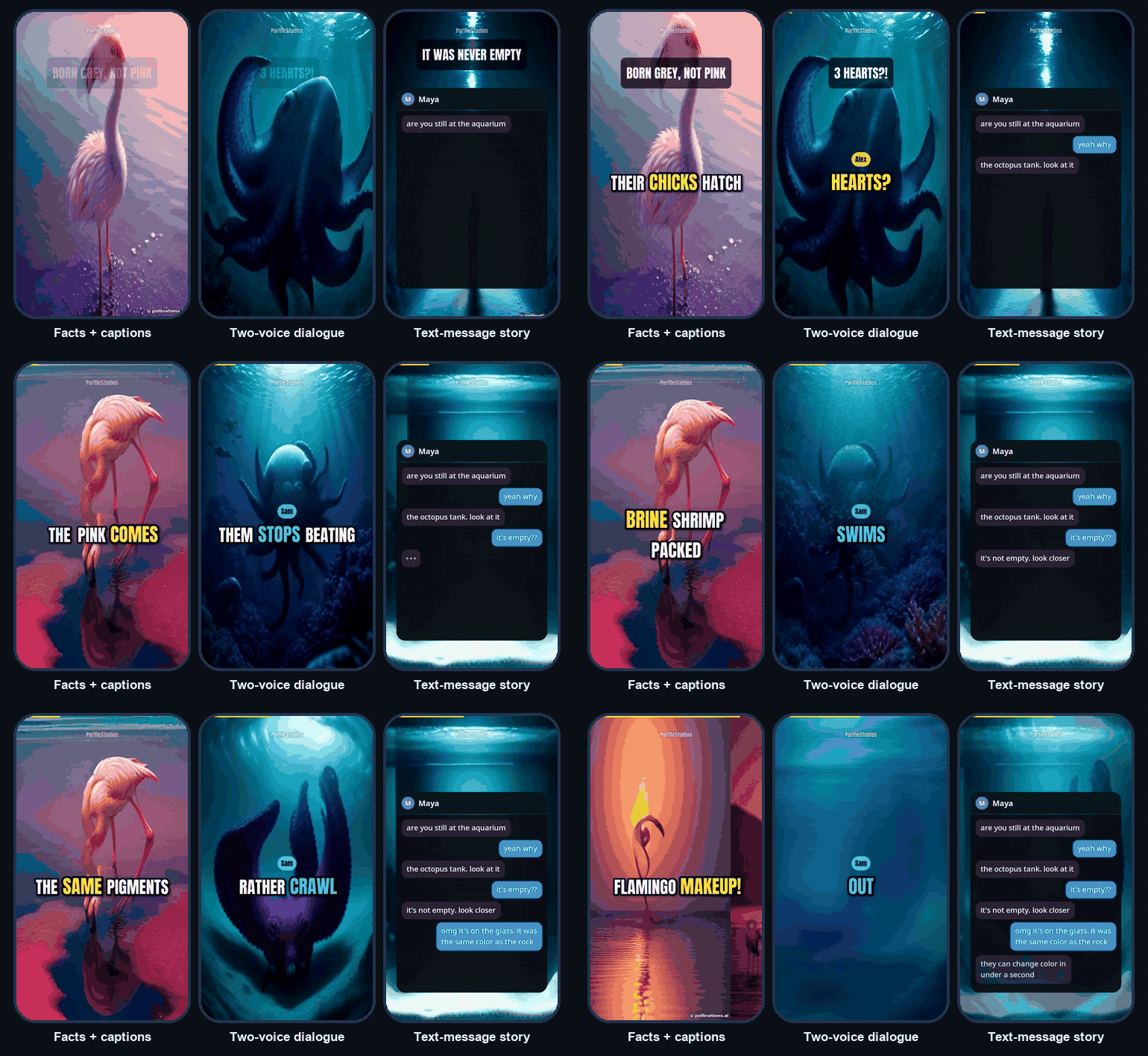
Real output, no editing: examples/flamingos.json, examples/dialogue.json and examples/chat-story.json rendered with make --script.
Free Microsoft neural voices, AI images from Pollinations (for the octopus videos they were downloaded one by one into a local folder first, because keyless Pollinations now allows about one image every few minutes). GIFs have no sound.
Try it with no API keys and no sign-up (needs uv):
uvx --from git+https://github.com/Chamanrajragu/purffle-shorts purffle-shorts demo --style chat
…or open it in Google Colab and make videos in your browser, with nothing to install.
⭐ If PurffleShorts saves you time, a star helps other creators find it. · 🌐 purffle.com/purffle-shorts
🤖 What is PurffleShorts?
PurffleShorts is a YouTube Shorts automation tool for faceless channels. Start it and it keeps going: fresh topic, retention-focused script that a second AI pass reviews and tightens, natural AI voiceover, relevant footage, captions synced to each spoken word, sound effects, a polished render, and an upload or scheduled release. It stays inside YouTube's daily API quota.
Beyond the autopilot, it is a small studio:
- Draft a script and edit any line before rendering.
- Make two-voice dialogues, text-message stories and Reddit-style stories, over stock footage or your own gameplay background.
- Turn an article or a Reddit post into a Short.
- Clip a podcast into Shorts, an Opus Clip-style workflow that runs on your computer, with jump cuts, punch-in zoom and face tracking.
- Publish the same video in several languages, and plan a week of ideas from what people search for on YouTube.
- Let the channel's own view counts steer new scripts.
It is made for content creators, faceless YouTube channels, educators and marketers who want short-form video at volume without editing by hand. It runs on your own computer (macOS, Windows, Linux), in Docker or in Google Colab. You pick every model, and the same video can go to TikTok and Instagram Reels as well as YouTube.
🎯 Use cases
- A faceless channel on autopilot. Pick a niche (space, history, animals, money tips), set three publish times a day and leave it running. Ideas come from real YouTube searches, Trends, Wikipedia, Reddit, RSS or your list, and are never reused. The AI is told to avoid your recent titles, and every script is reviewed before it is voiced.
- Reddit story videos over gameplay. The AI writes a first-person post, a narrator reads it over a post card, and your Minecraft parkour or other gameplay clip plays underneath: full screen, or split screen with footage on top. A real Reddit post link works as the source too.
- Fake text message videos for Shorts, TikTok and Reels: the AI writes a fictional chat, two voices read it, and the phone screen is animated with a pop as each message lands.
- Podcast, interview and stream clips.
clip episode.mp4 --count 5transcribes the video and lets the AI pick the moments that stand on their own (or the ones matching your brief, such as "the funniest bits"). You get captioned vertical clips with pauses and ums removed, the speaker kept in frame and a virality score each. There are no per-minute fees. - Articles, blog posts and notes into video.
make --url https://…or--from-file notes.mdturns your own writing into a Short. - One idea, many languages.
--also-lang es,hi,ptpublishes the same video with native voices in each language.LOCALIZE_METADATAtranslates the title and description of every upload. - Education and explainers. Quiz, myth-vs-fact, explainer and dialogue formats, in 9:16 for Shorts or 16:9 for regular YouTube.
- Automations and AI assistants. Drive it from n8n, Zapier or cron through the REST API, or ask Claude or Cursor to make, clip or upload videos through MCP.
✨ Features
AI scriptwriting
- One structured LLM call returns the whole Short: hook, scenes, a footage search, an image prompt, key words and an emoji per scene, title, description, hashtags, tags and YouTube category.
- Script Doctor: a second AI pass grades the draft on six points (hook, curiosity, pacing, specificity, payoff, accuracy), lists what is weak and rewrites it. The rewrite is graded again and only kept if it scores at least as well, so the 0–100 retention score always belongs to the script you actually get. Automatic checks (hook length, filler words, missing call to action, no concrete numbers) feed the review.
- Written for search: the phrases YouTube's own search box suggests for the topic are handed to the writer, so titles, descriptions and tags use the words people actually type.
- Strict JSON-schema replies on providers that support them (OpenAI, Gemini, OpenRouter, Ollama, LM Studio, Claude), with an automatic step down for the ones that don't.
- 12 providers: OpenAI, Anthropic Claude, Google Gemini, Groq, OpenRouter, DeepSeek, Mistral, Together AI, xAI Grok, Ollama, LM Studio, or any OpenAI-compatible URL. List backups in
LLM_FALLBACKSand they are tried in order if the main one fails. - 11 formats: facts, story, listicle, myth-busting, quiz, explainer, motivational, news, two-voice dialogue, text-message story and Reddit-style story (a post card while the title is read, then the story with captions).
- Draft first and edit any line in the Studio, or write a script yourself and render it with
--script, with no LLM call.
Sources
- Your niches, questions people search for on YouTube (
TOPIC_SOURCES=search), Google Trends, Wikipedia "On this day", Reddit TIL, RSS feeds, your own list, any web page or Reddit post (--url) or document (--from-file). - Content planner: the AI brainstorms a batch of specific, true, non-repeating ideas, guided by real YouTube searches, into a queue that the autopilot uses first.
Voiceover
- 320+ free Microsoft neural voices in 75 languages, with word-level timestamps. No key needed.
- Two speakers for dialogues and chat stories, each with their own voice, joined with natural pauses.
- One video, many languages:
--also-lang es,hiadds translated copies that reuse the same footage. - Also OpenAI TTS, ElevenLabs, Kokoro-82M, Coqui and the operating-system voice. Falls back to the free voice if a paid engine fails.
Footage & backgrounds
- A separate stock-footage search for every scene (Pexels, Pixabay). Each candidate is scored by how well its own description matches the scene, the search engine's ranking, shape and length; portrait clips preferred, never reused across videos.
- Gameplay and background videos (
BACKGROUND_VIDEO): one continuous stretch of your Minecraft parkour, Subway Surfers or "satisfying" clip plays under the whole story, either full screen or split screen with the scene footage on top. - Fast pacing: scenes longer than 4.5 s are cut into several shots with different footage, each cut placed on a natural pause between words.
- AI images per scene from OpenAI (gpt-image-1 / DALL·E 3) or Pollinations, or your own
media/folder. Ken Burns motion on photos, colour grades, transitions.
Captions, sound & editing
- Captions appear exactly when each word is spoken, with the current word highlighted. Key words and numbers get their own colour, and an emoji per scene pops up above them. 6 styles; Latin, Indic, Arabic, Thai and CJK scripts.
- Sound effects made in code (nothing to license): a whoosh on each scene change, a pop as each text message lands, a low hit under the hook. They are mixed 11 dB under the measured voice.
- Dialogues get speaker name tags and a colour per speaker; chat stories get an animated phone screen with typing indicators; Reddit-style stories open on a post card (community, poster, title, votes).
- 9:16, 16:9, 1:1 or 4:5 output (
--aspect), with captions and overlays sized for each shape. - Hook title, watermark, progress bar, end call-to-action, background music that ducks under the voice.
- Broadcast-grade audio: gentle voice clean-up (rumble cut, de-esser, compression), then two-pass loudness normalisation that measures the mix and applies one steady gain, landing on −14 LUFS without pumping.
- Voices without word timestamps get their phrase ends pinned to the real pauses in the audio, so captions stay in sync even without an aligner.
- The cover image is the sharpest, best-exposed frame of the opening seconds, never a frame mid-transition.
- Plain ffmpeg: each shot is prepared as a short segment, the soundtrack is mixed and normalised in its own pass, then one final encode joins them and adds everything above. No MoviePy, no ImageMagick, no GPU needed.
Clipping (a free Opus Clip alternative)
- Transcribes podcasts, interviews and streams locally with Whisper. The AI picks self-contained moments with a hook and a payoff, or only the ones that fit your brief (
--prompt "every tip about sleep"). - Each clip has a virality score with the reason. It is edited with jump cuts (long pauses shortened, "um" and "uh" removed, lips kept in sync) and punch-in zoom between sentences.
- Framing: face tracking (
--crop face), the centre, or the whole picture over a blurred copy. Word-by-word captions are added too.
Publishing & SEO
- Uploads to YouTube, or schedules each video into your next free time slot.
- TikTok, Instagram Reels and more (
PUBLISH_TO=youtube,tiktok,instagram): the same video goes out with a caption written for each network, at the same publish slot, through Upload-Post or Instagram's own API. Each network's result is saved, and a retry only re-sends what failed. - Localised titles and descriptions (
LOCALIZE_METADATA=es,pt,hi), so viewers see the video under a title in their own language, and optional caption-track upload (UPLOAD_CAPTIONS) so YouTube can index every word. - Quota-aware queue, AI-content disclosure, playlists, privacy, made-for-kids flag.
- Every video also gets a cover image, SRT subtitles and a metadata file for cross-posting.
Workflow
- Autopilot loop, one-off videos, bulk batches with parallel workers, several channels from separate settings files.
- Studio web app: create, draft and edit, and watch every stage live (pushed instantly, with a percentage and a time-left estimate learned from your machine). Cancel a running job, browse and play the library, plan ideas, clip videos and read channel stats.
STUDIO_PASSWORDprotects it when it runs on a server. - REST API for n8n, Zapier, cron or your own scripts (docs/api.md), a Google Colab notebook, and docker compose for servers.
- A live progress line in the terminal, and a voice cache so re-rendering an edited script only voices the lines that changed.
- MCP server: ask Claude Desktop, Claude Code or Cursor to make, clip or upload videos.
- Learns from your channel (opt-in): view counts of your uploads show the AI what works for your audience, and the format of each new video is chosen by Thompson sampling over your own results.
statstells you whether the retention score actually predicts your views (Spearman correlation) and which publish hours did best. - Discord / Slack / webhook notifications, a
doctorself-check, SQLite history, and CI that renders real videos on every pull request.
🆕 New since 3.0
| What you get | |
|---|---|
| Retention editing | Key words and numbers highlighted in captions, an emoji per scene, and sound effects (whoosh, pop, hit) placed 11 dB under the voice |
| Gameplay backgrounds | --background parkour.mp4: one video under the whole story, full screen or --layout split |
| Smarter clipping | Jump cuts (pauses and ums removed, lips in sync), punch-in zoom, face tracking, --prompt to steer the picks, and a virality score with the reason |
| Search-led SEO | Topics and keywords from real YouTube searches, titles and descriptions localised for other languages, optional caption-track upload |
| Better scripts | Script Doctor 2.0: a six-part rubric, automatic checks, and a rewrite kept only if it scores at least as well |
| Faster, live renders | About 40% faster on the same machine, a Studio that pushes progress with a time-left estimate, and cancel at any time |
| A new Studio | Its own design in light and dark: a numbered brief, a program monitor, an edit timeline for every job, the library as a contact sheet, and a new logo |
| TikTok and Instagram | PUBLISH_TO=youtube,tiktok,instagram: one video to every network, scheduled together, each result tracked and retried on its own |
| Run it anywhere | Google Colab notebook, docker compose with the published image, REST API with an n8n recipe |
The changelog has the full list, with the measured before-and-after numbers.
⚖️ How it compares
Open-source Shorts tools each cover part of the job: some write videos from a topic, some clip long videos, some make Reddit stories. PurffleShorts does all three. It is the only one we found with text-message stories, two-voice dialogues, a script review pass, and an MCP server that covers writing, clipping and uploading.
| PurffleShorts | MoneyPrinterTurbo | ShortGPT | RedditVideoMakerBot | AI-Youtube-Shorts-Generator | OpenShorts | |
|---|---|---|---|---|---|---|
| Writes the video from a topic | ✅ | ✅ | ✅ | ❌ Reddit threads | ❌ clipper | ➖ paid APIs |
| Any LLM, including local Ollama | ✅ | ✅ | ➖ OpenAI, Gemini | ❌ no LLM | ➖ OpenAI, Gemini | ✅ |
| Free voices, no key | ✅ | ✅ | ✅ | ✅ | ❌ no voice | ➖ ElevenLabs |
| Word-by-word highlighted captions | ✅ key words + emoji | ➖ | ❔ | ❌ | ❌ | ✅ |
| Script review and rewrite pass | ✅ | ❌ | ❌ | ❌ | ❌ | ❌ |
| Text-message chat stories | ✅ | ❌ | ❌ | ❌ | ❌ | ❌ |
| Two-voice dialogues | ✅ | ❔ | ❔ | ❌ | ❌ | ❌ |
| Reddit-style stories | ✅ | ❌ | ✅ | ✅ | ❌ | ❌ |
| Gameplay background, split screen | ✅ | ❔ | ❔ | ✅ background library | ❌ | ❔ |
| Clip long videos into Shorts | ✅ face tracking | ❌ | ❌ | ❌ | ✅ | ✅ |
| Silence and filler removal in clips | ✅ | ❌ no clipping | ❌ no clipping | ❌ no clipping | ❔ | ❔ |
| Videos in other languages | ✅ | ✅ | ✅ | ✅ | ➖ | ✅ paid dubbing |
| YouTube upload and scheduling | ✅ official API | ➖ via Upload-Post, no scheduling | ❌ | ❌ by design | ❌ | ✅ via Upload-Post |
| TikTok / Instagram upload | ✅ via Upload-Post, or Instagram's API | ✅ via Upload-Post | ❌ | ❌ | ❌ | ✅ via Upload-Post |
| MCP server | ✅ | ❌ | ❌ | ❌ | ❌ | ✅ clipping |
| Web app | ✅ | ✅ | ✅ | ➖ settings only | ❌ | ✅ |
| Colab notebook | ✅ | ✅ | ✅ | ❔ | ❔ | ❔ |
| Tests and CI | ✅ | ✅ | ❌ | ➖ lint only | ❌ | ✅ |
| License | MIT | MIT | MIT | GPL-3.0 | MIT | MIT |
✅ yes · ➖ partly · ❌ no · ❔ not stated. Compiled on 29 September 2026 from each project's README and code; the gameplay, silence-removal and Colab rows were checked on 20 October 2026. Projects change quickly: if a cell is wrong, please open an issue and it will be fixed. Where others are ahead: RedditVideoMakerBot ships a library of background videos, and MoneyPrinterTurbo has a one-click Windows package.
📸 Screenshots
New in 3.0: text-message stories, two-voice dialogues and Reddit-style stories. Rendered from examples/chat-story.json, examples/dialogue.json and examples/reddit-story.json.
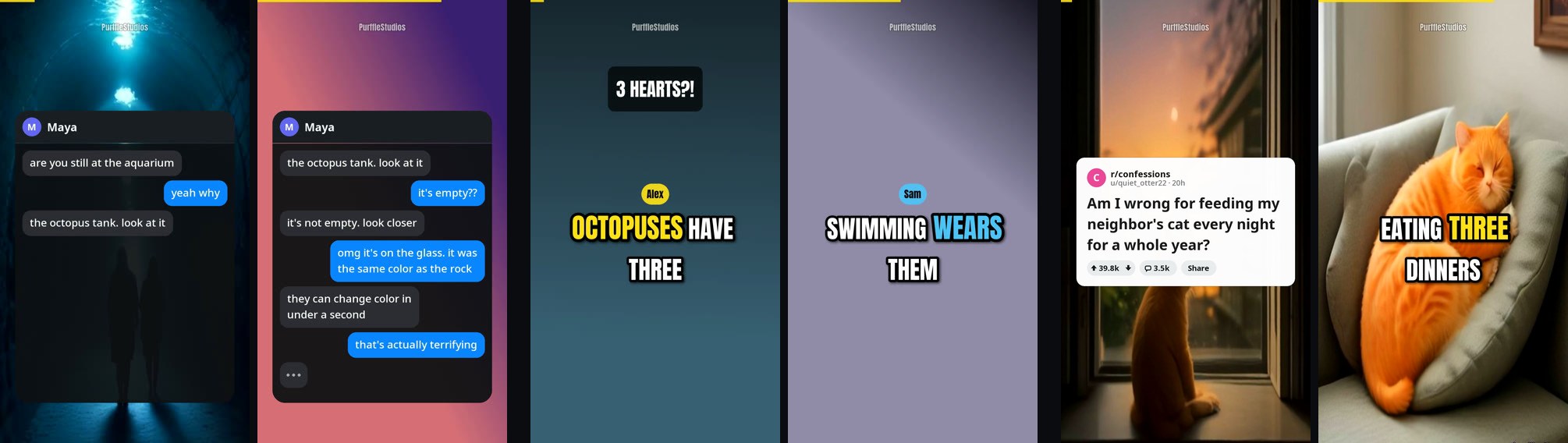
Frames from the flamingo Short above: hook title, word-highlighted captions, progress bar, end call-to-action.
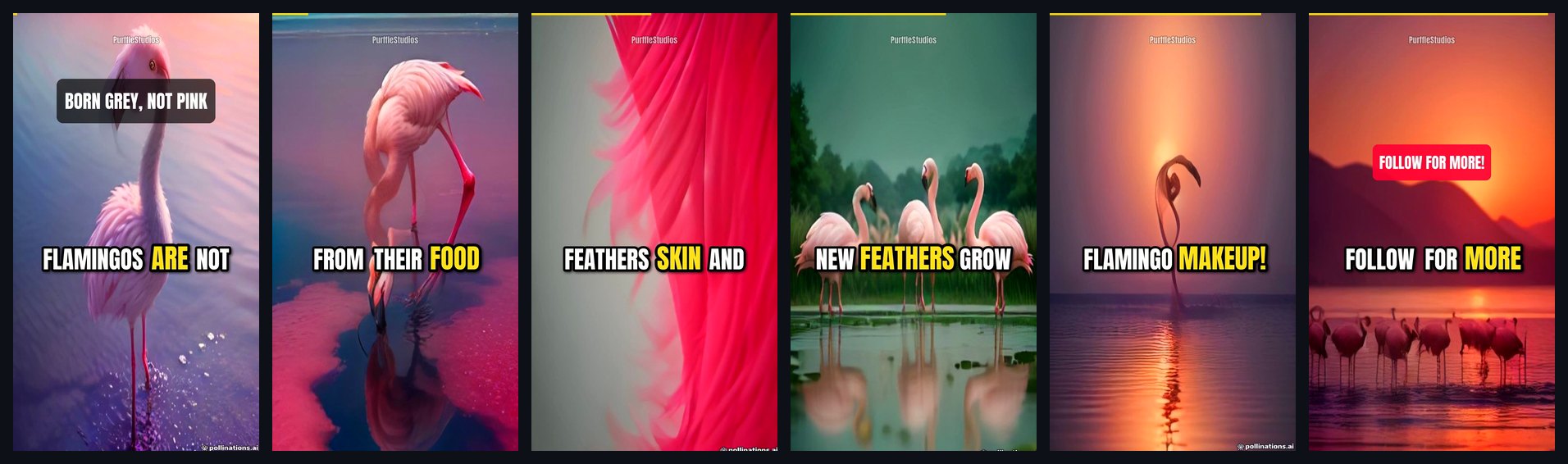
Six caption styles, drawn by the same renderer the videos use:
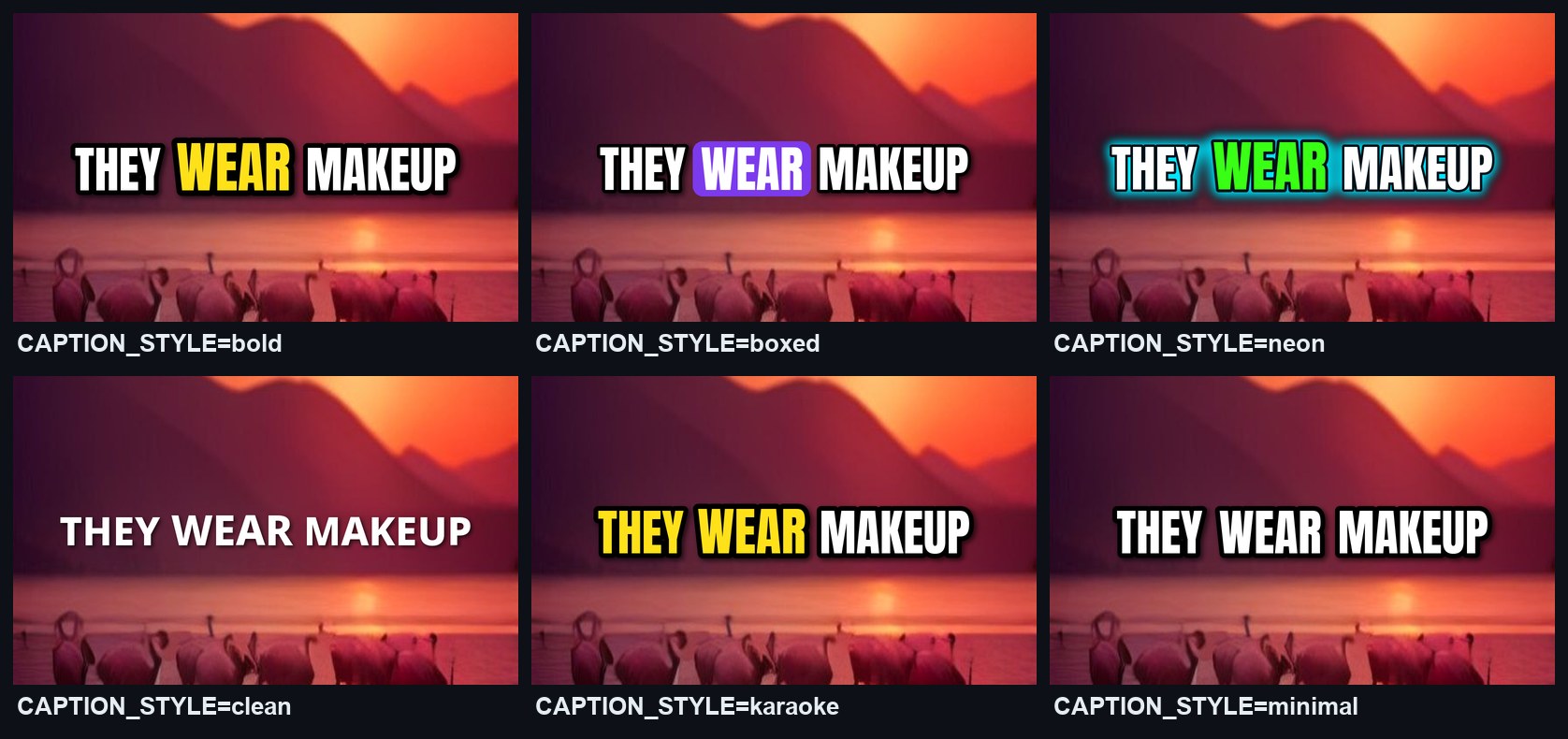
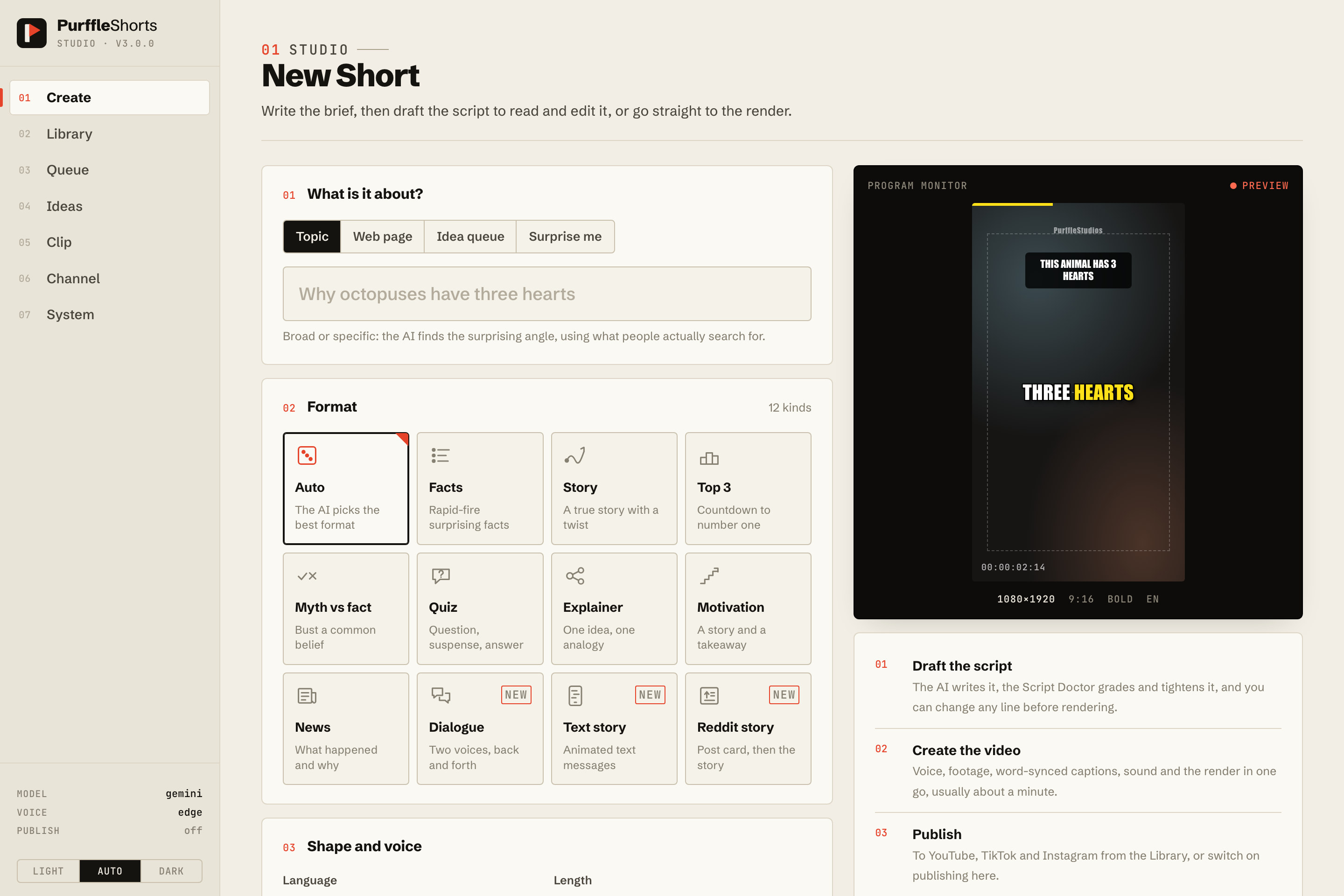
Studio, the local web app, in light and dark. The Create page is a numbered brief (subject, format, shape and voice, look and sound, model and publishing) beside a program monitor that previews the caption style, shape and safe area.
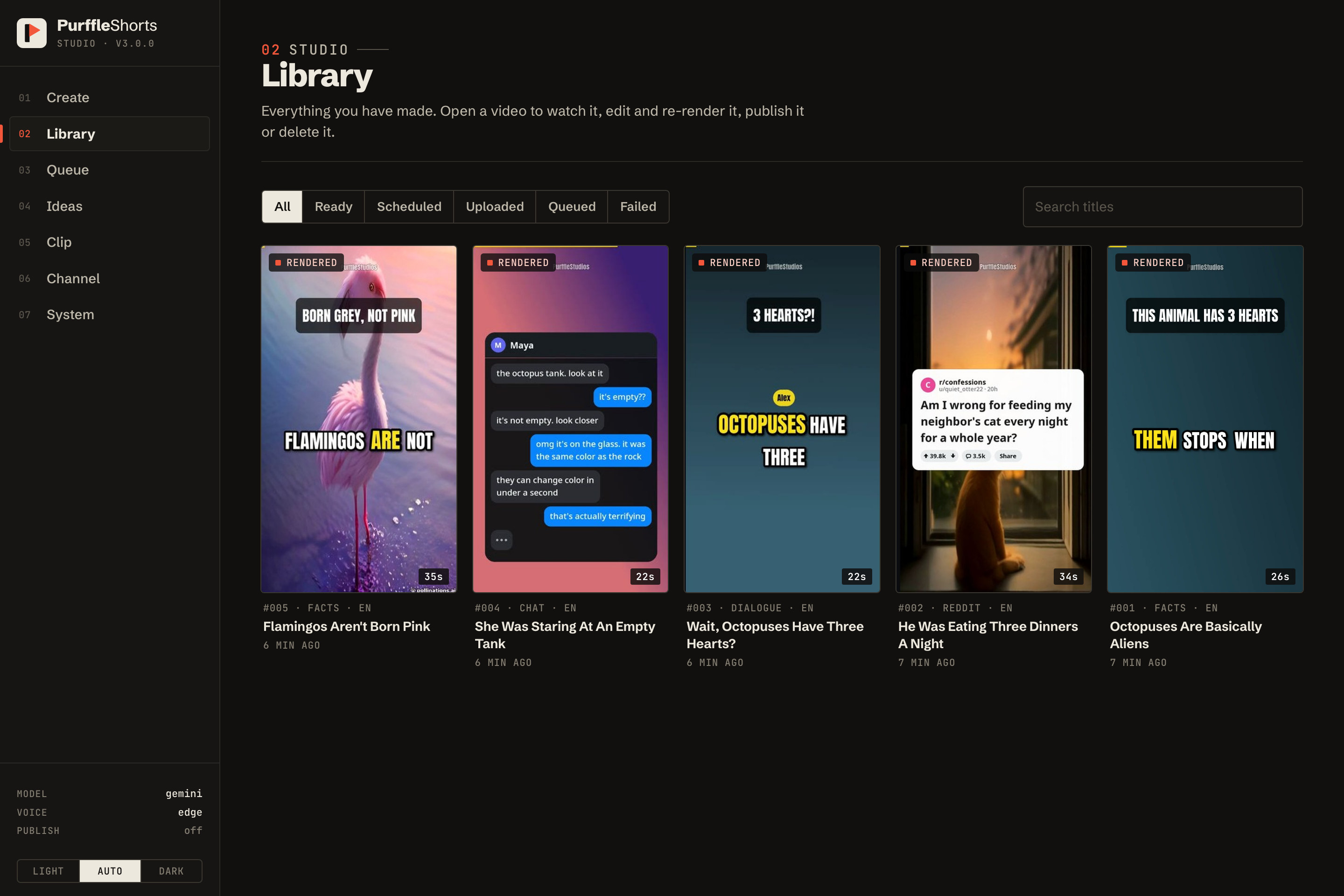
The library is a contact sheet of everything you made. Open a video to play it, publish it to YouTube, TikTok and Instagram, edit and re-render it, or delete it.
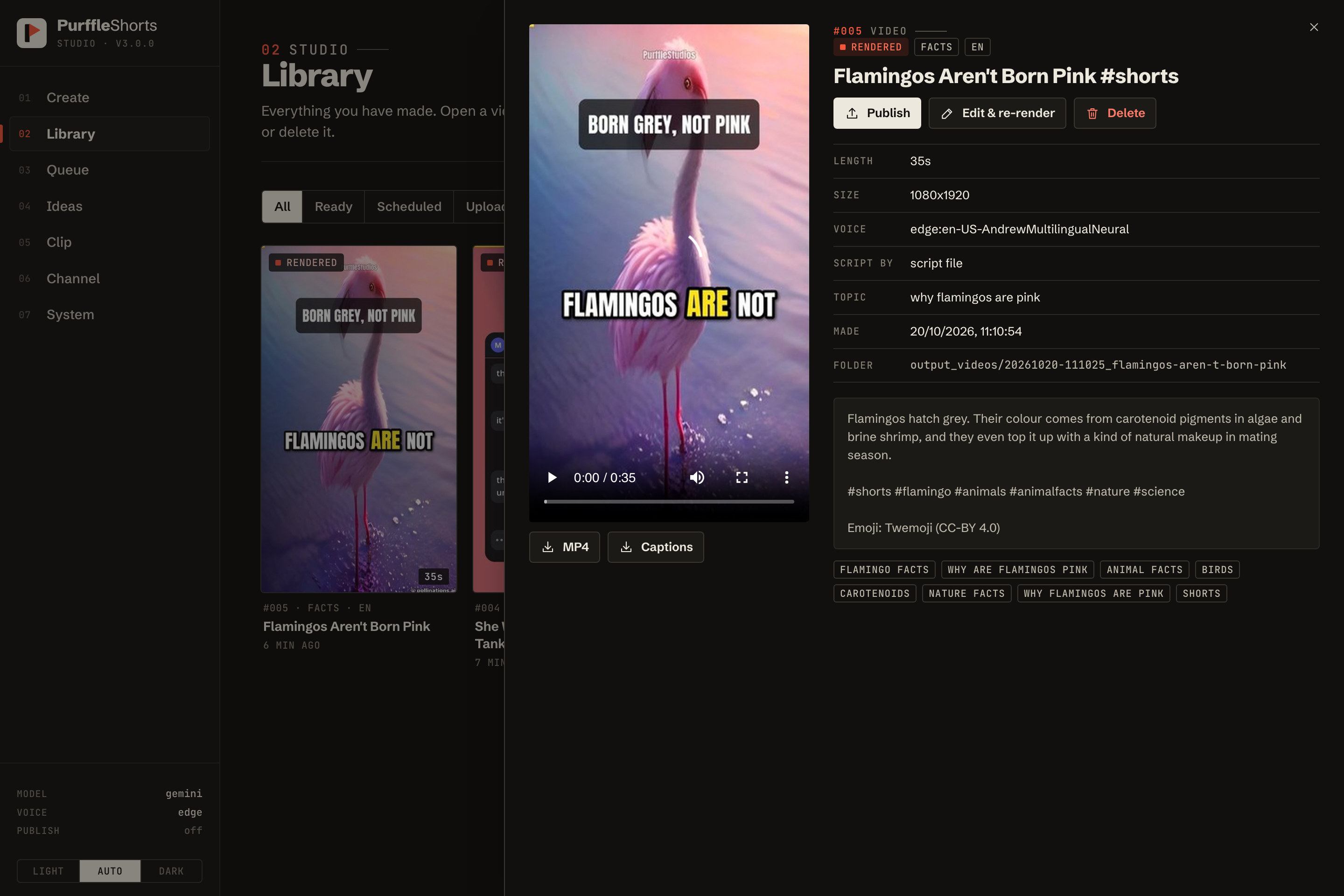 |
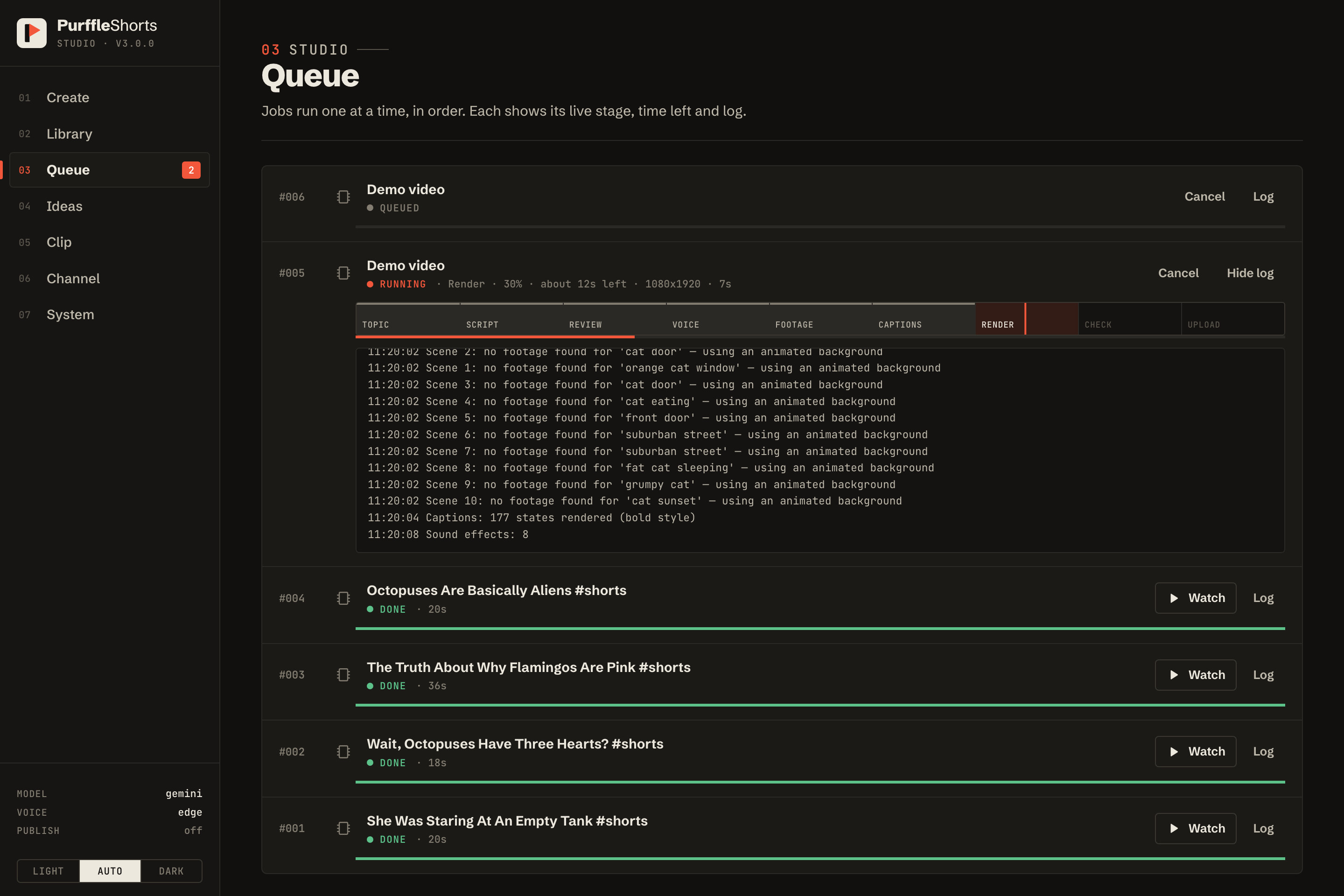 |
| A video's page: player, publishing, the details and the description. | The queue: each job's stage timeline, time left and live log. |
Command line: doctor checks the setup, make renders a Short.
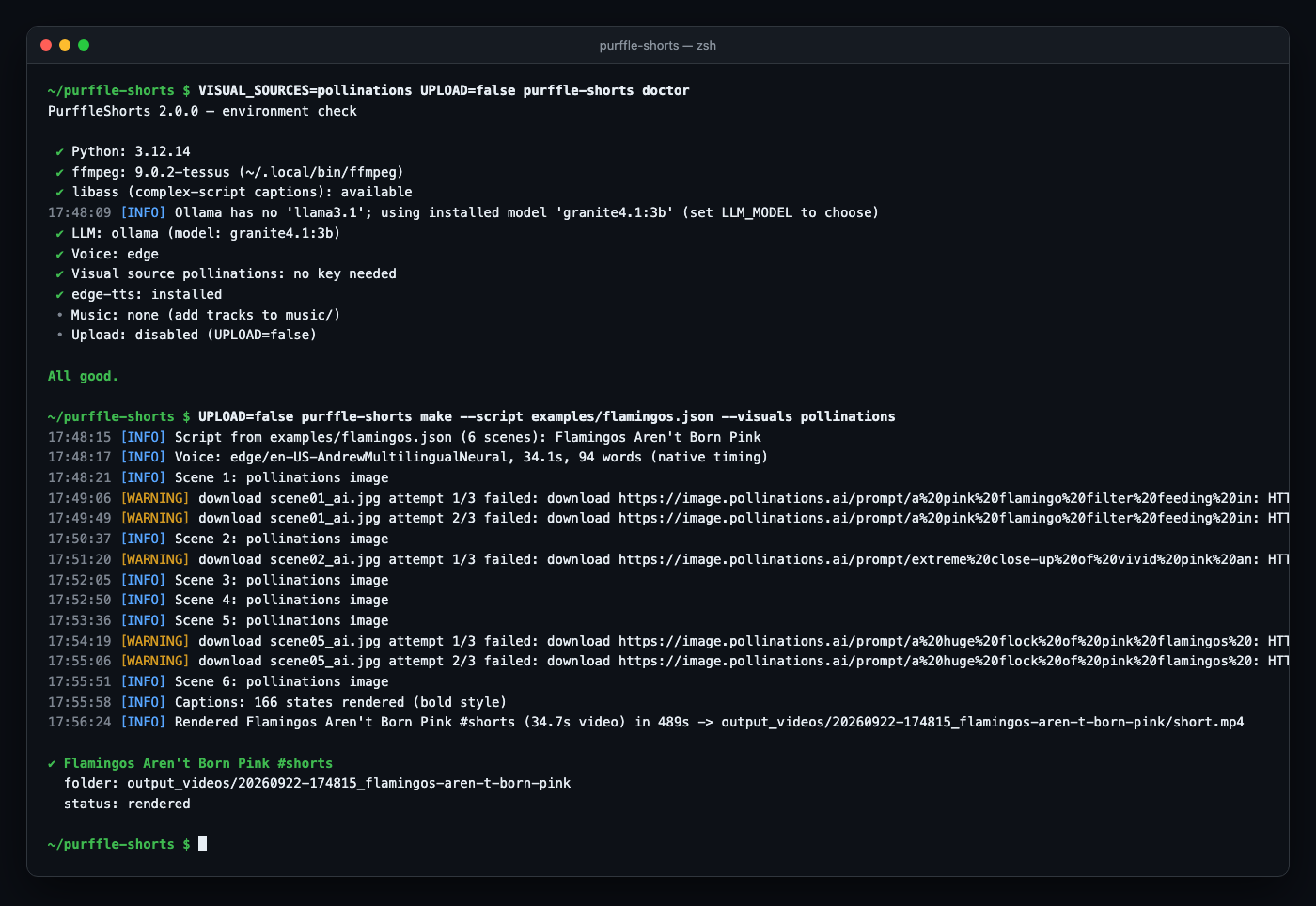
🗂️ Earlier releases
What changed in 3.0 (new formats, clipping, the Studio, MCP)
| 2.0 | 3.0 | |
|---|---|---|
| Script quality | One LLM call | Script Doctor: a second pass scores retention 0–100, lists the problems and rewrites weak lines. You can also draft first and edit every line in the Studio |
| Formats | 8, one narrator | 11, including two-voice dialogues (name tags, colour per speaker), text-message stories (animated phone screen, typing indicator) and Reddit-style stories (post card, then captions) |
| Sources | Niches, Trends, Wikipedia, Reddit, your list | Also any web page or Reddit post (--url), documents (--from-file), RSS feeds, and an AI content planner with an idea queue |
| Long videos | — | clip: transcribe a podcast or talk, the AI picks self-contained moments, vertical crop or blurred fit, word captions |
| Languages | One per video | --also-lang es,hi: translated copies of the same video that reuse its footage |
| Shapes | 9:16 | 9:16, 16:9, 1:1, 4:5 with sizes that adapt (--aspect) |
| Channel feedback | — | Learns from stats (opt-in): the best and worst performers are shown to the AI when it writes |
| Web app | A form and a list | New Studio: live stage progress, script editor, library with player and actions, ideas, clipping, channel stats, setup checks. Works on phones |
| Integrations | — | MCP server for Claude Desktop, Claude Code and Cursor; Discord / Slack / webhook notifications |
| Reliability | Clear errors for bad settings, hardware-encoder fallback to libx264, failed videos return their idea to the queue, database migrates itself, installs cleanly on Intel Macs, 120+ tests, Docker build checked in CI |
What changed in 2.0 (the rewrite from 1.x)
Version 2 is a rewrite. The 1.x pipeline had problems: the pinned openai SDK no longer had the API the code called, landscape footage was stretched into portrait, captions were evenly spaced rather than following the voice, the title and description were generated separately from the script, and every video went through six MoviePy re-encodes.
| 1.x | 2.0 | |
|---|---|---|
| Script | GPT-3.5, 4 separate calls, title unrelated to script | One structured call: hook, scenes, per-scene footage queries, title, description, hashtags, tags, category |
| Models | OpenAI only | OpenAI, Claude, Gemini, Groq, OpenRouter, DeepSeek, Mistral, Together, xAI, Ollama, LM Studio, any OpenAI-compatible URL, with optional fallbacks |
| Voice | Coqui Tacotron2 (robotic, heavy) | Free Microsoft neural voices (320+, 75 languages) + OpenAI, ElevenLabs, Kokoro, Coqui, system voice |
| Captions | Even time slices, no sync | Word-accurate timing, active-word highlight, pop-in animation, 6 styles |
| Footage | Same query for every clip, landscape stretched to 9:16 | A search per scene, portrait-first, smart 9:16 crop, never reused across videos, Ken Burns on photos, AI images optional |
| Render | MoviePy + ImageMagick, 6 encodes at 60 fps | ffmpeg only, one final encode, transitions, colour grades, progress bar. A 25 s Short rendered in 30–40 s on an Intel Mac in testing |
| Audio | Music at a fixed volume | Music auto-ducks under the voice, loudness normalised to −14 LUFS |
| Publishing | Always public, burns quota | Schedule into time slots, privacy options, AI-content disclosure, playlists, quota-aware queue |
| Ideas | 22 hard-coded categories, repeats | Niches, Google Trends, Wikipedia "On this day", Reddit TIL, your own list, with repeats prevented |
| Extras | — | Web dashboard, doctor self-check, history DB, SRT subtitles, cover image, --script for your own scripts, Docker, CI with an offline end-to-end render test |
🔄 How it works
flowchart LR
    A["Topic<br/>idea queue · niches · YouTube searches ·<br/>Trends · Wikipedia · Reddit · RSS · web page"] --> B["AI script<br/>any LLM, one JSON reply,<br/>real search phrases"]
    B --> R["Script Doctor<br/>rubric · rewrite · re-grade"]
    R --> C["Neural voice<br/>one or two speakers"]
    C --> D["Footage per shot<br/>stock video · photos · AI images<br/>or a gameplay background"]
    D --> E["Captions & overlays<br/>key words · emoji · hook · CTA"]
    E --> F["ffmpeg render<br/>9:16 · 16:9 · 1:1 · 4:5<br/>sound effects · −14 LUFS"]
    F --> G["Upload or schedule<br/>localised titles · captions"]
    F -. also-lang .-> T["Translated copies<br/>same footage"]
    G -. next video .-> A
| Step | What happens |
|---|---|
| 1. Topic | Queued ideas come first. Then one of your sources: your niches, questions people type into YouTube's search box, today's Google Trends, Wikipedia "On this day", Reddit TIL (best effort, since Reddit rate-limits anonymous requests) or topics.txt. Anything already made is skipped, and so is news about deaths, violence or elections |
| 2. Script | The LLM writes a hook-first script split into scenes. Each scene has its own stock-footage query, AI-image prompt, key words and emoji. The same JSON reply holds the title, description, hashtags, tags and category. Real YouTube search phrases for the topic are part of the prompt; with LEARN_FROM_STATS, so are your best and worst performers |
| 3. Review | The Script Doctor grades it on a six-part rubric, rewrites weak lines and grades the rewrite again, keeping whichever scores higher (SCRIPT_REVIEW=rewrite, the default). A rewrite that misses the target length is ignored, and a failed review never fails the video |
| 4. Voice | Neural TTS speaks the script and returns per-word timestamps (or they are aligned with Whisper, or pinned to the pauses in the audio). Dialogues and chats are voiced line by line with two voices; lines spoken before come from the voice cache |
| 5. Footage | Each shot gets its own clip, chosen for how well its description matches the scene. Sources: Pexels / Pixabay video (portrait preferred), photos with Ken Burns motion, your own media/ folder or AI images, with an animated gradient as the last resort. Long scenes are cut into several shots. With BACKGROUND_VIDEO, one stretch of your gameplay video plays under everything, full screen or split |
| 6. Captions | 2–3-word captions appear exactly when spoken, with the current word highlighted, key words and numbers in their own colour, and the scene's emoji above. Chat stories show messages popping in on a phone screen instead, and Reddit-style stories open on a post card |
| 7. Render | Shots are cover-cropped to the output shape, colour-graded and joined (hard cuts inside a scene, transitions between scenes). One final ffmpeg encode adds the hook title, watermark, progress bar and end CTA. The soundtrack (voice, ducked music, sound effects) is normalised to −14 LUFS in two passes, and the cover is the best frame of the hook |
| 8. Publish | Uploaded now, or scheduled into your next free time slot, with the synthetic-media disclosure set, localised titles and, if you like, the caption track. Uploads are queued automatically when the daily quota is used up |
🚀 Quick start
Needs: Python 3.10+. ffmpeg is used if installed; if not, the bundled imageio-ffmpeg binary is used. ImageMagick is no longer needed.
Fastest: with uv installed, run it straight from GitHub without cloning anything:
uvx --from git+https://github.com/Chamanrajragu/purffle-shorts purffle-shorts demo
To keep it and configure it, clone and install:
…
Releases